
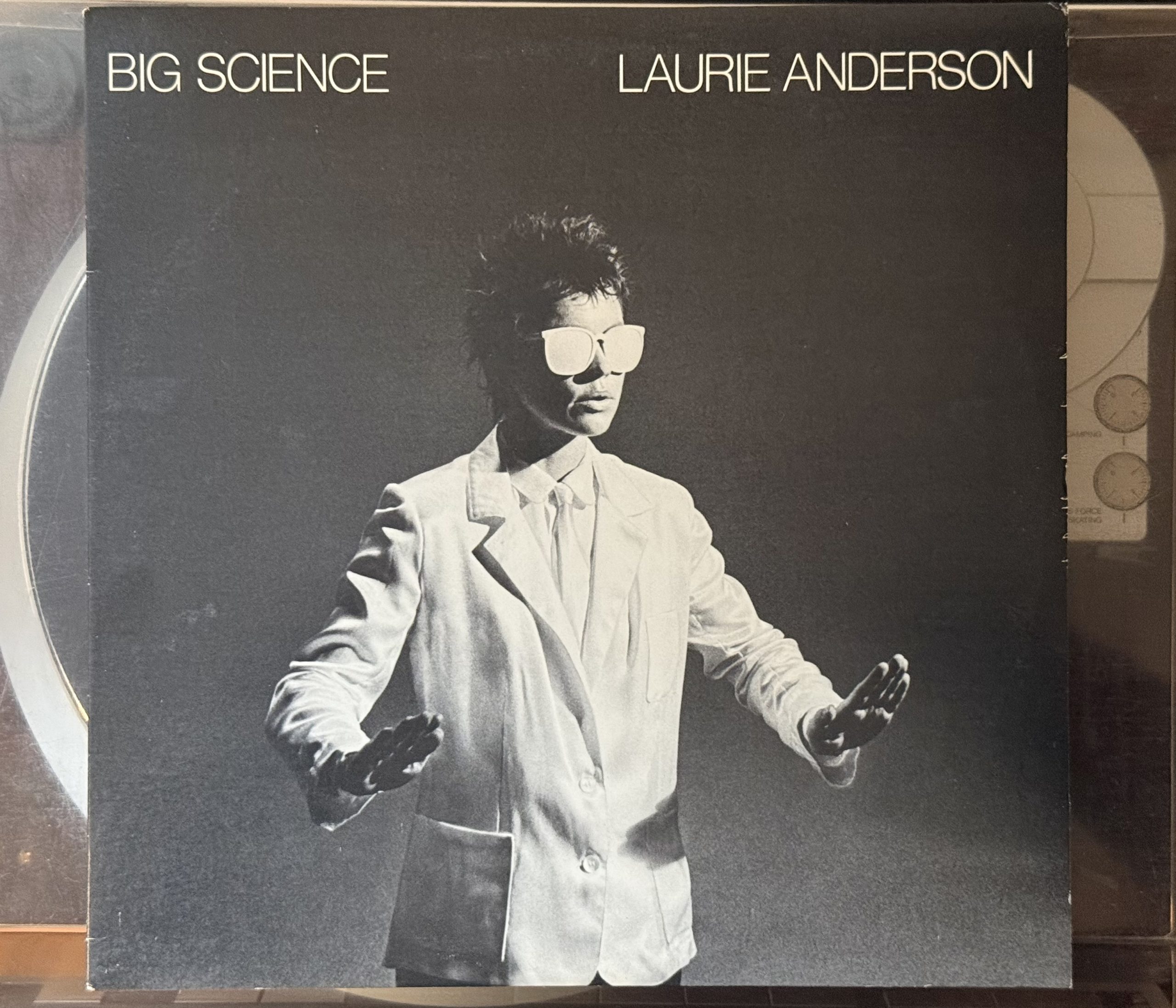
Album of the Week, March 28, 2026
Performance artists do art pieces and get grants. They might release recordings of their work on small labels. They don’t, typically, have singles that hit the top of the charts, and they certainly don’t dedicate those singles to a dead French composer. But then, Laurie Anderson has never been typical.
The story of Big Science starts before You’re the Guy I Want to Share My Money With. Laurie had recorded the song and released it as a single in the UK in 1980 on the small label One Ten Records, in a limited edition of 1000 copies. That’s when BBC DJ John Peel changed the trajectory of her career. Putting it in frequent rotation on his show on BBC Radio One, his championing of the song led a British distributor to request 80,000 copies of the single. Laurie signed a distribution deal with Warner Bros. Records and the single went all the way to Number Two in the UK. On the strength of the single, Warner Bros. signed Laurie to an eight-album deal.
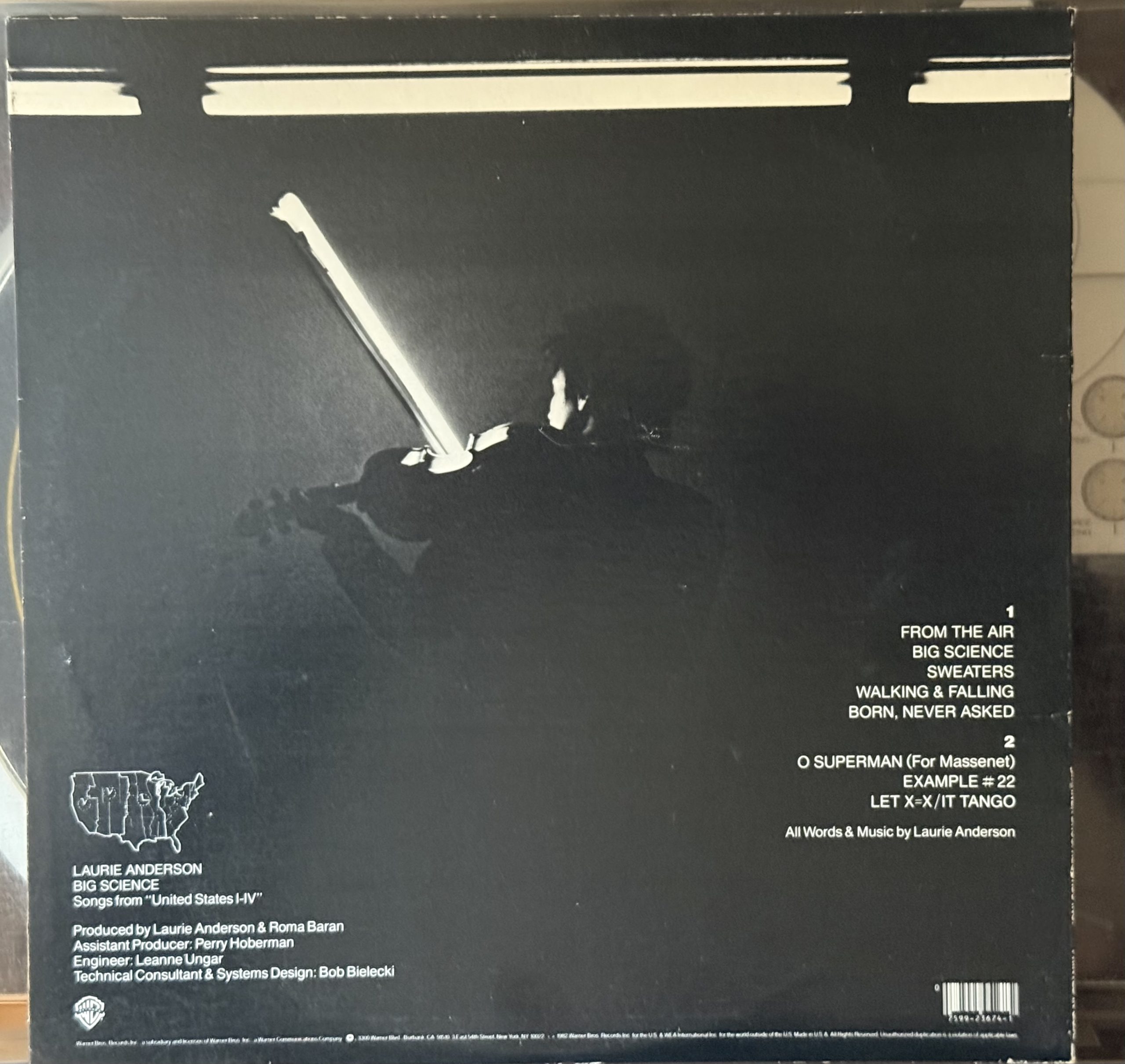
The album was released in April 1982. Produced by Roma Baran, who also played keyboards, accordion and percussion, and featuring installation artist Perry Hoberman on reeds, experimental composer Peter Gordon on clarinet and tenor sax, Bill Obrecht on alto sax, and composer David Van Tieghem on drums, marimba and percussion, the album featured a variety of performances drawn from a long-form show that she would eventually perform and record as United States Live I – IV. The material is much more melodic than the numbers on You’re the One I Want to Share My Money With, but still far from traditional song structures; built on loops, repetition, and open-ended chords, the pieces on Big Science feel like alerts from the future.
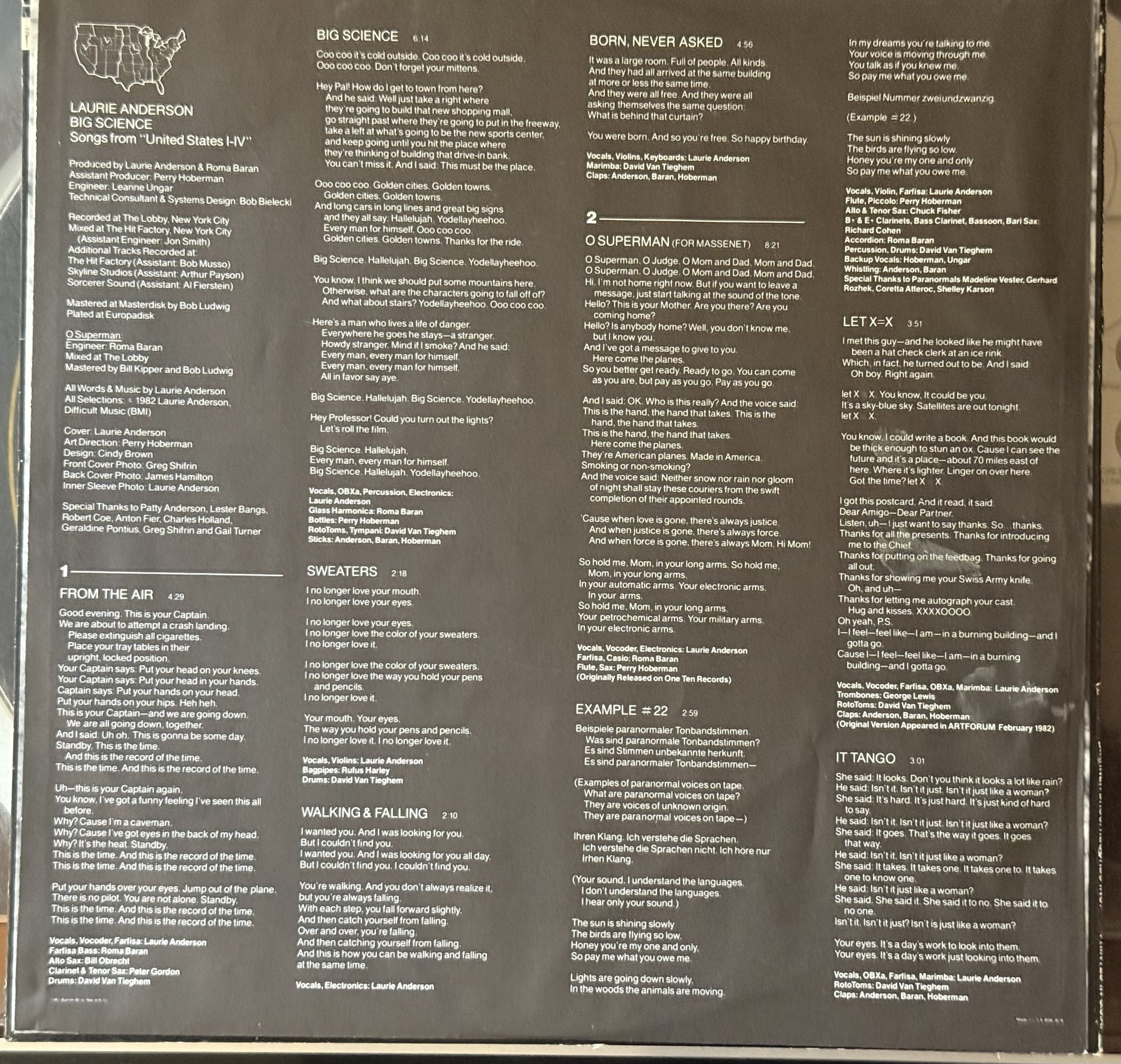
“From the Air” starts with a blast of keyboards and saxophones against the drums as Laurie Anderson narrates the increasingly unhinged thoughts of an in-flight announcement: “Your Captain says put your head on your knees. Your Captain says put your head in your hands. Captain says, put your hands on your head. Put your hands on your hips! Heh heh. This is your Captain, and we are going down. We are all going down together. And I said Uh-oh. This is going to be some day.” The repetition and music slowly ratchets up in intensity, and the syncopated drum pattern the sense of uncertainty, until the final verse: “Put your hands over your eyes. Jump out of the plane. There is no pilot. You are not alone. Standby. This is the time, and this is the record of the time.” Anderson’s words here (and elsewhere on Big Science) take on an uncomfortable resonance in the shadow of the September 11th attacks, but even without that massive hole in history lending its gravity, the intersection between order and chaos, the apparent power of the captain that is revealed to be illusion, pulls us in.
If “From the Air” has a sense of claustrophobia, “Big Science” and its synthesized lonely howl bring us to a wide empty space, with echoing handclaps and open fifths adding to the sense of anticipatory emptiness. We hear Laurie’s actual singing voice, a pure soprano in contrast to her normally lower pitched speaking voice, which gives an apocalyptic vision of the future: “I said, Hey pal, how do I get to town? And he said, well, just take a right where they’re going to build that new shopping mall, go straight past where they’re going to put in the freeway, and take a left at what’s going to be the new sports center. And keep going til you get to the place where they’re thinking of putting in the new drive-in bank.… And I said, ‘This must be the place.’” The future here is anticipatory but also hostile: “And long cars and long lines and great big signs/And they all say: Hallelujah. Yodellayheehoo. Every man for himself.” Laurie was listening to the same wavelength as William Gibson, who had written “The Gernsback Continuum” a year before about hallucinatory invasions of alternate future universes from 1930s pulp paperbacks: “The Thirties dreamed white marble and slip-stream chrome, immortal crystal and burnished bronze, but the rockets on the covers of the Gernsback pulps had fallen on London in the dead of night, screaming. After the war, everyone had a car—no wings for it—and the promised superhighway to drive it down, so that the sky itself darkened, and the fumes ate the marble and pitted the miracle crystal…” But here rather than hallucinatory bleed-through the future is just full of totemic emptiness.
“Sweaters” has all the edge of Laurie’s more confrontational early work, here amped up to eleven by Van Tieghem’s stumbling drum work and Rufus Harley’s screaming bagpipes, playing against Laurie’s nonverbal vocalizations and her drone-like violin, all against a series of aleatory declarations of ended love: “I no longer love the color of your eyes/I no longer love the color of your sweaters.”
“Walking and Falling” is a quieter experimental reading against a looped background, a meditation leading into a straightforward reading of a poem ending with the question: “What is behind that curtain?” Then we get the keyboards and marimba of “Born, Never Asked,” in a new reading that is compositionally identical to the version on You’re the Guy… but with much better sound. A voiceover announces “You were born, and so you’re free. So happy birthday,” providing a non-answer to the question of what lies behind the curtain: it’s up to you, apparently, even if that self determination ultimately leads to the desolation of “Big Science.”

Side two opens with the album’s most enduring work. “O Superman (For Massenet)” is so titled because of Laurie’s cockeyed translation of the Massenet aria (from the opera El Cid) “Ô Souverain, ô juge, ô père”: “O Superman, o judge, o mom and dad.” The music is simple: built on a loop of Anderson’s voice on a single note, the vocal melody destabilizes, going from a major key (with the single note on the third) to a minor key with the repeated note on the tonic. Effects on Anderson’s voice make the sung lines sound at once like a Greek chorus and a robot. Even more than “From the Air,” the stark arrangement and openness of the voices fill the listener with a sense of growing unease, ultimately growing to a real feeling of dread: “Hello? This is your mother. Are you there? Are you coming home? —Well you don’t know me/But I know you/And I have a message/To give to you:/Here come the planes.” Anderson has stated that she wrote the song in the aftermath of the failed rescue of the Iranian hostages, Operation Eagle Claw, and the tragic deaths of eight American servicemen, and it continues the message of dependence and violence: “So hold me mom/In your long arms… In your automatic arms/Your petrochemical arms/In your electronic arms.” Other motifs weave their way through the song, culminating in a crescendo of minor-key chord progressions that echo the melody of “From the Air,” rise like the tide to a crashing climax, and fall away, leaving only the “ah-ah-ah.” Listening to it, you understand what would drive John Peel to play the song over and over, and Warner Bros. to sign her.
From the sublime to the ridiculous, “Example #22” announces itself in German as “examples of paranormal voices on tape” (Beispeile paranormaler Tonbandstimmen), interspersed with ringing phones, saxophones, reeds, and an accordion, accompanying what must surely be Laurie’s brattiest vocal. It’s great fun and completely impenetrable.
By contrast, “Let X = X / It Tango” closes out the record with quotably wry wit. “Let X = X” is practically a quotable aphorism in every line: “And I said, O boy. Right. Again. … You know. It could be you. It’s a sky-blue sky. Satellites are out tonight. … You know, I could write a book. And this book would be thick enough to stun an ox. ‘Cause I can see the future, and it’s a place about 70 miles east of here. Where it’s lighter.” The handclaps and marimba tie the arrangement back to “Born, Never Asked,” only in a much lighter vein; they continue through “It Tango,” a stopping and starting argument in search of an antecedent. She closes with a declaration of utterly failed communication: “Your eyes. It’s a day’s work just looking into them.”
Laurie’s first album immediately established her as a witty, thoughtful, highly listenable artist. And a bankable one: it sold 150,000 copies in its first year of release, smaller sales than a typical rock album but not by much (compare to 100,000 copies of Peter Gabriel (1977) in the UK). Her voice would continue to develop over the next few years, and we’ll check in on her again soon, but first we’ll see what kept Peter busy since the 1980 self-titled album.
You can listen to this week’s album here:
BONUS: The b-side of “O Superman” was “Walk the Dog,” an exercise in odd narrative that leans into a trope from her shows, the “difficult listening hour,” with barking dogs, a voice shifted high in pitch to the edge of squeak, strummed violin strings, and a bashed drum kit:
BONUS BONUS: Laurie Anderson did a Tiny Desk Concert from home back in 2021, joined by Roma Baran and cellist Robin Kodheli, performing “Let X=X” and “O Superman”: