Virginia Glee Club history, 1910 director… found again

I found more evidence tonight about the mysterious 1910 director of the Virginia Glee Club, M. S. Remsburg. Ironically enough, it came from the same source that gave us the information of his existence in the first place.

I was thrown off by a description of him as Prof. M.S. Remsburg. That may have been an honorific, but his real title was director, as in the director of Christ Church, Charlottesville, as I learned from the September 17, 1910 issue of Madison House Notes, the newsletter of the YMCA at the University at that time. Following the departure of Dr. Faville from the faculty, there was no other organist or music director at the University for chapel services, this being ten years before the foundation of the McIntire School of Music, and the university faculty voted on or before September 17, 1910 to reschedule chapel services so that Remsburg could cover them after Sundays at Christ Church.

A week later, Remsburg picked up directorship of the Glee Club, which appears to have been reformed out of thin air around that time. The audition notice on the 24th of September notes “It is hoped that a large number will turn out, because we ought to have a Glee Club at Virginia. Other colleges in the State have them, and we must have one also.”

The irony, of course, is that there had been a Glee Club just a few years prior, and had had one longer than any other school in Virginia. But an organization entirely run by students, with no membership or support that lasts more than four years, has no long term memory.

As for Remsburg, there’s no reference to him in subsequent years of Madison House Notes, and the increasingly plaintive recruitment notes for the chapel choir and lack of mention of a director suggest that the group was back in student hands again. But not for long; no choir practices are listed in the 1913 bulletin, so even the chapel choir was gone by this time. It took the arrival of A. L. Hall-Quest, and his taking direction of  the dormant Glee Club and the chapel choir in 1914-1915, to rebuild it, partly with voices from the Glee Club.

Incidentally, I stumbled across another Glee Club name in the Madison House Notes. J.A. Morrow, the author of “Virginia Hail, All Hail” (aka “Ten Thousand Voices”), is described as singing a solo with the chapel choir on October 10, 1916, under the direction of Hall-Quest. I’m still looking for further information about him, but it’s starting to look like he too, like E. A. Craighill, the author of “The Good Old Song”‘s lesser sung verses, might have been in the Glee Club. But that’s a post for another time.

Glee Club history: The mysterious A. L. Hall-Quest

One of the more evocative notes in the official history of the Virginia Glee Club is this, from Philip Alexander Bruce’s centennial review of the University:

In January, 1915, Professor Hall-Quest, who, during six years, had been in charge of the Princeton Glee Club, undertook to reorganize the old association [the Glee Club] and train it scientifically.

I’ve written about the troubled history of the Glee Club at the turn of the century before, but we didn’t look at the motivating actor. Who was Professor Hall-Quest? And why, after giving an illustrious account of his success, does the historian Bruce say little further about him in the five volume history?

Let’s start with Hall-Quest’s official biography, from 1917. Alfred Lawrence Hall-Quest was 36 by the time he was directing the Club in 1915. Before that he took degrees from Augustana College and from Princeton Theological Seminary and was ordained to the Presbyterian ministry in 1903. Reading between the lines, he appears to have rambled: between ordination and 1914 he was associate pastor at one church and pastor at three, professor in philosophy and education in Westminster College, Fulton, MO, and “assistant in education” at the University of Illinois. He is listed as teaching the summer session at Illinois in 1914, then teaching the summer session at Virginia in 1915. That fall he was reconstituting the Glee Club and winning the hearts of students. From 1914 to 1916 he was associate professor of education, and by 1916 he was on the full faculty as professor of educational philosophy. It was in 1916 that his seminal educational theory work, Supervised Study, was published. By 1917 he had moved on to the University of Cincinnati. There he appeared to have stayed through the early 1920s until he made a move to the University of Pittsburgh.

Then: scandal struck in October 1924. Hall-Quest’s wife very publicly ran off with his best friend, and he granted her the divorce. This was grounds for dismissal from the University of Pittsburgh.

Hall-Quest landed on his feet, somewhat, at Milwaukee University, but left that position under a cloud in 1927 after public disagreements with the board of trustees. From there the trail goes a little dark, and we don’t know when or how he died. In 1940 he’s listed as an influential educator in The Swedish in America, and his writings on supervised study are still cited in educational theory today.

After all that, one wonders: how did he end up with the Glee Club in the first place? The evidence, drawn largely from the pages of Madison Hall Notes when that institution was still the home of the Young Men’s Christian Association, is that he helped reform the Glee (and Mandolin) Club as part of his larger work with Madison House. He had been “head organist at Princeton” while there, and in addition to the Glee Club was directing a chancel choir in 1916. So Club’s rescuing from obscurity and training in scientific principles appears to have been a happy accident. Hall-Quest had ambition and drive, and did a lot, but in the end he was just passing through Virginia. Though he refounded the group, he didn’t provide the stability the group needed to move beyond its year-to-year existence. That wouldn’t come until the 1920s and the establishment of the Music Department.

The Virginia Glee Club and the National Symphony, 1947

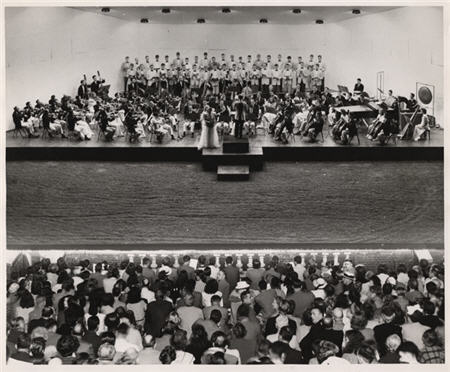
The Virginia Glee Club in concert at the 1947 Virginia Music Festival.

We’ve visited the Virginia Glee Club during their spa years in the 1930s, but what was the group doing in the 1940s? Part of that history, the group’s participation in the creation of Randall Thompson’s “Testament of Freedom” (dedicated to the group and composed in honor of Thomas Jefferson’s 200th birthday), is well documented. The postwar years find the group in a variety of settings, including preparing for the first Songs of the University of Virginia recording, but little is documented publicly except for one concert appearance at the inaugural Virginia Music Festival.

The Virginia Music Festival was started as an “experiment” in musical performances in the state–a non-profit organization bringing “the best in music to the Old Dominion.” Its founders included Dr. Meta Glass, president of Sweet Briar College, and Edward Stettinius, Jr., UVA alum, former secretary of state, and then-rector of the University. Performances were hosted in Scott Stadium at the University. In its first year, 1947, the “best in music” was three performances by the National Symphony Orchestra. In subsequent years, there were school band competitions and folk musicians (the latter program curated by none other than my distant cousin Bascom Lamar Lunsford). In 1949, its cofounder Stettinius died of a coronary thrombosis at the age of 49. After 1950, the Festival was no more, at least in this incarnation.

It’s tempting to imagine the Virginia Music Festival as a possible Southern incarnation of the Tanglewood Festival, but its small scale, lack of a permanent orchestra in residence, and lack of a musical education component render it just a curiosity of history, albeit one in which the Glee Club was involved. The photo above shows the Glee Club, resplendent in summer whites, on a temporary stage behind the NSO, accompanying Mona Paulee of the Metropolitan Opera in Brahms’ Alto Rhapsody. Unlike the northern glee clubs, the Virginia Glee Club did not often collaborate with major symphony orchestras (due in part to proximity issues), so this has to be counted as a high point in the group’s mid-century artistic history. In fact, between the association with Randall Thompson, this event, and musicologist Stephen Tuttle’s involvement in directing the group, this period was a high point overall in the group’s musical renown. Five years later Tuttle would be gone to Harvard University (and in eight he would be dead), and the group’s focus would be narrowed, for a while, to University audiences.

Review: Virginia Glee Club, Songs of Virginia

Virginia Glee Club recording first Songs of the University of Virginia, Old Cabell Hall, 1947
The Virginia Glee Club recording first Songs of the University of Virginia, Old Cabell Hall, 1947.

This is a review of a new CD from the Virginia Glee Club that is available for purchase on the group’s website.

This is the season of Virginia Glee Club CDs. After a long drought, Frank Albinder’s years as director are finally documented with not one, but three new recordings available now: Virginia Glee Club Live!, Christmas with the Virginia Glee Club, and Songs of Virginia. The latter disc is the most ambitious of the three, and is unique among recent Glee Club recordings for being a thematic recording rather than simply capturing the group’s repertoire at a point in time. The theme: songs of the University of Virginia, as documented through old recordings, sheet music, and books, and running the gamut of the group’s existence.

The recording project won a Jefferson Grant in April 2008, and the group has been at work since researching and recording the songs. The provenance of the songs is extensive, with some performances echoing the 1947-1951 recording Songs of the University of Virginia, some later songs (such as “Vir-ir-gin-i-a”) that were documented in 1972 on A Shadow’s on the Sundial, and some that are only known in published form, for instance from the 1906 Songs of the University of Virginia songbook. The earlier Songs recording is the most prominent touchpoint, with “The Cavalier Song,” “Rugby Road,” “Hike, Virginia”, “Yell Song,” “The Good Old Song,” and “Virginia, Hail, All Hail” all reprised, five with accompaniment from the Cavalier Marching Band as in 1951. The remaining tracks on the original recording, including the Eli Banana and T.I.L.K.A. songs and “Mr. Jefferson’s favorite psalm,” were wisely discarded in favor of more interesting repertoire.

The rest of the repertoire includes some of the more interesting selections from the 1906 songbook, including “The Orange and the Blue,” “In College Days,” “Here’s to Old Virginia,” and “Oh, Carolina!” (in an updated arrangement), as well as other fight songs and alma maters (“Virginia Chapel Bell” and the “Rotunda Song” are especially touching). Lyrical authenticity is kept–football songs that refer to the University’s ancient and quiescent rivalries with Princeton and Yale keep their original references, rather than being updated to reference more modern opponents. (It was regular practice when I sang in the group to substitute Maryland for Carolina in the lyrics of “Just Another Touchdown for UVA.”) The liner notes are thorough and well illustrated, featuring a few photos that have appeared on this blog, albeit without explanation–see my earlier notes on why the Glee Club wore dresses in 1916, and how the old Cabell House was tied to the Club’s birth. My hat’s off to the students and director of the group for their research–though I am credited on the liner notes, the only direct contact I had during the process was providing some scans of the cover of the Songs of the University of Virginia record that weren’t used.

So enough about the repertoire–how’s the recording? In a word, wonderful. Dusty old songs like “Oh, Carolina” are given sharp new readings that ought to stir up the UNC rivalry (imagine singing “See the Tar Heels, how they’re running/Turpentine from every pore/They can manufacture rosin/but they’ll never, ever score” in Scott Stadium today!), while more familiar standards like the “Good Old Song” and “Virginia Hail All Hail” are made more potent by being put in the historical context of the song. Perhaps one minor quibble is the balance–melody lines in the second tenor and baritone are sometimes overshadowed by more prominent high harmonies–but this is a small point in the scope of things.

Bottom line: if you are an alum of the University, you ought to own this recording. And Alumni Hall ought to be giving copies out at Reunion.

Catching up with history

I’ve been busy, which is of course no excuse, but there are going to be posts forthcoming. I received my long-awaited copy of the Virginia Glee Club’s Songs of Virginia today in the mail, along with a new Christmas CD from the group, and notes on both will be forthcoming. I was tickled to get a credit in the Songs of Virginia booklet, presumably for the digging and research I’ve been doing about the group’s history.

In the meantime, I note that I neglected to note my appointment as the official historian for the Virginia Glee Club Alumni and Friends Association. So what’s next? More news soon…

The first UVA glee club

Grab bag: free press and old records

The Virginia Glee Club in the 1930s: the Tin Can Quartet

gleeclub1930s

This post is one of an ongoing series on the history of the Virginia Glee Club.

Today, I heard something that hasn’t been widely heard in about seventy years: a recording of members of the Virginia Glee Club made in 1933.

Prior posts in this series have focused on the period from the 1890s to the early 1920s. (For a reminder: 1871, 18931894 and the 1894 tour, 19061910, 19121916-1921, and a survey of directors from 1878 to 1989.) The trail of historical evidence about the Club goes a little cold in the 1920s–perhaps because the Club became, during this period, a full-on curricular option under the direction of the first head of the newly formed Mcintire Department of Music, Arthur Fickénscher. Things … quieted down a bit. There’s no indication of more musical theatre performances and precious little press coverage, aside from a performance at the creation of the Thomas Jefferson Foundation in 1923.

In the early 1930s, things changed, and as so often with the group, it happened with a change of director. Fickénscher grew up in California but was tied to the European tradition, having both studied and taught in Germany; his successor, Harry Rogers Pratt, was a colorful man who was all American. In the 1930s the Club started reaching out again: performances at various high society gatherings at the Greenbriar (1932) and Hot Springs (1933, 1934, 1935),  performances in New York for the Club’s 50th anniversary in 1936, and a much publicized tiff with Wagner in 1939, in which the boys of the Club on the eve of world war refused to sing the original words of the final chorus of Die Meistersinger and its praise of the German masters of the art of song.

And now, we know, the group was branching out in other ways as well. As I trolled the catalog of the UVA library in search of  more clues to the Glee Club’s past, I found a recording I had never heard of, by a group I had never heard of–the Tin Can Quartet of the Virginia Glee Club, on a 16″ aluminum transcription record from 1933. A further Google search for the group turned up exactly one reference to them–in a presentation from the preservation department at UVA. And a contact to the author turned up two MP3 files, all that could be recovered from the record.

I should note that this isn’t the full Virginia Glee Club. Instead, this barbershop group was “of” the Virginia Glee Club, in much the same way that the Virginia Gentlemen would start as an octet of the Club exactly 20 years later. And the repertoire isn’t Club repertoire, either–instead, the traditional barbershop songs “Aura Lee”, “I Want a Girl (Just Like the Girl Who Married Dear Old Dad)”, and “I’ve Been Working on the Railroad” take pride of place. But the harmonies are tight and the recording is quite good–just about as good as any recording I’ve heard from the pre-war era. I’m trying to resolve copyright questions to figure out if the music can be freely shared, but in the meantime I’m just kind of basking in the light of discovery. Update: The copyright on the recordings is owned by the University of Virginia, so alas no audio samples on this blog…

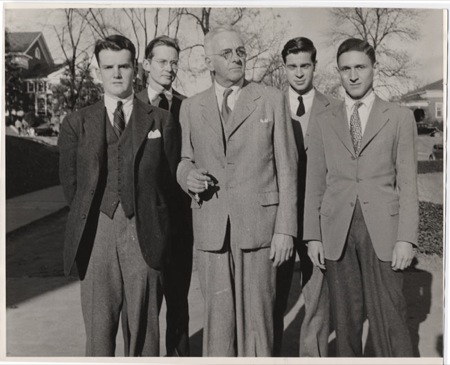
Oh, and the photo? The 1930s were also when UVA professor Ernest Mead was in the group as a student. And that’s Harry Rogers Pratt front and center. No photos are known to exist of the Tin Can Quartet, but I might have to drop Mr. Mead a note and see what he remembers…

Grab bag: The bad and the good of UVA

Grab bag: New open source from Apple, new Glee Club CD

Review: Virginia Glee Club Live!

glee_club_liveVirginia Glee Club Live!, the first of this year’s new recordings from the Virginia Glee Club, is now listed on the group’s website and available for purchase through Paypal. I received a copy in the mail about six weeks ago and have had some time to listen and digest, and I can recommend this recording without hesitation.

After I published the recent series on early 20th century Glee Club history and leadership and, um, performance practices, one of the members of the Alumni and Friends Association commented to me that each generation’s Glee Club is different, and I think that’s right. The 1910s group was as different from the 1890s group as the 1990s version was from Don Loach’s Renaissance singers from the 1960s and 1970s. If each group is different, Frank Albinder’s Glee Club is in unusually good shape. This is the best sounding Glee Club recording I’ve heard in a while. (Disclaimer: I didn’t hear all of the Paris live disc or of Bruce Tammen’s recordings.)

The new disc, as the name suggests, is a compilation concert recording over the past five years, spanning Albinder’s tenure to date as Glee Club director. The repertoire includes some “usual suspects” — “Brothers, Sing On!”, Chesnokov’s “Spaseniye sodelal”, “Ride the Chariot,” and the Biebl “Ave Maria” make appearances — as well as mini-sets of more specialized material, such as commissioned works and Virginiana. The focus on short repertoire makes the disc eminently listenable, and the performance standards are generally quite high.

A note on the commissions: The recording features the first appearance in Glee Club history of the group’s recent commissions, Lee Hoiby’s “Last Letter Home” and Judith Shatin’s “Jabberwocky,” in a set together with the Club’s 1991-1992 commission of James Erb’s male voices arrangement of “Shenandoah.” The Hoiby work, a setting of the last letter home from Iraq of PFC Jesse Givens, is given a sensitive performance, and Shatin’s “Jabberwocky” is the surprise hit of the recording, an adventurous and jazzy rollick through Lewis Carroll’s poem. Sadly, the Erb is one of the few low points on the disc. I remember all too well the many opportunities for a group to go flat in the first stanza, and the Glee Club doesn’t avoid them, ending the piece about a half tone low.

The Virginiana at the end, consisting of Loach’s arrangement of “Vir-ir-gin-i-a”, the “Virginia Yell Song” (which regained currency during my tenure with Club), “Rugby Road,” and the University’s alma maters, is sung powerfully and with gusto (and, unlike the 1972 recording, this version of “Rugby Road” includes one of the more scandalous verses). I look forward to playing it to console myself as the football team buries itself this fall (seriously: William and Mary???)

All in all, the piece is a great souvenir of a student group that is performing at a high level of competence. If the concert recording is this good, I can’t wait for the Club’s next recording, the Songs of Virginia collection.