The 1910 Virginia Glee Club: found, one director

I may have found a missing link in the Virginia Glee Club’s history prior to the 1920s, when it became a part of the McIntire Department of Music at the University of Virginia. As I’ve written before, the Club disbanded and reformed pretty frequently in the first two decades of the twentieth century, and we have evidence that the group came back together in 1910 following a hiatus of no more than four or five years. Now we know who led the group then–and it was a professor, not a student. (See my prior post on student directors of the Glee Club for some of the history there.)

A new volume of Madison Hall Notes, the journal of what was then the UVA branch of the YMCA, is on Google Books. In Vol. VI No. 7 (Oct 22, 1910) and Vol. VI No. 11 (Feb. 11, 1911) we read of the newly (re)formed Virginia Glee Club under the direction of Professor M.S. Remsburg. Hopefully I’ll turn up some more information on Remsburg and the efforts to rebuild the Club as more information from this era comes online.

Virginia Glee Club: the musical comedy years

X4004B

No, that’s not a typo, and no, I didn’t post the wrong picture–at least, not if the attributions in the Holsinger Digital Collection at UVA are correct. Today’s stroll down history lane with the Virginia Glee Club covers an era in their history which is, perhaps justifiably, forgotten–their days as a musical theatre troupe.

To understand how a group founded on moonlight serenades, that eventually became a serious musical organization, spent time in the footlights with greasepaint and drag clothing, it’s helpful to go back to the re-formation of the Glee Club in 1910. At that time, the Glee Club, after a few years without any qualified student direction, reconstituted itself, responding, according to University historian Philip A. Bruce, to the disbanding of the musical theatre group the Arcadians. Through contemporary eyes, it’s easy to read this as meaning that the students from that group of musical players saw the error of their ways and became serious choral singers. Apparently not. Instead, this incarnation of the Virginia Glee Club appears to have arrived to fill a market void and spent at least some of its time doing real musical theatre.

And by musical theatre, I mean drag. The photo above, taken by the Holsinger photographic studio on April 4, 1916 (note the date), is attributed to the Glee Club with a question mark, as if to say, “No way!” Alas, other documentary evidence says “Way!” I have in my possession a copy of the April 1, 1921 edition of the Yellow Journal, the University’s anonymous satirical newspaper, in which a reviewer describes a performance of the Glee Club’s April Fools show for that year, “The Visiting Girl”:

“The Visiting Girl” presented by the University of Virginia Glee Club, John Koch, president, director and chief actor. Jefferson Theatre as an April Fool joke, April 1, 1921. We last saw this show in December and later we saw it in Richmond during February. If it hasn’t improved, and we doubt whether it has improved, we advise you not to go to see it. … The chief attraction of the show is Jack Parrott as a girl and John Koch as a rube. Jack plays his girl’s part very well, though he is a bit awkward. The girls’ chorus looks about as much like a bunch of girls as a litter of pups does. …

I could write it off as satire, but then there’s the ad in the back pages of the paper (the ads, while written to be funny, all are for real products or events):

TO-NIGHT

University Glee Club

IN A MUSICAL COMEDY

Suggestion: Why not cut out the “musical”?

Suggestion: They might cut out the “comedy” too.

The YJ’s hostility to the performance is partly a put-on (they spend the whole issue carping about class issues, and there’s “no one notable” in the Club), but the event is all real. It may well have been an April Fools tradition, judging from the dates of the evidence points, but the events were clearly real.

I would be remiss if I didn’t point out other photos from this era in the Holsinger archives. Yeah, the Glee Club did some of their “musical comedy” in blackface. I guess this isn’t surprising in a group doing musical comedy in the South in the early 20th century, but it’s still sobering to realize that the Glee Club really was of its time.

Student directors of the Virginia Glee Club

I uncovered another student director of the Virginia Glee Club this weekend, poking through the New York Times archive. It got me thinking about how the group’s governance and musical direction has changed over the years and how large a role students have played in its direction.

Virginia is not unusual in having had students conduct its Glee Club. Princeton didn’t have a professional conductor until 1907, and the Harvard Glee Club invited its first professional conductor, Dr. Archibald Davison, in 1919. But the Virginia Glee Club is unique in having returned to student and other non-faculty conductors as a consequence of its separation from the UVA music department.

Most of the students who conducted the group are doomed to anonymity, but a few have names that have been recorded, even in the earliest years of the Club. I suspect that more could be found were someone to go through and comprehensively digitize the old University of Virginia Magazine (hint, hint). Some of the students went on to lead interesting lives. Here’s a snapshot of four of them.

John Duncan Emmet (ca. 1879-1880). One of the Club’s first directors, Emmet was there during Woodrow Wilson’s first year at the University, the 1879 – 1880 season. Wilson’s presence earned Emmet immortality, as the New York Times dug into Wilson’s student past to uncover a few gems about the Glee Club:

The [University of Virginia] Magazine contains several humorous descriptions of the reception accorded the Glee Clubbers on their serenading expeditions. A pert comment on the editorial page of one issue is typical of the many to be found in the files: “Painfully do we record the last unhappy adventure of the unhappy Glee Club. Most lamentable was their failure! Wrapped in sweet sleep the serenaded slumbered peacefully on, unconscious of the frantic efforts of the serenaders. We can only wish them better success next time.

Emmet graduated with his medical degree in 1880, and went on to bigger and better things, serving as the chief gynecologist at St. Vincent’s Hospital and founding the American Gynaecological and Obstretrical Journal. Emmet was the grandson of Dr. John Patten Emmet, professor of chemistry at the University, and namesake of Emmet Dorm.

Harrison Randolph (ca. 1893-1894). I’ve written about Randolph before. The only student director named by University historian Philip A. Bruce, Randolph went on to the presidency of Charleston College.

John Amar Shishmanian (ca. 1904-1905). Shishmanian is a little bit of an enigma. His leadership of the Club is attested by a 1905 Atlanta Constitution article about the Club’s concerts there: “The clubs are now undergoing bi-weekly rehearsals under the leadership of Mr. Shishmania [sic], the winner of the southern intercollegiate oratorical medal last winter.” Digging deeper, we find Shishmanian’s accomplishments as an orator attested in John S. Patton’s Jefferson, Cabell and the University of Virginia,which preceded Bruce’s account and is packed with all kinds of trivia–including a list of Jefferson Society medal winners. Shishmanian, who was registered with the University from Lexington, Kentucky, was a graduate student in law, having finished his BA at the University of Kentucky. The October 1903 Alumni Bulletin was a little more forthcoming about his origins: “an Armenian resident in this country, has entered as a student in the course recently established leading to a consular service certificate.”

He was the president of the Jefferson Society in 1905, and was also awarded the medal for oratory in that year. He is attested as a speaker at the honorary initiation of Virginia governor Claude August Swanson into the Delta Chi fraternity in 1905 or 1906. He graduated in 1906 and went west, joining the firm of Barbour and Cashin, before going east, eventually far east, joining the faculty of Robert College in Turkey.

Michael Butterman (1989-1991). Butterman is better known to modern Glee Club members, serving as joint conductor of the group with Cheryl Brown-West in the first season after its separation from the University, then taking over as solo conductor in 1990-1991 during the 120th anniversary year. Butterman was a grad student at the time, and left in 1991 to head to Indiana University in their conducting program. He’s now conducting the Boulder Philharmonic and the Shreveport Symphony, and is director of outreach for the Rochester Philharmonic, according to a 2007 Boulder Daily News interview.

The Virginia Glee Club disbands — in 1912

gleeclub_1914

This week’s Virginia Glee Club history post comes a little late, but better late than never because it sheds light on an interesting chapter of the Club’s history—its apparent, and apparently intermittent, disappearance in the years between 1905 and 1915. Thanks to a new item that has turned up in Google Books, and which I finally got a photocopy of today, I think we can piece together a fairly decent timeline.

We can piece together the history from a few scraps of evidence. First, UVA historian Philip A. Bruce, who wrote the history of the University’s first hundred years, alluded to the Club’s troubles between 1905 and 1915:

…no play was offered in 1910-11. This fact led to the revival of the Glee Club, an association which had disbanded in 1905. A mass-meeting of all the students interested in music was held; a new vocal and instrumental club organized; and rehearsals at once began. This club was composed of twenty members. It gave two concerts in Cabell Hall and four beyond the precincts. Choruses, quartets, and vocal and instrumental solos, were skilfully rendered. This association failed to re-form in 1912-13 and 1913-14, as the result of the absence of an experienced and attentive director and manager.

We know that the group was still active in the fall of 1905. A letter written on October 29, 1905 by Sue Whitmore, the mother of a University of Virginia student, mentions her enjoyment of hearing the Glee Club perform.

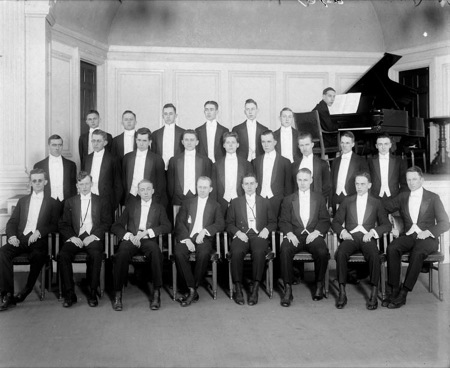
We also know that the Club was around in January 1914, from photographic evidence (above). Then, in 1915, the group was “reorganized” and “trained scientifically” by Professor A. L. Hall-Quest.

But what happened to the group between 1905 and 1914? What did Bruce mean that it “failed to reform”? He laid its failure to succeed on poor leadership, but on what evidence? Here’s where the new discovery sheds some light.

In early October of 1912, the following notice appeared (and was reproduced in the Alumni Bulletin, series 3, vol, 5):

We, the officers of the University of Virginia Glee Club, in consideration of the disadvantageous circumstances under which the afore-mentioned club has operated within the past three years, do officially declare said club disbanded, believing that by so doing an ultimate success may be achieved along another line. (Signed): Roger M. Bone, president, Robert V. Funsten, vice-president, Vaughan Camp, secretary, C.A. McKean, treasurer.

(Thanks to the fine folks at Special Collections for sending me a photocopy of the bulletin.)

So now we have a timeline:

  • In late 1905 or maybe early 1906, the Glee Club disbands.
  • In 1910, the Club reforms, responding to a musical vacuum left by the demise of the Arcadians, a musical theatre group, and struggles for a few years with inexperienced musical and logistical leadership.
  • At the beginning of the third season, in October 1912, the officers of the time disband the group temporarily.
  • At the beginning of the fall 1913 semester, the group re-forms (though the photo is dated January 1914, the re-formation must have happened in the fall—the odds of getting so many young men into matching suits for an official portrait in less than a month are probably no better then than they are today).
  • In 1915, the students connect with a professor, A. L. Hall-Quest, who has connections to the Princeton Glee Club tradition and who sets them on a sturdier footing.

Bruce overstated the hiatus by a year, based on the photographic evidence, but otherwise he was right on. The timeline speaks of an organization that was making it, or not, year-to-year, with little to no institutional support. That sort of existence resonates with my memory of the group between 1990 and 1994, with one difference: we had alumni who cared about the group enough to keep it afloat, and the Club guys of the early 20th century did not. There wasn’t a real alumni association, to speak of, until the first World War.

The next question, which will have to wait for another post, is: what happened after Hall-Quest left? He resigned in 1918, and Arthur Fickénscher didn’t take his job at UVa, and the directorship of the group, until sometime in the 1920s. But this answer might have to wait until I can get back to Charlottesville to do some real research.
Songs of the University of Virginia: the 1906 songbook

It’s Friday, so it must be time for some Virginia Glee Club history.

Before the first Songs of the University of Virginia album, there was the songbook. Compiled by A. Frederick Wilson in 1906 and featuring a combination of the still familiar (“The Good Old Song,” “Drink To Me Only With Thine Eyes”) and the unfamiliar (“The Orange and the Blue”, “Upidee,” just about anything else), there are some fascinating trends in the music. Certainly lots of drinking songs, two sung fully in Latin, and lots of fight songs where “old Eli” (Yale) and “the tiger” (Princeton) are the opponents.

And there is much that is destined to remain obscure: certainly I can’t imagine how to interpret the song “The Man Who Has Plenty of Good Peanuts,” with its verse “The man who has plenty of Pomp’s peculiar patent perpetual pocket panoramic ponies for passing examinations/And giveth his neighbor none /He shan’t have any of my Pomp’s peculiar patent perpetual pocket panoramic ponies for passing examinations/When his Pomp’s peculiar patent perpetual pocket panoramic ponies for passing examinations are gone.” But with the majority of songs containing four part harmony, and with many fight songs that could be revived, the book is definitely worth a download.

Yes, download–you can get the PDF from Google Books, since the book is out of copyright. So while you’re waiting to purchase the Glee Club‘s new album Songs of the University of Virginia, check out some of the historical precedents.

For incentive, here’s the foreward, in which credit is given to the Virginia Glee Club of the time for keeping the songs alive:

P.S.: This is one of the only sources I’ve seen for sheet music for “Upidee,” one of three songs mentioned as a Virginia favorite in 1871 just before the first appearance of the Glee Club.

Where was the Cabell House?

cabell house
The standard biography of the Virginia Glee Club traces their formation to the creation of a glee club at the University of Virginia’s “Cabell House,” which the group’s history calls the “Cabell House Men.” Inspired by my visit to the University this weekend, I went digging to find where and what the Cabell House was.

Jefferson’s original university design had 54 student rooms on the Lawn and a similar number on the East and West Ranges, holding somewhere between 150 and 200 students (assuming double residency for all the Lawn rooms except the Bachelor’s Row). So the growth in University attendance from 128 in 1842-1843 to more than 600 in 1856-1857 (figures from Philip Bruce’s History of the University of Virginia vol. III), combined with the lack of further dormitory space, led to a growth industry in Charlottesville boarding houses. One of these was the Brock Boarding House, later known as the Cabell House. Later called the “Stumble Inn,” the two-story brick structure, located on the north side of West Main Street between 9th and 10th, was ultimately razed. Today the block hosts a handful of businesses and a book shop and overlooks the train station on the other side of West Main Street.

The Glee Club’s formation wasn’t the only brush with fame the Cabell House had, however; it was also infamous as the site where John Singleton Mosby, later famous as the Confederate raider known as the Gray Ghost, shot fellow University student George S. Turpin.

2009 University of Virginia reunions

3563704058_78b7d3c02d_o

I returned yesterday from an extended weekend attending my 15th class reunion at the University of Virginia. It was a great weekend and I had a lot of fun, though not necessarily because of the reunion itself.

We started the weekend on a rocky note, driving through pouring rain through Connecticut and New York before it finally cleared away when we got to New Jersey. Lisa and I drove on solo the next morning and made it to Charlottesville about 3 pm. I had grand plans of catching up with a few folks in town but was exhausted by the drive and we punted, managing only to have a few drinks at Michael’s Bistro and to get over to L’Etoile. Okay, so that wasn’t such hardship. In fact, Friday was a pretty amazing date, the first we’ve had in quite a long time.

Saturday was a more structured day. This year I went in with the expectation that we would go to a few things that interested us and otherwise spend most of the day with friends. And it worked out that way, kind of. We did hear Julian Bond speak about the connection between civil rights, changing demographics, and the evolution of R&B and rock music–an unexpected but pleasurable discussion with an old professor, if not perhaps as consciousness raising as some of Bond’s past lectures have been.

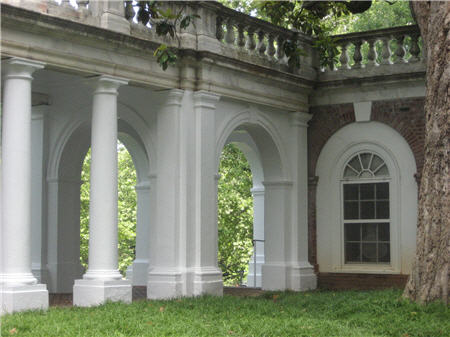
Then it was lunch, which was unpleasant. The Big Tent was raised over yesterday’s muddy grass, our claustrophobia was in full swing, and we retreated to a stone planter near the Small Special Collections Library to eat our hot dogs (good) and hamburgers (overcooked). A slow stroll around Grounds followed, during which I snapped the majority of the photos from this trip. We sat in the Rotunda for a disappointing class panel, but the real unexpected jewel was sitting in the Shannon Garden along the west side of the Rotunda. Named for Edgar Shannon, who presided over the University during its most turbulent period since the Civil War during the 1960s and early 1970s, it was a fittingly tranquil place that I had walked past many times before but never appreciated until the weekend. (The picture above shows the colonnade that Stanford White added during the post-fire renovation of the Rotunda to create what became the Shannon Garden.)

The reunion part of the weekend was the least successful, primarily because the 15th reunion is not too well attended for a lot of folks, and partly because I didn’t sign up for enough fun activities. (Lesson learned: will sign up for wine tasting next time.) But we had a great time catching up with Greg, Bernie, Anne and the other folks from the class that were there, and the reunion left me wanting to go back in five years and do it again–which I suppose is the goal of all good reunions.

Virginia Glee Club history: Harrison Randolph

harrisonrandolphExploring some of Google’s new search options a week ago bore surprising fruit, as I discovered enough about the first named conductor of the Virginia Glee Club, Harrison Randolph, to write a Wikipedia article about him. There has long been little publicly available information about Randolph, aside from a mention in Philip Bruce’s 1921 five volume history of the University of Virginia and his presence in the archival 1893 Glee Club photo that also features the author of the “Good Old Song.” The liner notes to the Club’s 1972 recording A Shadow’s on the Sundial place him as the organist at the University Chapel, but otherwise he seemed doomed to fade into obscurity.
However, when I did a news timeline search for “virginia glee club”, I turned up some hits in the 1890s that I hadn’t seen before. In particular, one 1894 report in the Atlanta Constitution gave me quite a bit more information about Randolph and the boys of the Glee Club than I had seen previously. In this case, the description of Randolph as an “instructor of mathematics” made me go back and look deeper into his biography, and I turned up a fuller biography of him in a 1920-era volume that says that he left Virginia in 1895 to go to the University of Arkansas, and then in 1897 to the presidency of the College of Charleston, where he spent nearly the next 50 years.

It appears, despite his accomplishments, that the directorship of the Glee Club was not then without its perils; the Constitution gives a glowing description of his intellect, then drily notes, “To him has been allotted the awful task of directing the Glee Club.” Even allowing for the “amazing,” “awe-inspiring” sense of the word, one still feels the pressure of the world on Randolph’s young shoulders, particularly looking back at his 1893 photograph. Born the same year as the Glee Club itself, he looks at the age of 22 smaller and more exhausted than those around him in the publicity photo. Is it any wonder that only two short years later he fled to the relatively safer world of academia?

For those with patience, I’ve added the text of the original 1894 concert review article; it provides a rare glimpse at the mechanics of how the Glee, Banjo, and Mandolin clubs worked together and gives thumbnail biographies of each member.

Remembering Steve Bognaski

I learned this morning that a Virginia Glee Club friend, Steve Bognaski, died two months ago on Valentine’s Day of a heart attack. He was 38, and left a wife and two children.

I’m kind of flabbergasted. Steve always was one of the most bighearted guys I knew, full of life, a dedicated singer, and capable of highly vocal joy. It doesn’t seem fair that he’s gone.

I count myself fortunate that I was able to meet up with him when I was in Charlotte in September 2007 for the iTSMF show. He was excited about his family’s upcoming move to Suffolk, Virginia. I am sorry I didn’t see him more often in the time since graduation.

Remembering Gilly Sullivan

UVA Today: Gilly Sullivan, Former U.Va. Alumni Association Director, Has Died.

If the worth of a man is measured in the impact that he left on the lives of others, Gilly Sullivan was the most important man I’ve ever known. He was dedicated to helping students at the University of Virginia and to ensuring that Mr. Jefferson’s principles of student self-governance were consistently upheld, and he was able to produce miracles in a way that no one else associated with the institution seemed able.

I had three separate interactions with Gilly. In one, he was the bearer of the news that I had won an alumni-sponsored scholarship that I didn’t know existed and had never applied for. In the second, he helped save the magazine that I had cofounded just an issue before when our business manager decided not to sell any ads and not to tell me about it.

In the third, which began before I got to the University and continued the whole time I was there, he was the guardian angel that helped ensure the survival of the Virginia Glee Club as an independent organization when the UVA music department wanted to subsume it into a mixed chorus. He did it by ensuring that the music department couldn’t claim any control over the Glee Club’s alumni-funded endowment, thus ensuring we’d have some way to survive without department support. He was similarly instrumental in helping the revival of the UVA Women’s Chorus.

I wrote a Wikipedia entry for Gilly a few months ago but never shared it with the broader world until this week; I wanted to dig deeper to find more information about the man. For all his influence, he left a remarkably small impact on the news world–a few articles around the time he retired and that was it. He deserved more praise than he got, but I think he knew how much of a difference he made to students like me.

A Shadow’s on the Sundial: initial notes

My copy of the Virginia Glee Club‘s 1972 record, A Shadow’s On the Sundial, arrived today. I haven’t listened to much of it yet, but a quick scan of the first few tracks on the first side and a review of the liner notes (transcribed) provide the following observations:

  1. This is a completely different group than the rough-hewn group from 1951 (or was it 1947) that recorded Songs of the University of Virginia. No monophony here, no vigorously gasping phrases, no mediocre baritones. Don Loach should rightly be credited with introducing the tradition of countertenor singing to the Glee Club, as evidenced in the first four madrigals, and for generally setting a high level of musicianship. When I joined the group, in the second year after he and the group parted ways, much of the musical philosophy of the group was still proceeding in the fundamental direction laid down by him.
  2. Only four of the Summer Songs, settings written by the group’s conductor David Davis of poetry by the group’s student business manager, Michael B. Stillman (class of 1963), are included on the recording—not included is the oddly funny “Little Polly Ethylene.”
  3. The record’s liner notes reveal the identity of the mysterious Harrison Randolph, who in 1893 broke it out of the Glee, Mandolin and Banjo Club and set it on its path of independent existence: he was the organist in the University Chapel.

More notes as I finish listening to the record…

Virginia Glee Club 1972 European Tour

Continuing this week’s back to school theme (hey, in the fall I get a little nostalgic for UVA), I did a little more spelunking through the broken Cavalier Daily archives and turned up a review of the Glee Club’s 1972 European tour. Check out Around the Western World in Eighteen Days: A Glee Club Diary, and marvel at the thought that college students could once visit the Hofbrauhaus on a University-sponsored trip.

The Virginia Glee Club: A Shadow’s on the Sundial (1972)

Having sung the title work, I’ve always been curious about the Glee Club’s 1972 recording A Shadow’s on the Sundial, not least because it financed their 1972 concert tour. I hadn’t been able to find any references about it other than a newspaper ad and a passing mention in Virginius Dabney’s history of the 1920s through 1970s at Virginia, but today I struck paydirt.

There are a lot of bugs in the UVA library’s onsite access to digitized back issues of the student newspaper the Cavalier Daily, but you can get to the content by searching to find the article you want, browsing to the year that it was published, opening the file containing all the content for that date, and viewing source (the content is contained in the XML). For those who might not want to go through the hassle, here’s an excerpt from an article that appeared in the February 29, 1972 issue of the Cavalier Daily:

Profits from A Shadow’s on the Sundial, the Glee Club’s recent recording, will also go toward the tour. The record contains several traditional settings of English, French, and Italian madrigals, some of which will be sung in Europe. Two more serious works included are Francis Poulenc’s Lauds of St. Anthony of Padua, which the Club plans to sing in Padua, and Dietrich Buxtehude’s Cantate Domino, “Sing To God The Lord”.

“From Rugby Road to Vinegar Hill” (two verses only) and “Glory, Glory To Virginia” combine in a pleasant medley, offering a sharp contrast to the above pieces. Also included among Virginiana are new arrangements by recent Glee Club directors of “The Good Old Song,”, “Virginia Yell Song,” and “Ten Thousand Voices.”

A recent addition to the collection is “Vir-ir-gin-i-a,” by Professor Emeritus of English, Arthur Kyle Davis, Jr. Setting verses to a chorus by G.F. Handel, Professor Davis dedicated his new song on April, 1968, to the Jefferson Society. He sang the first performance of it on that occasion.

Portions of two other compositions that the Glee Club has come to regard as their own have been included. One is Randall Thompson’s Testament of Freedom which was dedicated to the Glee Club in 1943, having been composed for the Two Hundredth Birthday of Mr. Jefferson.

The other composition was written by former Glee Club director David H. Davis, entitled Summer Songs. The title of the album, A Shadow’s on the Sundial, is taken from the name of the concluding Summer Song in the group.

The album represents a lot of work on the part of the Club members. It seems the incentive involved has produced what many consider to be one of the best albums ever put out by the group. The album can be purchased for $5.25 at the corner stores, Newcomb Hall Bookstore, Stacy’s Music Ship, and HiFi House or through any member of the Glee Club.

With the group preparing to record a new album honoring the legacy of Songs of the University of Virginia, I thought the discovery of this description of Shadow was interesting.

Songs of Virginia redux

I got a little pleasant news in the mail over the weekend. Somehow I had missed the announcement that the Virginia Glee Club won a Jefferson Trust grant back in April to record a followup to Songs of the University of Virginia. I had previously been contacted by a current Glee Club member who asked questions about the old record, but hadn’t heard about the grant. Well done, guys.

The Fennell roast

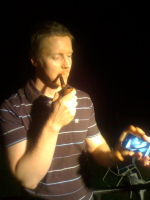
Fennell, with iPhone and pipe, at the partyI had a bit of driving to do this weekend; I traveled from one Arlington to the other, from Massachusetts to Virginia, so that I could help Craig Fennell celebrate his impending nuptials. It was a great time, quite mellow as these things go. Lars Bjorn and his wife Erin were great hosts, and I got to spend time with quite a few folks I hadn’t seen in years (Kevin Dixon, John Duncan, Ananth Kadambi, Ben Johnson, Dan Roche, and even Guido Peñaranda) as well as some folks I hadn’t met (mostly the rest of Craig’s bandmates in Wonderjack, as well as his brother and sister). It was a great evening, and my only regret was that I had to drive sixteen hours (eight each way) to be there for only sixteen hours.

(It’s kind of funny that, even with gas at $4 a gallon, the car was still the cheapest way to go this weekend; $50 cheaper than Amtrak, $150 cheaper than JetBlue. I don’t think that will be the case for too much longer, though.)

Anyway, it was a great time and there was much reminiscing. I wasn’t in the VGs with Fennell, Dan, Ben, and Ananth, but had enough common experiences that we stayed up talking until late in the night about music. I’m looking forward to hearing the Imogene Heap cover that this year’s VGs did–we all passed around Fennell’s iPhone so we could hear parts of it, but I think it probably will sound better over speakers.