Exfiltration Radio: can’t we smile?

An hour of bliss at the intersection of spiritual jazz and jazz-funk, circa 1969-1976.

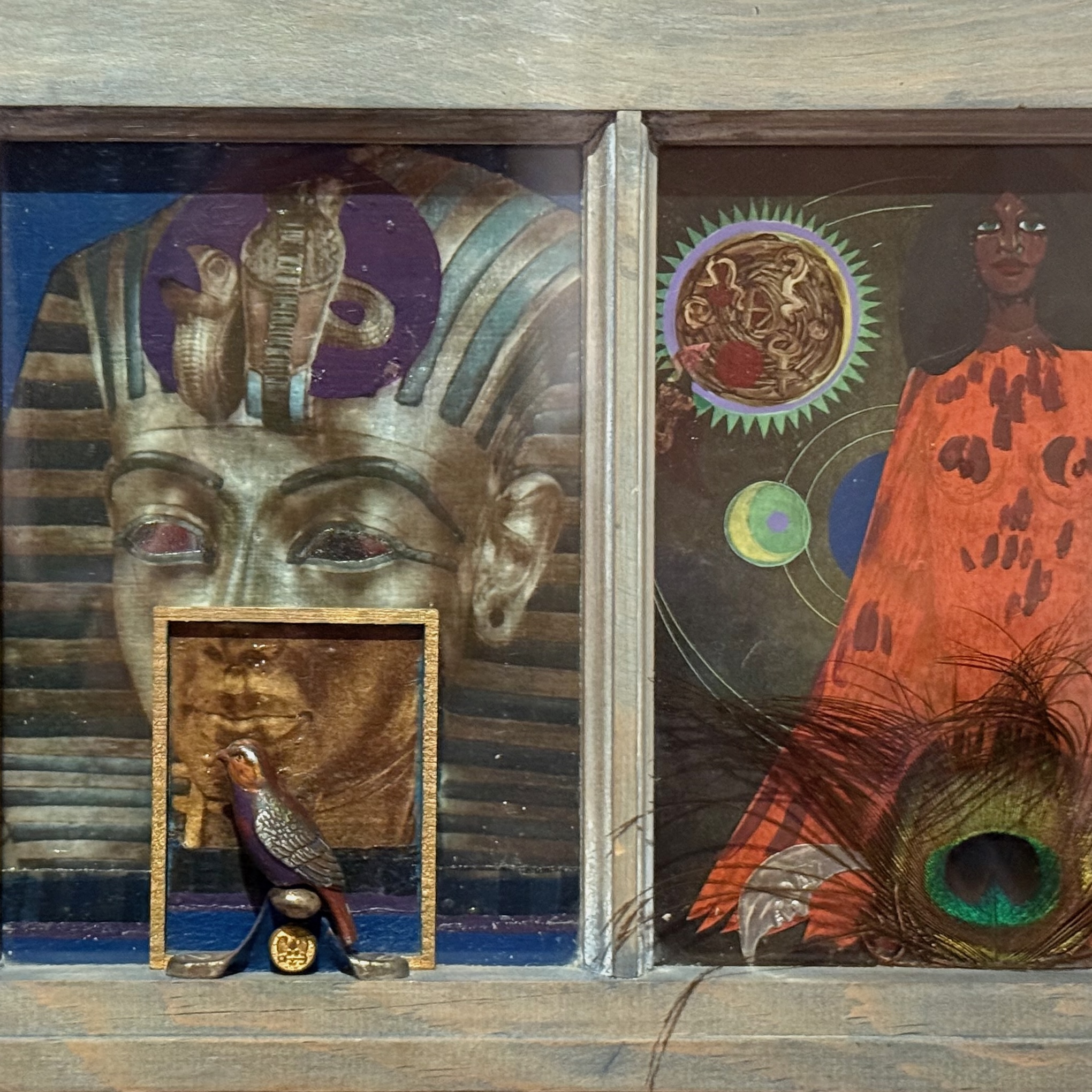
Detail from Betye Saar’s “Window of Ancient Sirens,” 1979

Not enough people talk about the through-line from spiritual jazz to smooth jazz.

That may seem like a strange, almost nonsensical thing to say, to compare Coltrane’s A Love Supreme to Grover Washington or Kenny G. Nevertheless, there’s a path there, and it runs through some artists that I’ve talked about on this blog many times before. Generally speaking, the sound I’m talking about, and that I explore in this hour of Exfiltration Radio, blends the soaring messages of hope of Pharoah Sanders’ Karma with the more cosmic sounds of the Fender Rhodes. Many of the works are more audibly optimistic, i.e. in a major key; many of them have lyrics; several have full-blown string arrangements. Some are more spiritual in focus, while others just enjoy the groove. And they almost all seem to come from the late 1960s to around the mid-1970s, with the sweet spot being from about 1969 to 1973.

That said, the overall driving force for this mix was definitely tunes that put a smile on the face and lower the blood pressure. So enjoy! The track listing:

Lonnie Liston Smith, “Expansions” (Expansions): The title cut from Smith’s 1975 album on the Flying Dutchman label, this is a darker groove than most of the songs on the show, but with that deep plea for peace at the heart of it: “Expand your mind to understand/we all must live in peace.” With a great band comprised of Cecil McBee on bass, brother Donald Smith on flute and vocals, Dave Hubbard on saxophones and Michael Carvin on drums.

Ramsey Lewis, “Bold and Black” (Another Voyage): This track from the perennially sunny improviser’s 1969 album points toward more smooth experiments, like 1974’s Sun Goddess, while providing a sunray of musical joy. Classic top-down, driving around music.

Norman Connors, “Carlos II” (Love From the Sun): Drummer, composer and arranger Connors spent most of his career in R&B and smooth jazz, but this, his third album as leader, is a fascinating, fantastic collection of straight ahead jazz with hints of spirituality poking through around the corners. A great line-up of players, including Herbie Hancock on Fender Rhodes, Gary Bartz on saxophones, Buster Williams on bass, Hubert Laws on flute, Kenneth Nash on percussion, Eddie Henderson on trumpet, and Carlos Garnett, who wrote this track, on tenor sax. Dee Dee Bridgewater guests on two tracks. The whole album is a great listen.

Azar Lawrence, “Theme for a New Day” (People Moving): Lawrence played on McCoy Tyner’s Enlightenment, Sama Layuca and Atlantis before recording his first album as leader. By 1976’s People Moving he was producing fully orchestrated sonic experiences that were full of spiritual energy and deep grooves.

Donald Byrd, “Places and Spaces” (Places and Spaces): By 1975, Donald Byrd was in a very different place than when he played on Herbie Hancock’s second album, or even his mid-1960s spiritual jazz outings for Blue Note. His 1973 album Black Byrd, produced by Larry and Fonce Mizell, was a jazz-funk fusion high point that for many years was Blue Note’s biggest selling album. Places and Spaces is the fourth of Byrd’s Mizell-produced albums, and cranks much of what made that album successful up to 11, including swooning strings and a guitar-driven hook that wouldn’t be out of place on an O’Jays record. The chant that drives the record isn’t quite P-Funk quality, but it gets the job done, and Byrd sneaks in a fully respectable trumpet solo amid the rest of the funk.

Bobbi Humphrey, “Harlem River Drive” (Blacks and Blues): Humphrey, a hugely talented flautist, also benefited from the Mizell brothers’ production on the 1973 Blue Note album Blacks and Blues, including their writing this ode to summertime cruising. The band here is mostly session players, including Jerry Peters on keyboards, Chuck Rainey on bass and the great Harvey Mason on drums, but Humphrey’s flute solo is the main thing here, a work of searing beauty in an otherwise light track.

Johnny Hammond, “Can’t We Smile?” (Gears): This work, by keyboardist and sometime jazz organist Johnny Hammond, née Johnny “Hammond” Smith, not only gave me the title for this hour but kicked off the process of putting it together, after Lisa asked me why I was listening to smooth jazz; defending the track made me realize how much I liked it and how much depth lurked beneath its smooth exterior. Released in 1975 on Milestone Records, it’s another Mizell Brothers joint with Mason, Rainey, Peters, and Nash, along with trombonist Julian Priester (from Herbie Hancock’s Mwandishi band) and avant-spiritual violinist Michael White.

Lonnie Liston Smith & the Cosmic Echoes, “Rejuvenation” (Astral Traveling): Before there was Expansions there was Astral Traveling. Smith’s first album with the Cosmic Echoes was recognizably straight-ahead jazz, with much the same crew as on Expansions, but again Smith’s composition leaned forward to the optimistic and hopeful, particularly in the ebullience of George Barron’s saxophone melody. Smith’s solo similarly feels extroverted in an almost soul-shouter kind of way.

Alphonse Mouzon, “Thank You Lord” (The Essence of Mystery): Mouzon’s first album, in 1973, has tinges of the same mystery that the drummer brought to the first incarnation of Weather Report, combined with a melodic and compositional sensibility that feels akin to with Smith was doing at the same time. It also feels like some of Keith Jarrett’s 1970s work, broadly anchored in major-key tonality with a swooping saxophone shining a light in the darkness.

Pharoah Sanders, “Astral Traveling” (Thembi): Before there was Astral Traveling, there was … “Astral Traveling.” The first track on Sanders’ 1971 album, his last with Smith, was legendarily composed by the band as Smith sat and played a Fender Rhodes for the first time ever in the studio. I like this version better than the one on Smith’s later album because I feel more wonder in the playing, as though the band is together exploring a new world. It’s also a welcome view of a side of Pharoah Sanders that we don’t often think of, but he could be as gentle as he was often fiery.

Leon Thomas, “The Creator Has a Master Plan” (Spirits Known and Unknown): This brings us to the last track. Vocalist and composer Leon Thomas collaborated with Sanders on the composition of “Creator,” and both Sanders and Smith are here on this recording. This version from Thomas’s debut album gives a good view of his approach: a wide-eyed spirituality, still with some of the ululating vocal flourishes of Sanders’s recording, but overall less cosmic brimstone and more bliss.

There is nothing wrong. We have taken control as to bring you this special show and we will return it to you as soon as you are exfiltrated.

McCoy Tyner, Sahara

Album of the Week, May 18, 2024

In the early 1970s, several of the stalwart jazz labels we’ve followed for a while, including Impulse! and Blue Note, were in trouble. Jazz records were no longer selling the way they did previously, and the jazz audience was splintering, leaning away from the acoustic jazz we’ve been writing about so far and into various forms of fusion, thanks in no small part to Miles’ In a Silent Way and Bitches Brew. But the artists we’ve followed were still around, and they found their way to smaller, scrappier labels. One of those was Milestone.

Producer Orrin Keepnews, who we met thanks to the great Bill Evans sessions he recorded (including Moon Beams, which featured the anagrammatic dedication “Re: Person I Knew”) started Milestone in 1966, and it was bought by Fantasy Records in 1972, the year it released McCoy Tyner’s first record for the label, Sahara. The label would prove to be fertile ground for Tyner and for other musicians in the early 1970s, including Joe Henderson. Keepnews recorded Tyner and his band, including saxophonist and flautist Sonny Fortune, bassist Calvin Hill, and drummer Alphonse Mouton, in January 1972 in New York City, where they laid down the five tracks on the album in a single session.

(Fortune was at the early stages of his career in January 1972, having first appeared on the jazz scene in New York in 1967 with Elvin Jones’ group, and playing with Mongo Santamaria and Pharoah Sanders collaborator Leon Thomas in the interim. Alphonse Mouton we’ve previously met, on the 1971 debut of Weather Report. And Calvin Hill, who has played with just about everyone, is the sole living member of the quartet.)

Ebony Queen” starts off where Extensions left off, a strongly rhythmic modal romp that is led off by Tyner. As on so many of the Extensions cuts, the horn plays the opening melody next. Sonny Fortune’s tone is easily distinguished from Wayne Shorter or Joe Henderson on the prior album, particularly when he transitions from the melody into a high wail on his soprano sax following the first chorus. Also notable is the impact that Alphonse Mouton’s drumming makes. While sympathetic with the overall performance, he brings a lot of cymbal splashes and snare rolls that hint at some of his fusion performances. Here it makes for an almost overwhelmingly intense presence in the rhythm section beneath Tyner’s continual melodic improvisation. Unusually for Tyner, the track fades out as the song reaches its end.

A Prayer for My Family” provides a strong contrast. A solo performance by Tyner, it’s played freely, out of time, and seems to be a meditation. Tyner picks up the pulse of the track at about the two minute mark with a set of strong chords, but this is alternated with chime-like runs which morph into a quiet conclusion. It’s continued almost seamlessly in “Valley of Life,” but the opening instrument is the koto, a Japanese dulcimer-like instrument that is plucked. Sonny Fortune enters on flute over the koto and percussion played by Mouton for a four minute long meditation that is unlike anything that Tyner had recorded to this point: experimental without being free, still anchored in rhythm and chord. At one point Tyner’s strumming of the koto finds a counter melody that is supported by Hill’s bass and cymbal splashes from Mouton, before Fortune re-enters on flute to recapitulate the opening melody. It’s a stunning performance.

The quartet reassumes more familiar instruments and compositional direction on “Rebirth,” seemingly reclaiming a more traditional ground but still bearing the marks of the works that came before. Tyner’s solo features rolling arpeggios in the right hand that echo his koto work on the prior track. Fortune returns to the stratosphere in his solo before ceding to Tyner, who takes the final solo, improvising around the melody as Mouton raises holy hell and Hill plays a bowed tonic note as the track, and side 1 of the album, closes.

Side two is taken entirely by “Sahara,” at 23 minutes the longest single track in his oeuvre, and almost his longest work (only the title suite from his live performance Enlightenment, recorded at the 1973 Montreux Jazz Festival, is longer). The work features percussion, flute and reeds from almost every member of the band in a ninety second opening, before Tyner plays the opening statement of the work on the piano with great crashing chords, ultimately locking into a groove that seems to be in a couple of different time signatures, eventually settling into 6/8, with Tyner playing in two and Fortune’s melody blowing in 3. Fortune, then Tyner take a solo, but the real delight here is Hill’s bass solo, which re-establishes the pulse and sings alongside contributions from the reeds and flutes. The unusual wind accompaniment continues over Mouton’s drum solo, which plays propulsively into the return of Tyner’s piano, which revisits the first theme and the second 6/8 one.

Tyner would continue to record mind-blowing albums for Milestone until 1981. In addition to Enlightenment, his Song for My Lady and Echoes of a Friend are strongly recommended, but there really isn’t a bad one in the bunch. His later recordings could be a little less focused—I don’t really care for his final studio recording, Guitars—but he continued to play and record well into his 70s, always in the modal and post-bop traditions that were audible in his earliest 1960s recordings, solo and with Coltrane.

We’ve almost come to the end of our exploration of Trane’s music and influence. But recordings from the great musician continued to surface in the decades following his death. We’ve heard a few of them already, and next week we’ll close the series with one of the most astonishing of these posthumous recordings.

You can listen to this week’s album here:

New mix: Exfiltration Radio, Cooking With Fat

It’s a Veracode Hackathon, so it must be time for an Exfiltration Radio playlist! This time, naturally, the musical choices were influenced by all the Miles-related jazz I’ve been writing about over the last few months, as well as an unlikely source: my Apple Music library maintenance.

So, when you source your library from iTunes Store purchases, third-party high-res music providers like HDTracks and Bandcamp, and CD and vinyl rips, you end up with pretty big music files and a lot of music. Too much music to fit on the internal hard drive of most Macs. I’ve been using an external drive for my media for many years now. Mostly it works fine. When it doesn’t, though, it’s disastrous. There is some kind of error condition in Apple Music that causes it to freak out when the external drive is temporarily unavailable and re-download all the music in the iCloud library. Which is OK, I guess, except when the external drive comes back online, you now have two copies of all the music in your library. Or, if it happens again, three.

I’ve figured out a rubric for cleaning this up, which will be the subject of another post. But I’ve been going through all the music in my library album by album, and in the process creating new genres to make it easier to find some types of music. In particular, the genres that inspired this mix were Jazz Funk and Fusion. The latter needs no explanation due to our journey with Miles; jazz funk is just the hybrid of a bunch of different strains of African American music with a heavy focus on improvisation over a funky beat. The end mix combines some tracks I’ve already written about with some more modern jazz from my collection; I’ll provide notes for each track below.

“Wiggle-Waggle,” from Fat Albert Rotunda: the track that got the most comments from my write-up of Herbie Hancock’s TV show soundtrack, with friends noting how it sounds like this track dropped in from another dimension.

“Chunky,” from Live: Cookin’ with Blue Note at the Montreux Jazz Festival, by Ronnie Foster. I’ve programmed Foster’s great “Mystic Brew” in past Exfiltration Radio segments, including the Hammond special. This is a live version of the opening track from the same album, Foster’s great Blue Note debut Two Headed Freap. There’s a lot that’s different about his approach to the Hammond organ compared to earlier artists, but all I can say is: he funky.

“Flat Backin’,” from Moon Rappin’ by Brother Jack McDuff. Speaking of earlier artists, a lot of McDuff’s early work was squarely in the “soul jazz” category (like his great Hot Barbecue), but by the time of this 1969 album McDuff was on another planet, and the electric guitar and bass land the music in Funklandia.

“Funky Finger,” from The Essence of Mystery by Alphonse Mouzon. We have seen Mouzon on the first Weather Report album, but his solo debut for Blue Note is another thing entirely. Despite the name, it’s got less of the mystery of Weather Report and more of the funk, and this track is a great example.

“Sugar Ray,” from Champions by Miles Davis. “That’s some raunchy sh*t, y’all.” Listen to how the chord changes are so wrong, the way they just walk over to an adjacent major key and then settle back into the original as though nothing happened. Also note the remarkable Wayne Shorter solo.

“Superfluous,” from Instant Death by Eddie Harris. Sampled on “What Cool Breezes Do” from Digable Planets’ Reachin’, this is an instant classic.

“The Griot,” from Henry Franklin: JID014 by Henry Franklin, Adrian Younge and Ali Shaheed Muhammad. Composer Younge and former Tribe Called Quest member Shaheed Muhammad have been having a blast recording albums with their jazz idols in the Jazz is Dead series, and this newer release with bassist Franklin, who played with Freddie Hubbard, Bobbi Humphrey, Archie Shepp, Willie Bobo, Stevie Wonder and others, is a tasty slice of funk anchored by his acoustic double bass.

“Tell Me a Bedtime Story,” from Fly Moon Die Soon by Takuya Kuroda. This funky cover of Herbie Hancock’s original from Fat Albert Rotunda is a great example of latter-day jazz-funk, with the arrangement draped (or smothered, depending on your taste) in layers of Fender Rhodes, synths, and electric bass. Kuroda’s incisive trumpet anchors the arrangement and lifts the funk to another level.

“Timelord,” from Inflection in the Sentence by Sarah Tandy. A great 21st century London jazz album, featuring Tandy on both acoustic piano and electric keys, the latter notably apparent in this moody track.

“Where to Find It,” from SuperBlue by Kurt Elling. I’ll write more about this track another time, but it’s worth noting that Elling is one of the few vocalists to brave the task of putting lyrics to modern jazz tracks like this one, Wayne Shorter’s Grammy award winning “Aung San Suu Kyi.”

Enough words. “We have taken control as to bring you this special show, and we will return it to you as soon as you are exfiltrated.”

Weather Report, Weather Report

Album of the Week, September 24, 2022.

It’s not clear how it was that Wayne Shorter, Joe Zawinul, and Miroslav Vitouš got together to form the jazz-fusion supergroup Weather Report. One story has it that Shorter and Zawinul, who we last saw together recording on Miles’ In a Silent Way, started working together and then recruited Vitouš. Another story has it that it was Shorter and Vitouš, fresh off their collaboration on Super Nova, recruited Zawinul (who had collaborated with the Czech bassist on his eponymous album Zawinul). Regardless of who recruited whom, the three together then were joined by drummer Alphonse Mouzon, who had been working with pianist and Coltrane collaborator McCoy Tyner, and the percussionists Don Alias and Barbara Burton. As the recording progressed, Alias found Zawinul’s directive tendencies constraining and left, to be replaced by Davis collaborator Airto Moreira, otherwise mononymically known as Airto. So it goes.

But what was the music like?

I will be honest: growing up, I thought I knew what the music was like, and I avoided it for as long as possible. My earliest exposure to live jazz came from the inclusion of a jazz-fusion band, which if memory serves was called TRADOC Rock, at the US Army Fourth of July concerts at historic Fort Monroe in Hampton, Virginia, where my family would inevitably go to celebrate the holiday. I remember as a kid liking the rhythmic, guitar-heavy music, but as I grew older I found it increasingly cheesy. I thought that was what fusion was. And I knew that Omar Hakim, from Sting’s first band, had played in Weather Report, so I assumed that the band had that same kind of rock inflected jazz.

Then of course I heard Miles. First In a Silent Way, which I loved, and then Bitches Brew, which I was more ambivalent about; then tracks from Live-Evil on the Columbia compilation that covered Miles’s whole career with that label (highly recommended, if you can get your hands on it), which I found utterly fascinating for its combination of rock, funk, and electronic augmentation. When I reflected that Weather Report contained the mastermind behind In a Silent Way and the equally mesmerizing Wayne Shorter, I decided to check out their first album. It was completely different from my expectations in every way.

The first track, “Milky Way,” sounds like a transmission from Voyager. The sound is otherworldly, with distant echoes of harp and wind; I’ve read that they made the sound by closely miking piano strings, then having Zawinul hold down chords while Shorter blew his soprano sax directly at the soundboard, invoking sympathetic resonance. Whatever they did, it’s an utterly unique sound and completely hypnotic. In another world, they would have recorded whole albums with this technique; here, after just over two and a half minutes of transmissions from the Solar System, they’re on to…

Umbrellas,” which more nearly fits the fusion stereotype, and features a severely fuzzed out electric bass, which (it’s hard to tell) may or may not be doubled by distorted synth lines from Zawinul, over a driving rock backbeat from Mouton and Airto. Shorter’s soprano sax plays the melody over a series of chords from Zawinul, then the beat abruptly shifts into a slightly faster, fatter funk groove, with Shorter and Vitouš trading phrases over Zawinul’s chords. Shorter’s solo comes in as if transmitting from another world, the soprano sax descending in a different mode, and passes into silence before the group drops back into the opening beat and theme. The sound world passes quickly, in only three minutes—a theme on the album, which seems determined to fit in as much experimentation as possible.

Seventh Arrow” opens with a brisk burst of sound led by Shorter over a Zawinul electric piano line that you’d be forgiven for mistaking for Herbie Hancock. It’s the tune most like Miles’ work on the album, sounding a little like a group improvisation from the Bitches Brew sessions; that it was composed by Vitouš, who never collaborated with Miles, seems beside the point. Unlike the first two tracks this is a group workout, with each of the three lead players throwing licks back and forth over a ferocious bed of percussion.

The shift into the reverie of “Orange Lady” is a complete contrast. Zawinul’s echoing Fender Rhodes line, possibly supplemented with additional effects, leads into a plaintive solo line played on unison soprano sax and Rhodes. This might be the track closest in its genetic makeup both to In a Silent Way and the experiments on Zawinul’s self-titled album; unsurprisingly it is the first track on the album solely credited to him. After the contemplative opening, the gears shift and Vitouš lays down a bass line that climbs in open fifths back and forth, while Shorter plays a modal line that descends from the fifth of the scale down to the second and back, before the group comes back together to the opening reverie. It’s a stunning work closing out side 1.

Morning Lake”, the second of the two Vitouš compositions on the album, sounds a lot like Zawinul with a funk twist and is a spiritual cousin to the more contemplative numbers on Infinite Search. With Airto (and possibly Alias and Burton) conjuring bird sounds and the bass line rippling out like circles in the water, the effect is a tone poem that sounds like a continuation of “Orange Lady.” Indeed, if there’s a criticism to be levied at the album, it’s the similarity of the tunes at its center, but the trance they induce is rewarding in its own way.

Waterfall,” Zawinul’s turn at evoking this evolving musical concept, centers on a rhythmic repetition of the third of the scale in the piano while the other players explore around it. In some ways the composition anticipates minimalism and the works of John Adams, or even some of the later, more lyrical works of Philip Glass, as the bass and soprano sax alternate in an octaves-apart duet. It’s a more delicate and in some ways optimistic exploration, with Zawinul’s keyboard line evoking, in turns, a stream, an oboe, and a music box.

Tears,” the first of two Wayne Shorter compositions on the album, eschews some of the avant-garde explorations from Super Nova in favor of pure melody — first lyrical in the saxophone, then a swerve into funk, then wordless song, courtesy of Alphonse Mouton. The overall effect is stunning and anticipates Shorter’s later 1970s work with Milton Nascimento. The track transitions seamlessly into “Eurydice,” which dives into the world of Super Nova with a group improvisation on a chromatic theme. The album ends with the group still searching.

With Weather Report, Zawinul, Shorter and Vitouš invented a new tonal language and created a new jazz brand. The original band would not stay together—Vitouš left during the recording of the third album and a rotating cast of percussionists played with the band during this career. But the group would stay together for nearly 15 years, promoting a brand of jazz fusion that was heavily influenced by R&B and world music. The tonal language that they invented—synths and keyboards, innovative percussion, serene soprano sax—stood well apart from many of the other practitioners of jazz fusion, not coincidentally including Miles Davis, who continued to explore his own fierce brand of musical innovation. We’ll hear from him next time as we close out this long series on Miles and his legacy.

You can listen to the album here: