
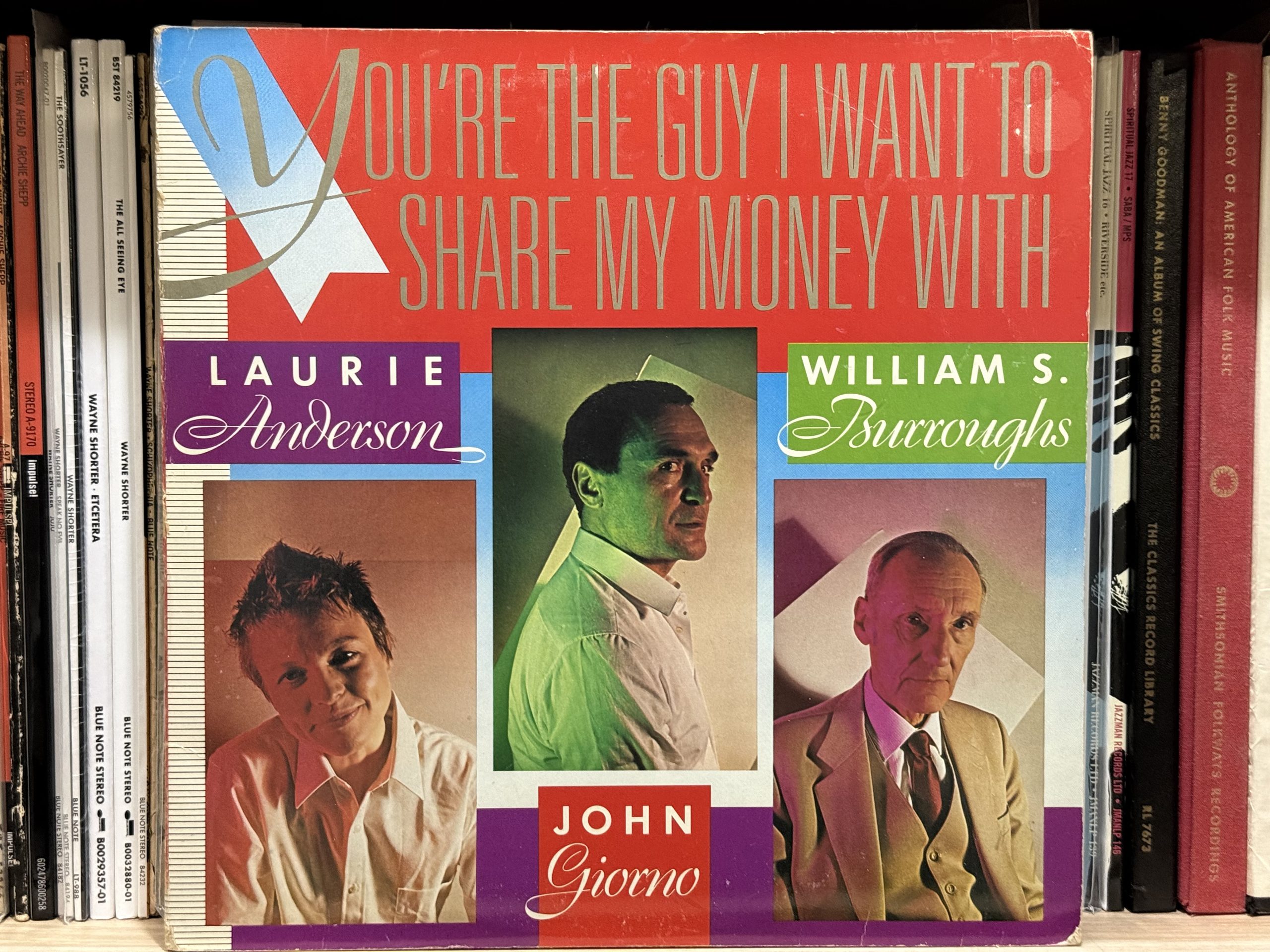
Album of the Week, March 21, 2026
The name of this segment of my album reviews was originally going to be “art rock.” But while that term has been used to apply to Peter Gabriel’s work, it’s impossibly undefinable, and didn’t really cover the work of one of his collaborators whose story we’ll begin to discuss today. Though Laurie Anderson is undeniably an artist, the “rock” part is an ill-fitting label, and none of her recordings illustrates the challenge as much as today’s recording, a compilation of spoken word, performance art, and poetry that pairs her with two other challenging artists over a year before the release of her debut album.
Laurie Anderson was born in Chicago and grew up in the Illinois suburbs studying art and playing in the Chicago Youth Symphony. She drew comics, made sculpture, and did performance art: her first public performance was a symphony for automobile horns, and one of her best-known pieces from the 1970s, “Duets on Ice,” involved her playing violin against a recording of herself while wearing ice skates that had been frozen into blocks of ice—the performance ended when the ice melted enough to free her skates.1 Also in the 1970s she connected with New York poet and performance artist John Giorno, on whose Giorno Poetry Systems label she released some of her earliest recordings (including some for his groundbreaking “Dial-A-Poem” system).2
Increasingly Anderson was drawn to recorded art, though she never abandoned her more visual instincts, and in 1981 she released two important records. One, a single called “O Superman,” was released in October on a small label and had an unusually strong reception (which we’ll discuss another time). The second was a side (er, a side-plus) of this double album on Giorno Poetry Systems, with which Anderson appeared alongside two even more avant-garde poets: Giorno himself, and William S. Burroughs.
The latter had outlived his early tumultuous years—gay, addicted to opiates, accidental murderer—and had built a solid, if solidly weird, literary reputation as the author of works like The Naked Lunch, a science fiction trilogy (The Soft Machine,3 The Ticket That Exploded, Nova Express) and a great many short stories. He also made a number of recordings on a variety of small labels that featured his distinctive reading of his own works, based on the live readings that he was now giving on the lecture circuit. It was in this vein4 that Burroughs appeared on this recording. All three artists had appeared together in a series of readings and performances dubbed “The Red Night Tour.”
Laurie Anderson’s segment of the album is the most straightforward, and that’s saying something. While parts of the performance were recognizably connected to other things happening in music in the early 1980s (“Doctor Miller” is practically a Kraftwerk song, if you subtract the increasingly anxious PA voiceovers calling for the doctor), others are distinctively and uniquely Laurie’s voice, even (“It Was Up in the Mountains”) when the words are spoken by someone else. If I’m honest, “Closed Circuit” is more interesting than listenable, notable primarily for featuring Laurie’s use of vocal effects to create a deeper timbre for her speaking voice—a trick that she would perfect elsewhere, but here is marred by the lengthy lyric that feels more like a shaggy dog story. The end of Side 1 closes with an eerie instrumental played on a Farfisa, a marimba, handclaps, and Laurie’s brilliant violin; “Born, Never Asked” would appear again.
Side 2 is given over to two John Giorno poems, “I Don’t Need It, I Don’t Want It, and You Cheated Me Out of It” and “Completely Attached to Delusion.” Like Laurie Anderson, he plays with vocal effects, but his use of tape delay and pre-recorded alternate readings of the work is by turns disorienting, exhilarating and overwhelming. But it is a committed and fully out there reading, and there’s a direct line to be traced from his work to poetry slams.
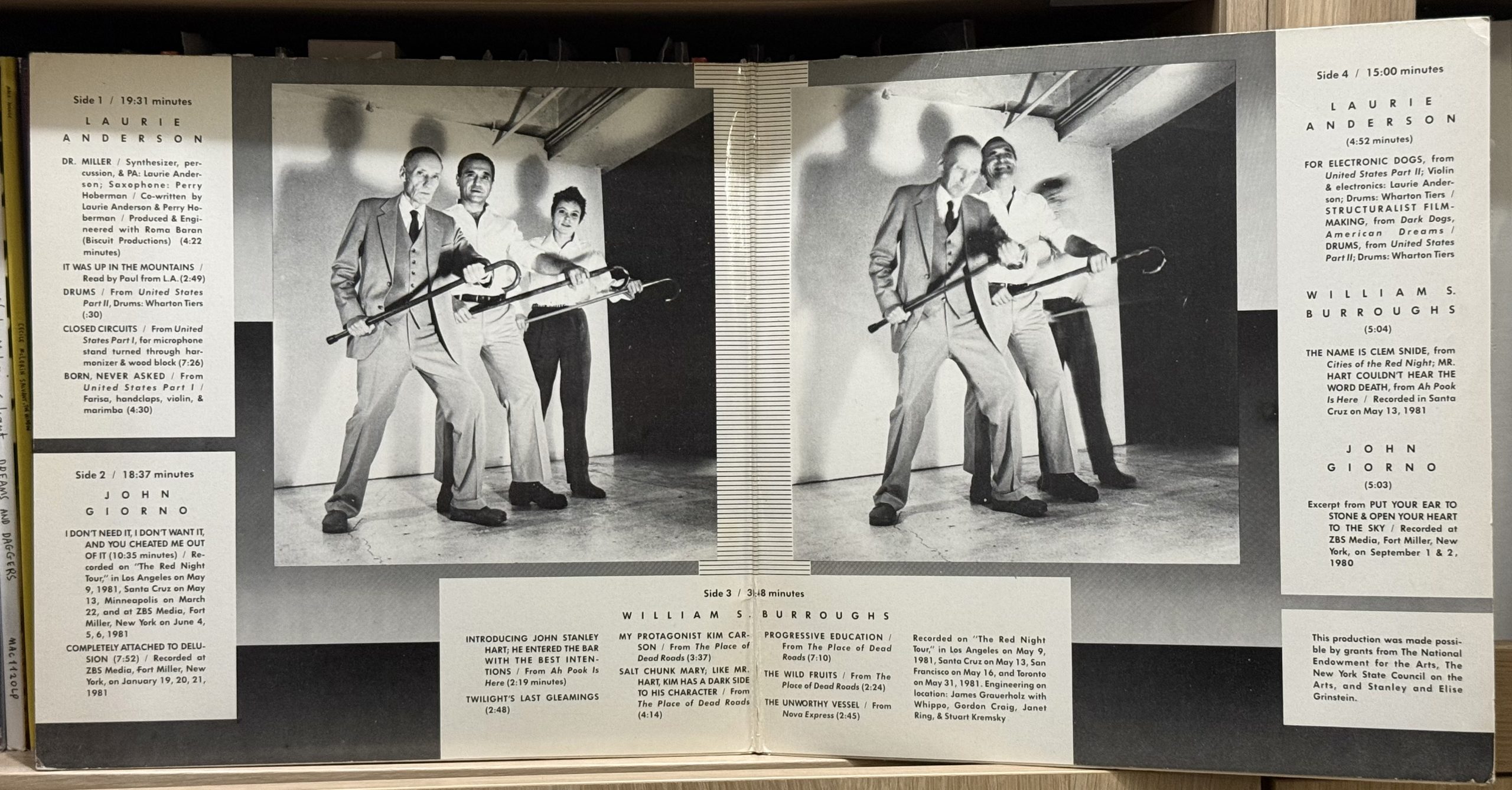
Burroughs gets the next side, giving a series of readings from his novels, including the first appearance of his horrifically funny Dr. Benway (“Dr. Benway, ship’s doctor, drunkenly added two inches to a four inch incision with one stroke of his scalpel… ‘Perhaps the appendix is already out, doctor?’ The nurse said, appearing dubiously over his shoulder. ‘I saw a little scar.’”) But listening to the material one after another, one draws the following conclusions: that half the joy in listening to Burroughs comes from the sheer naughtiness of it and the joy he takes in elongating the sneering tones of protagonist and antagonist alike; that beneath that sneer lurks a pointed and deadly serious battle against inhumanity, stupidity and senseless violence; and that the non sequiturs introduced by Burroughs’ “cut up” method of literally cutting and pasting his writing together into new alearic combinations can sometimes be the only defense against a nonsensical and fragmenting world.
The most unusual feature of the album is its tracklist. Each of the performers takes up a side from 1 to 3, but the fourth side is something else again, featuring three independent grooves about five minutes each. Which one you get depends on where you drop the needle. Laurie’s contribution is a montage featuring two electronic percussion numbers (“For Electronic Dogs” and “Drums”) sandwiching an earnest young man reading a short bit over some cheery library music. “Structuralist Filmmaking” is one of Laurie’s most dryly funny bits; I wonder how much of its narrative was inspired by Burroughs’ cut-up method.

Taken together, the two hours of You’re the Guy I Want To Share My Money With are by turns funny, bracing, moving, and occasionally maddening. The connection from Laurie Anderson’s experimental synthesizers and samples to Peter Gabriel’s increasingly rhythmic art-pop sensibility is hard to see at this stage. But in next week’s album, we’ll see the bridge begin to be built, and it starts with that other 1981 Laurie Anderson release.
You can listen to this week’s album here:
BONUS: Giorno was one of a group of artists in Burroughs’ orbit when he returned to New York City in the 1970s, and later lived in the windowless apartment (dubbed “The Bunker”) where Burroughs lived and wrote and shot pistols for target practice (!). Here he gives a tour through the Bunker, which was restored to the way it was when Burroughs lived there after the latter’s death:
Footnotes
- For those for whom this sort of stuff is fascinating, her 1994 book Stories from the Nerve Bible offers a great look at all the wonderful weirdness of her performance art days. ↩︎
- Somewhat to my amazement, not only is Giorno Poetry Systems still online, but so is the web version of Dial-A-Poem. ↩︎
- The Soft Machine later lent its name to an English progressive-rock group that included about twenty musicians among its membership in its lifetime, including Rick Wakeman (later of Yes), Andy Summers of the Police, and Peter Gabriel’s occasional saxophonist Dick Morrissey. ↩︎
- Pun intended. ↩︎
Should have mentioned that the running order on vinyl (as I reviewed it here) is not only indeterminate thanks to that fourth side, it also differs significantly from the running order on the CD reissue.