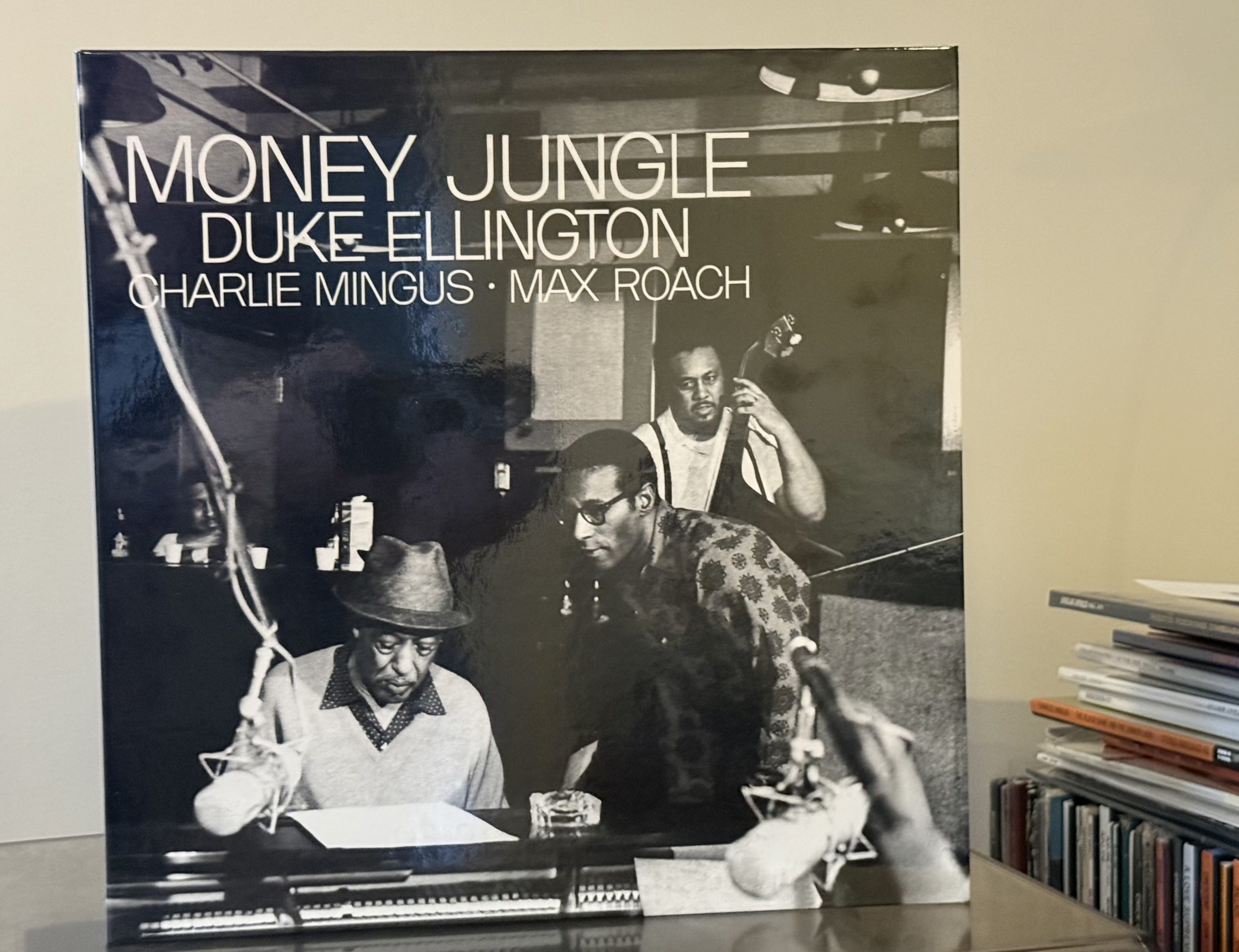
Duke Ellington/Charles Mingus/Max Roach, Money Jungle

Legendarily tense and extraordinarily beautiful, this rare Mingus trio album repays close listening.

Album of the Week, January 17, 2026

If you listen to enough music, you’ll inevitably hear about those albums that almost never happened because of drama during the recording sessions. The bands who come up in this kind of conversation might be the Beatles, Metallica, or Fleetwood Mac; it’s less common to hear about jazz players coming to blows. And then, there’s Charles Mingus. Never an easygoing guy at the best of times, Mingus’ legendary temper almost ended what turned out to be one of his most legendary sessions prematurely.

It started with the logistics of the session. In 1962 Duke Ellington came to producer Allen Douglas, who was then working at United Artists Records, to see about doing a piano trio session. Douglas was excited and suggested Charles Mingus, who had been in Ellington’s band, as the bassist; Ellington agreed, and Mingus suggested bringing in Max Roach, with whom he had worked in Charlie Parker’s band, as drummer. Ellington didn’t have a recording contract at the time, so they used Mingus’s contract. Ellington suggested to the men that they think about what tunes they might like to record, and said they needn’t be Ellington compositions.

On the day of the session, Ellington came in with a sheaf of scores, including four new tunes written for the occasion. History doesn’t record Mingus’s reaction, but one suspects he could feel the session slipping away from him and he was frustrated. As the session got more and more tense with each song, he reportedly argued, with Ellington, Roach, or both, eventually leaving the studio. Stories vary about whether Ellington caught up with him at the elevator or the street, but Mingus was eventually persuaded to return and finish the session.

To say you can hear the tension in “Money Jungle,” the opening track in the album’s running order as released,1 is an understatement. Mingus opens with four bars, opening with the low subdominant of the minor scale followed by two hard pizzicati an octave up. Hard is also an understatement; he bends the strings so hard that the pitch distorts. Ellington follows with explosive, dissonant chords as Roach plays a circular pattern on the drums. Eventually all the players lock in on a blues, but it’s not an easy journey. Mingus alternates more conventional walking parts, stuttering stabs, and high runs on the bass as Roach drops snare rolls, fills and other surprises in his part. At the end, Mingus abandons any pretense of conventional playing, hammering a series of suspended chords; the pianist waits him out eventually tolling a series of low notes to signal the end. If Mingus was attempting to assert dominance, Ellington appears to have showed that he could go toe-to-toe with him. (It’s thought that Mingus attempted to quit the session after this number.)

Which makes “Fleurette Africaine” all the more surprising. Like the opener, it was written for the album; unlike the opener, it’s a classic Ellington ballad. Mingus plays much more sympathetically here, but still adds new dimensions to the composition, playing shuddering arpeggi to which Roach reacts with polyrhythmic heartbeats and fills. Mingus plays alternate harmonies under the bridge, and the whole thing comes together just above a hush. It’s gorgeous.

Very Special” is another twelve-bar blues, this one far less combative. Here Mingus’s bass improvisations are primarily in the space at the end of the twelve-bar repeat, or under Ellington’s third and fourth solo verses. That’s not to say he’s not innovating; some of the rhythmic patterns are quite striking, and the trio locks in on an improvised secondary rhythm during the bridge. But compared to the apocalyptic feel of “Money Jungle” it’s left in a supporting role on the album. It’s followed by “Warm Valley,” with the first verse played solo by the pianist. A classic Ellington composition, named after a landscape feature he saw from the train in Oregon that reminded him of a reclining woman, here it’s a duet with the bassist, with only subtle brush work by Roach adding atmosphere.
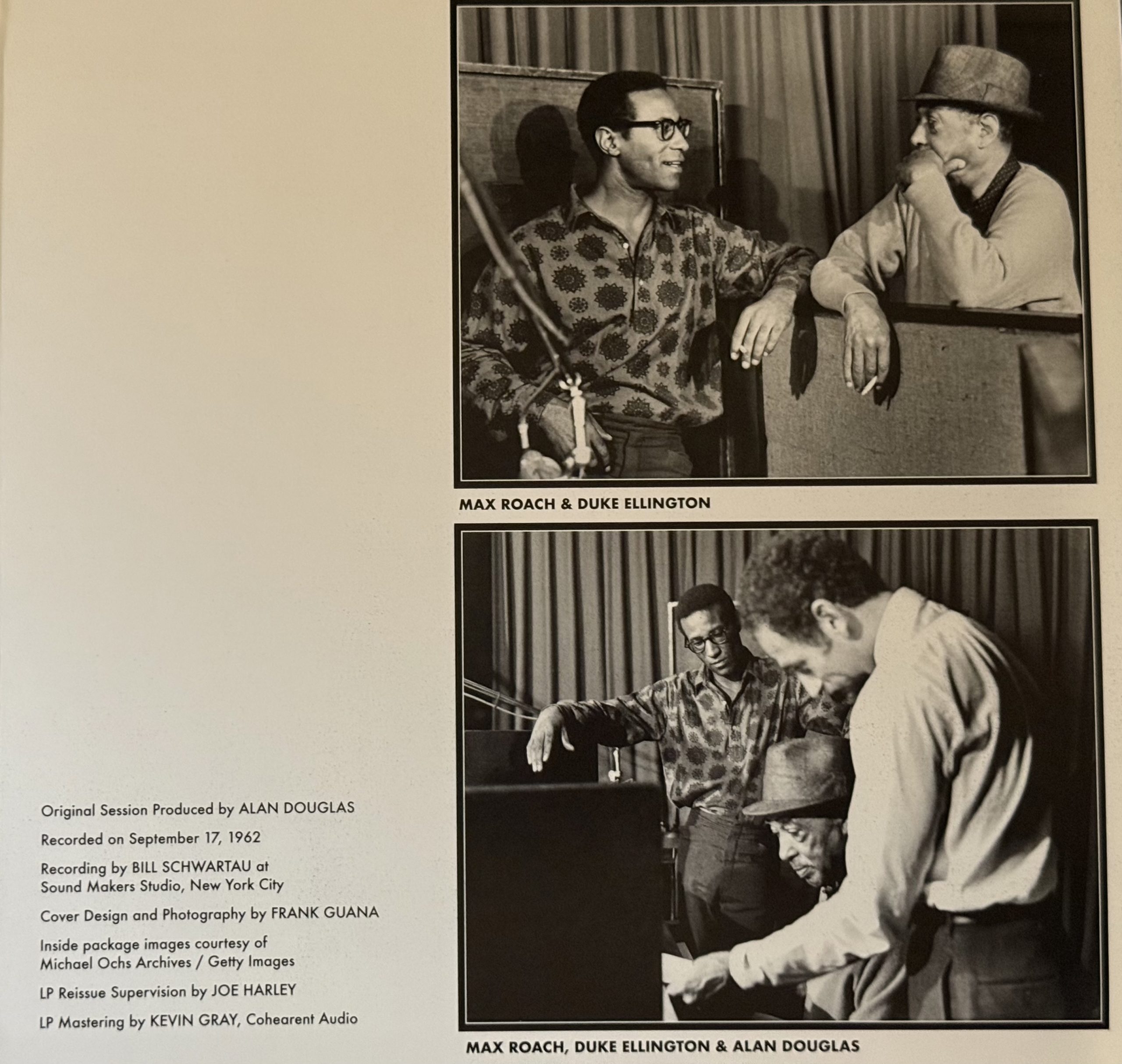
Wig Wise” is the last of the newly written works for this session. A classic Ellington tune, it unfolds at first like a Bach improvisation, all pieces in place, but slowly Mingus starts to sound as though he’s slipping a gear, shifting the emphasis on the beat, leaving deliberate holes in the texture, moving the rhythm. He finds a second melody entirely in the bridge, and responds to the gap left by Ellington at the end of each verse with a different fill each time, finally ending the tune with a plucked glissando up to the highest note on his fingerboard.

Caravan” was written by Juan Tizol, he of the fight that got Mingus kicked out of the Ellington band. It’s unclear whether it’s the association with Tizol or the fact that the number was recorded late in the session, with temperatures already high, but this one also feels like a raised-voice discussion between Ellington and Mingus. The bassist is imaginative in his fills, but there are places where he continues to run in his pattern rather than following the changes in the music, and at the end he and Ellington alternate attempts to close the track out. This is probably Roach’s high point on the album, with explosive statements from the drums and a variety of tonalities from his kit. (I included this track on an Exfiltration Radio show featuring noteworthy bass performances a few years ago.)

The set closes with “Solitude,” again with Ellington opening the tune solo. Whether to offset the explosive nature of the rest of the recording, or just as a reflection of the innate quietude of the track, it feels almost like an interior monologue at the beginning. Mingus supports the pianist with single notes in the second chorus, but as he modulates the tune into another melody the bassist falls silent, rejoining along with Roach as the composer reenters the melody, now forthright and triumphant. At the end, Mingus plays a rolling fanfare over Ellington’s final chords; Ellington puckishly refuses to resolve the harmonies so Mingus finally does it for him as the album draws to a close.
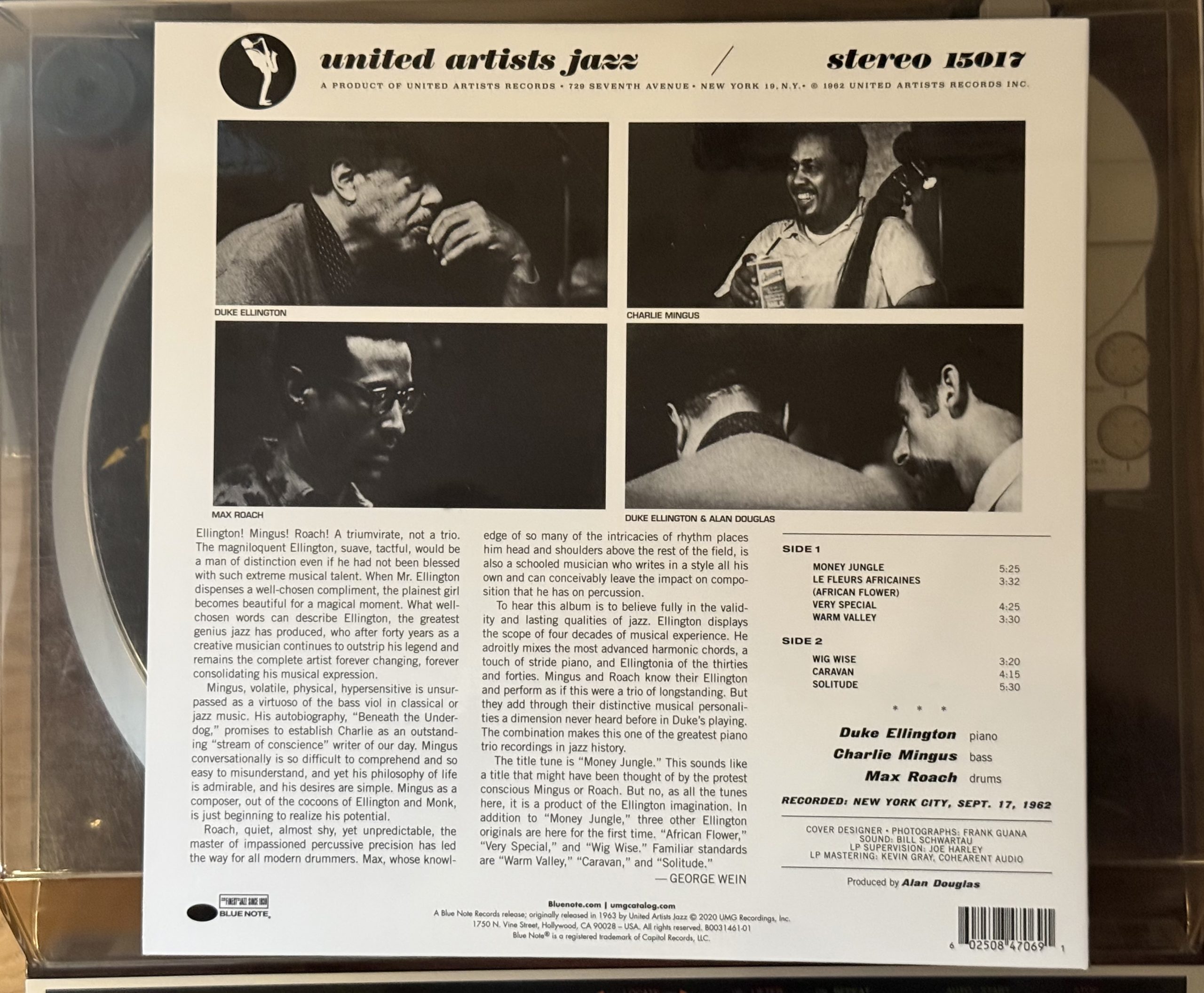
Whatever the tension in the room, Money Jungle is a complete artistic success, a portrait of music being made amid conflict and frustration. It’s also an opportunity to hear Mingus as a performer, apart from his compositions and his band, and to hear his rhythmic and harmonic imagination at play. Next week we’ll hear those qualities in the context of his compositions once more.

You can listen to this week’s album here:

BONUS: The great drummer Teri Lyne Carrington played the whole Money Jungle album live during the 2014 Internationale Jazzwoche (jazz week) in Burghausen, with a sextet that included Aaron Goldberg on piano, Tia Fuller on saxophone, flute and vocals, Antonio Hart on saxophone and flute, Claus Reichstaller on trumpet, and James Genus on bass. Here’s the title track:

BONUS BONUS: “Fleurette Africaine” has entered the repertoire, with recordings by Gary Burton, Horace Tapscott, Vijay Iyer, and many others. Here’s a 2017 version with Norah Jones on piano and vocals, Brian Blade on drums, and Chris Thomas on bass, from Ronnie Scott’s jazz club in London:

  1. A 1980s reissue sequenced the album by recording order and added alternate takes and bonus tracks; this version is what’s available on the CD. ↩︎
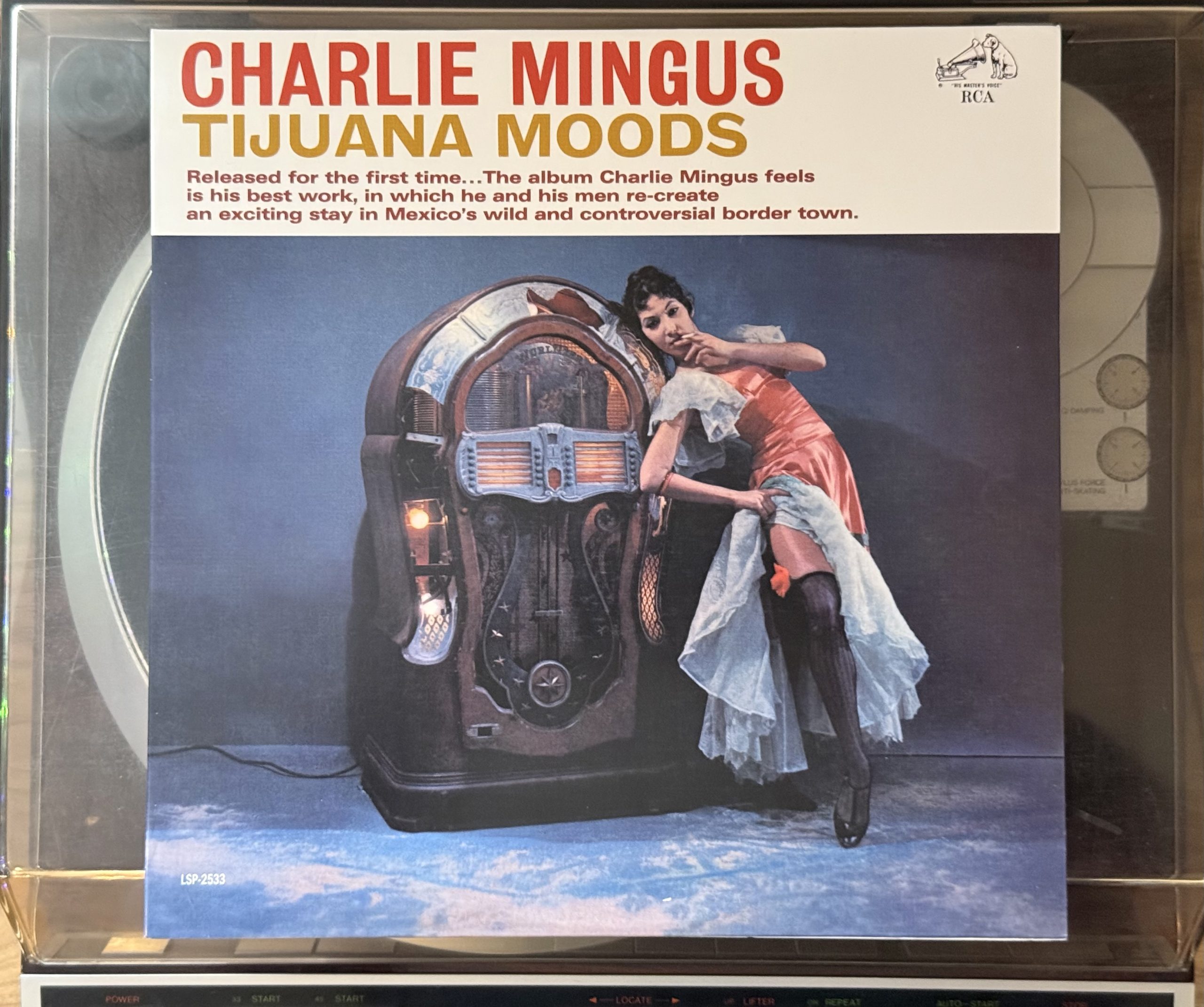
Charles Mingus, Tijuana Moods

A turbulent, magnetic stroll through the border town streets in one of the great bassist’s early long-form suites.

Album of the Week, January 9, 2026

The hazard of writing about jazz records is that you inevitably hit the question: do you write about the records in the order they were released? Or in which they were recorded? This makes a big difference in the order, as many labels would sit on recording sessions for years. Prestige practically made a business plan out of this, recording many sessions with Miles, Trane and others and then releasing the albums when the artists had grown famous—sometimes years later. The same thing happened with today’s Charles Mingus session; recorded in 1957 by RCA Victor, it didn’t see the light of day until June of 1962, following one of his most eclectic and eccentric albums, Oh Yeah.

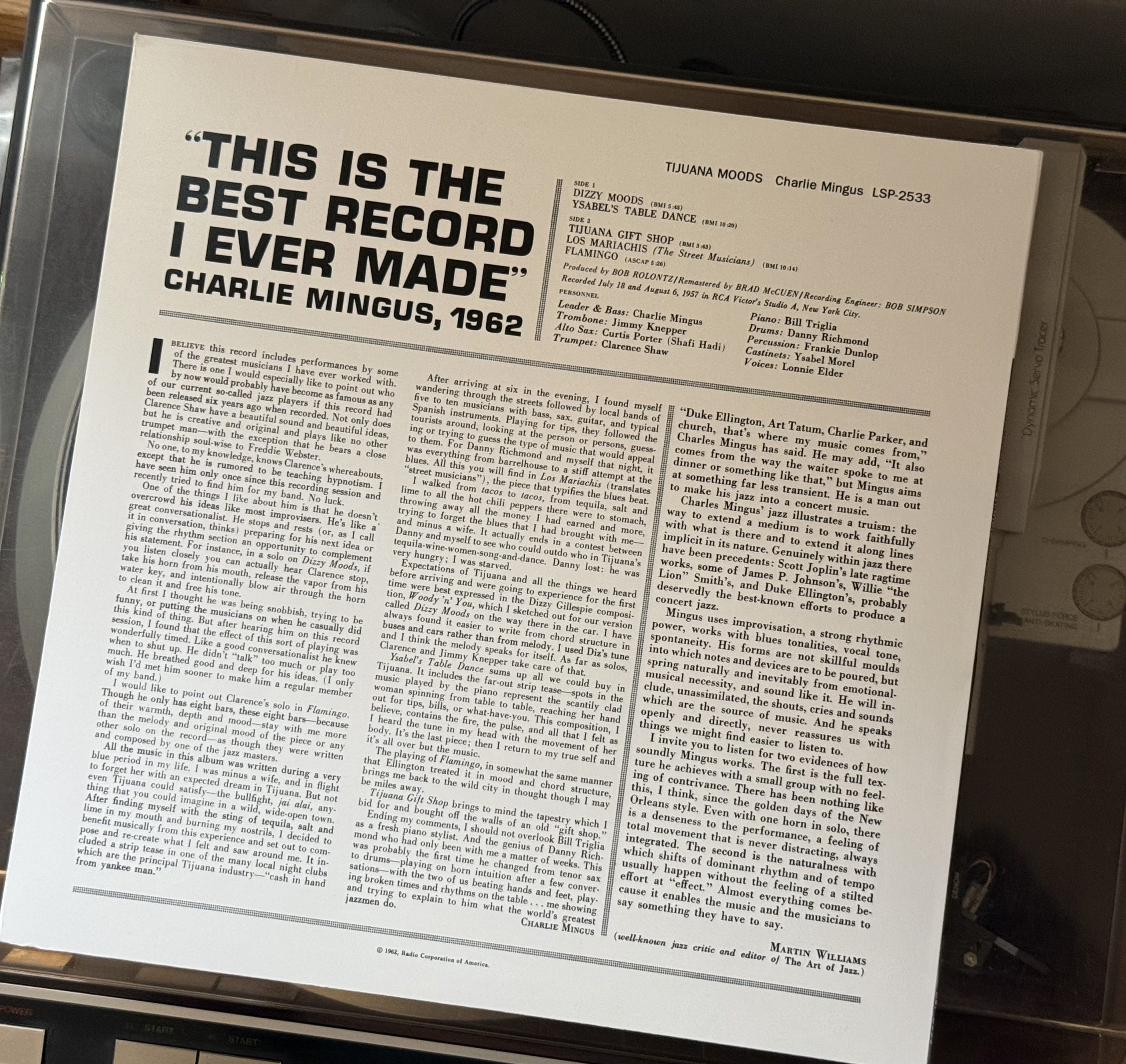
The group heard on the album is a mix of Mingus stalwarts, including Dannie Richmond on drums, Clarence Shaw on trumpet, Jimmy Knepper on trombone, and Shafi Hadi on alto and tenor sax, all of whom performed with Mingus through the 1950s and 1960s; and percussionist Frankie Dunlop and pianist Bill Triglia, both of whom racked up their sole Mingus recording credits on this album. Special note should be made of the contributions of actor and playwright Lonnie Elder, providing “luxury casting” in the blues singing on “Los Mariachis,” and especially Ysabel Morel, playing castanets and providing yelps and cries as a flamenco table dancer in her sole recording credit. The album provides a phantasmagorical journey through the South of the Border town through Mingus’s originals and highly idiosyncratic arrangements.

Dizzy Moods,” a Mingus re-arrangement of Dizzy Gillespie’s “Woody’n You,” opens us up with a cockeyed horn fanfare followed by short solos from Mingus, Richmond, and Triglia. The band plays the first verse together, getting an atmosphere highly reminiscent of Mingus’s “Haitian Fight Song” in places. Knepper, Hadi and Shaw all turn in ripping solos, but what ultimately what sets this apart from other large-ensemble jazz of the 1950s (especially Miles and Birth of the Cool) is the feeling that the group’s playing might edge into chaotic noise at any moment. Indeed, there’s enough menace in the playing to recall Mingus’s penchant for fighting, whether the story about him and Juan Tizol that we talked about last week, or his turbulent relationship with other musicians—including some on this record.

Ysabel’s Table Dance” is a tequila-tinged tour de force of a composition, the rhythm alternating between Morel’s castanets, sounding like a sped-up toreador battle, and the band’s more relaxed swing temp0. Mingus accompanies Morel’s initial foray with an emotive solo, played both arco and pizzicato like a large cello. There are what seem to be hard cuts from one section to another,1 as Hadi, Shaw and Knepper all take brief statements of the melody at something approaching warp speed. A melancholy solo from Triglia stops time, and the band returns in a swinging slow four. The final few minutes find a synthesis of the band’s melody and Morel’s Iberian dance, with Mingus accompanying the castanets with a col legno riff of his own.

Tijuana Gift Shop” opens with a brisk riff by Richmond and Dunlop, followed by a playful melody in the horns that seems to embrace the wild energy of the town; Mingus’ notes state it was inspired by a tapestry that he “bought off the walls of an old ‘gift shop.’” The band engages in some inspired collective improvisation, with hardly any single-horn solos until Hadi’s lovely melody at the end, sounding a closing cadence reminiscent of Miles’ Sketches of Spain (still three years in the future when this album was recorded!).

Los Mariachis” evokes the visitors walking through the streets of town until they are stopped by a group of horns playing a sad ballad. Mingus’s bass propels a slow blues beat into motion, with Shaw and Knepper limning the blues melody as Lonnie Elder provides an inchoate blues cry. There’s an abrupt shift of mood courtesy of Shaw’s trumpet as the band strikes up a more traditional mariachi melody, albeit one with the horns playing in multiple musical motifs all at once. We return to the ballad once more before launching into a more modern dance, which becomes a tender moment scored by Knepper and Triglia. The blues and the modern dance alternate through to the end of the track, but ultimately the blues wins out.

Ted Grouya’s “Flamingo,” given a far more expansive reading here than when I last wrote about it on Wynton’s Standard Time Vol. 3, has its melody sketched out by Shaw and Hadi in a completely free moment, the players pulling the melody out of the late night air. Knepper plays a heartfelt solo on the bridge, punctuated by a dissonant blast from the horns as the tune turns the corner into the chorus. The overall impression is of a quiet early morning rendezvous, with the romance punctured by bursts of sound spilling out as a door opens and a patron reels into the night air, bringing Mingus’s tour of the wild town to a close.

Mingus is said to have stated, on the occasion of Tijuana Moods’s release in 1962, that it was “the best record he’d ever recorded.” While that is highly debatable (Mingus Ah Um, anyone?), it does provide a highly coherent, if kaleidoscopic, view of his compositional talents in these longer-form songs. As noted, many of the musicians began longer journeys with Mingus with this album; Dannie Richmond in particular had switched to the drums from the saxophone shortly before this recording. Not all the relationships would last; Mingus notoriously punched Knepper in the mouth during an argument later in 1962, damaging his teeth and his embouchure, an injury that affected his playing and required years for him to recover from. We’ll hear another notoriously argumentative—but brilliant— Mingus recording next time.

You can listen to this week’s album here:

BONUS: There are relatively few live performances of the material from this album, making this 1964 Copenhagen performance of “Ysabel’s Table Dance” (minus Ysabel, and castanets!) highly interesting:

  1. A 1986 reissue notes that there are hardly any complete takes from the original sessions; the tracks were assembled from something like 21 takes of the five songs. ↩︎

Charles Mingus, Charles Mingus Presents Charles Mingus

We begin our survey of the great bassist and composer in midstream, with a spectacular performance from the last days of one of his best bands.

Album of the Week, January 3, 2026

There is a danger, with larger-than-life musicians (or really any public figures), that you remember them as caricatures, not for the balance of what made them great but for the quirks that stand them out from the crowd. Such a figure is Charles Mingus, about some of whose albums we’ll write about for the next little bit. Undeniably a genius and a great composer and performer, it’s tempting to remember him for his rages1, for the impenetrability of his performances,2 and for his wild Epicureanism that launched such monuments of excess as his legendary eggnog recipe. As always, the curative is simple: let’s listen.

As I’ve lamented before, the scope of this series of posts about music is limited, by design, to the contents of my vinyl collection. If that were not the case, we might start with a different Mingus recording: Pithecanthropus Erectus, for instance, or certainly his 1959 masterpiece for Columbia Records, Mingus Ah Um. But neither of those records is on my shelf at present, so we’re going to start with a slightly unconventional choice, a record that Mingus made at a time when both Atlantic and Columbia were releasing his albums but that he chose to release on the small Candid Records label, to give a less filtered view of his work.

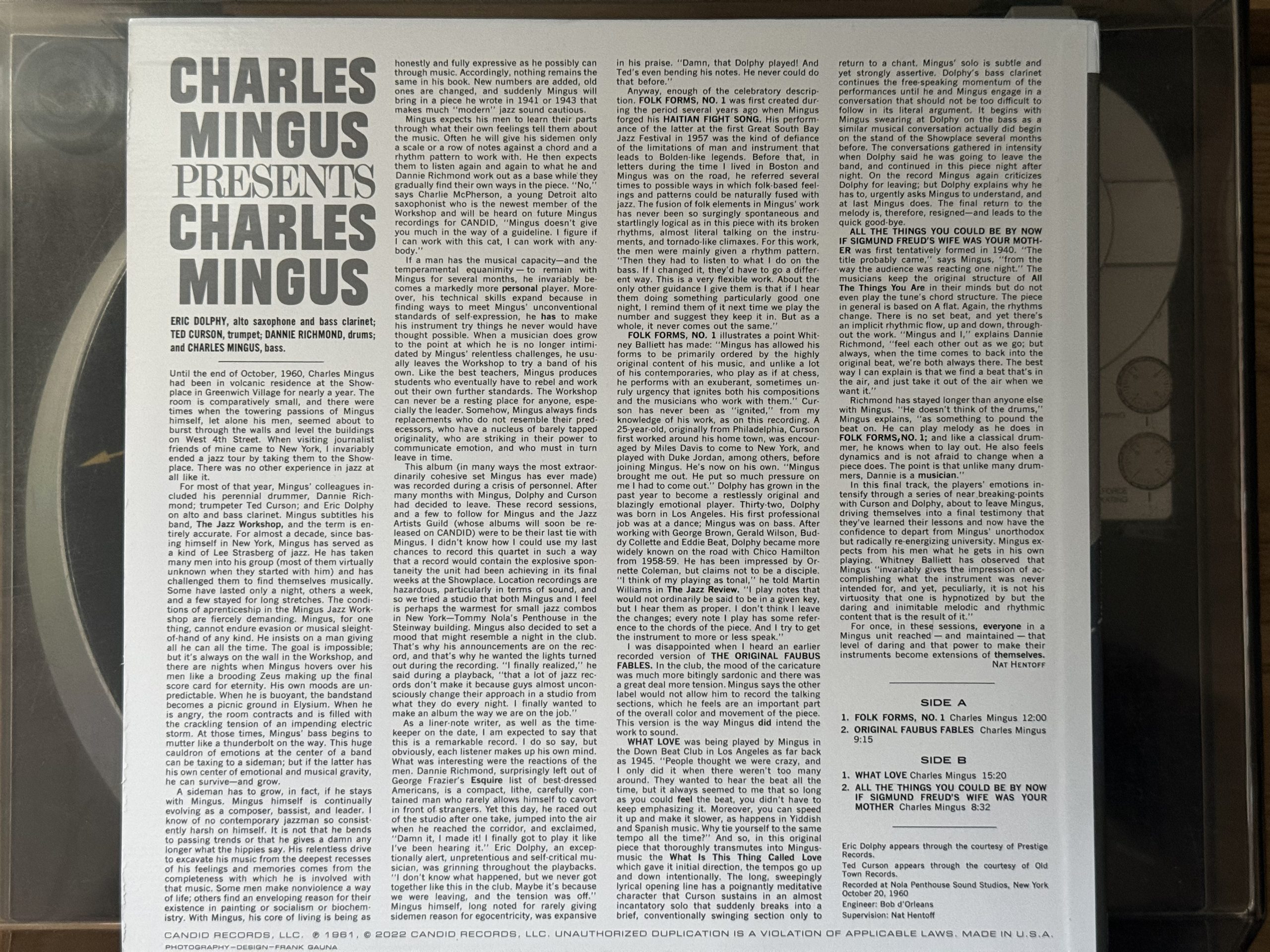
Candid, founded in early 1960 by parent label Cadence Records owner Archie Bleyer, had as its A&R director jazz writer and critic, and civil rights activist, Nat Hentoff. He sought out sounds that, to him, reflected the jazz of the dawning 1960s. The second album the fledgling label released was Max Roach’s milestone civil rights suite We Insist!; Mingus, Roach’s former rhythm section partner in Charlie Parker’s combo, released the fifth album in the series with a pianoless quartet consisting of multi-instrumentalist Eric Dolphy, trumpeter Ted Curson, and drummer Dannie Richmond. Though recorded in the studio in October 1960, Mingus sought to present the illusion that the performance was happening live in a nightclub, going so far as to introduce the first tune with the admonition not to applaud between tracks and to refrain from ordering food and drink during the recording. Generally speaking, his approach to the album (as indicated by the title) was to take control of the way his own music was typically presented to the public.

The first tune is titled “Folk Forms, No. 1;” the “folk form” in question is the blues. Mingus had a complicated relationship with the blues; he was clearly conversant with the form and the feel of the blues, but just as clearly resented the insistent demands that he play more blues and less of his own music.3 However he felt about it, this is a deep blues. Mingus starts the song solo, with a rhythmic figure in the bass that is slightly reminiscent of the opening to his great tune “Better Get Hit In Yo’ Soul.” Richmond follows him, listening to his rhythm and replicating it in snare and hi-hat. Dolphy follows with an essay at the melody, and Ted Curson plays a counterpoint to the melody; the two horns trade ideas and thoughts as though executing a complex fugue, but the lines are all improvised, the group turning on a dime as Mingus proposes different phrases and rhythms in his solos.

Original Faubus Fables,” a retitling of the 1959 “Fables of Faubus” for contractual reasons, is the most clear case of Mingus presenting his music the way he wanted it to be heard. The original version of the tune had lyrics that were highly critical of Arkansas governor Orval Faubus, who legendarily called out the Arkansas National Guard to prevent Blacks from enrolling in Little Rock High School following the 1957 federally mandated desegregation order. Columbia Records was legendarily cowardly about putting out any records that would offend the Southern buyer, and requested that Mingus present the song as an instrumental; this conflict and others possibly led to Mingus not extending his recording contract with Columbia beyond the two records released in 1959. The lyrics are not exactly epic poetry, but they resonate:

Name me someone who’s ridiculous, Dannie
Governor Faubus!
Why is he so sick and ridiculous?
He won’t permit us in his schools!
Then he’s a fool!

Boo! Nazi Fascist supremists!
Boo! Ku Klux Klan (With your Jim Crow plan)

Name me a handful that’s ridiculous, Dannie Richmond
Bilbo, Thomas, Faubus, Russel, Rockefeller, Byrd, Eisenhower!

Don Heckman has commented that Mingus doesn’t let his portrait of Faubus give the politician too much power; he keeps the music on a light, satirical level, poking fun at Faubus rather than demonizing him.

What Love?” is an original composition that approximately combines “You Don’t Know What Love Is” and “What Is This Thing Called Love?” Hentoff’s liner notes position this deep dark ballad as being inspired by a personnel crisis in the band; after many months together, both Dolphy and Curson had decided to move on from Mingus’ band, and Hentoff cites some of the melodic choices in “What Love?” as conversations between the bandleader and his saxophonist, alternately cursing the choice to leave and imploring him to stay. Dolphy plays some far-out music on the bass clarinet in this number in conversation with Mingus’s angry, imploring, and ultimately resigned pizzicato solo.

The final track, “All The Things You Could Be By Now If Sigmund Freud’s Wife Was Your Mother,” is a complete free-for-all, introduced by a complex melody played by both Dolphy and Curson in harmony before the trumpeter takes the first solo, followed by Dolphy, with Richmond banging things out underneath both. This performance shows Mingus at his most far-out. There isn’t much of his genius for melody or harmony here, just him and his three players going flat-out in a wunderkammer of improvisational magic.

Mingus’s many facets as a musician included the ability to collectively improvise with his band at the highest order, and …Presents Charles Mingus is a great example of that. But he might have been even more effective and innovative as a composer of longer works, and we’ll hear one of those next week.

You can listen to this week’s album here:

BONUS: This quartet doesn’t seem to have too many live shows recorded, but an expanded version of the band, adding Booker Ervin on tenor and the amazing Bud Powell on piano, played the Antibes Jazz Festival on July 13, 1960, five days before the quartet entered the studio to record …Presents…. It’s a monster of a live recording; here’s “I’ll Remember April” from the French TV presentation of the concert.

  1. Mingus was legendarily fired from Duke Ellington’s band in 1953 over a confrontation with trombonist Juan Tizol. Accounts differ as to what happened exactly; Mingus’s autobiography Beneath the Underdog claims Tizol impugned his musical abilities while using the N-word, while other onlookers claim Mingus was insulted when Tizol called him out for flubbing a note. It is pretty clear from all accounts, though, that Mingus rushed after Tizol with either a pipe or a fire axe in his hand. ↩︎
  2. Mingus premiered his major work Epitaph in 1962 at Town Hall in New York City to mixed reception. Again, accounts differ as to what happened, but poor sound at the venue and a general state of under-rehearsedness on the part of the band appear to have doomed the original performance. The concert was later released on Blue Note Records in the 1990s, when I was first expanding my jazz horizons; I thought it was pretty good. ↩︎
  3. In the liner notes to his 1960 Atlantic Records session Blues and Roots, Mingus noted, “This record is unusual— it presents only one part of my musical world, the blues. A year ago, Nesuhi Ertegün suggested that I record an entire blues album in the style of ‘Haitian Fight Song,’ because some people, particularly critics, were saying I didn’t swing enough. He wanted to give them a barrage of soul music: churchy, blues, swinging, earthy. I thought it over. I was born swinging and clapped my hands in church as a little boy, but I’ve grown up and I like to do things other than just swing. But blues can do more than just swing. So I agreed.” ↩︎