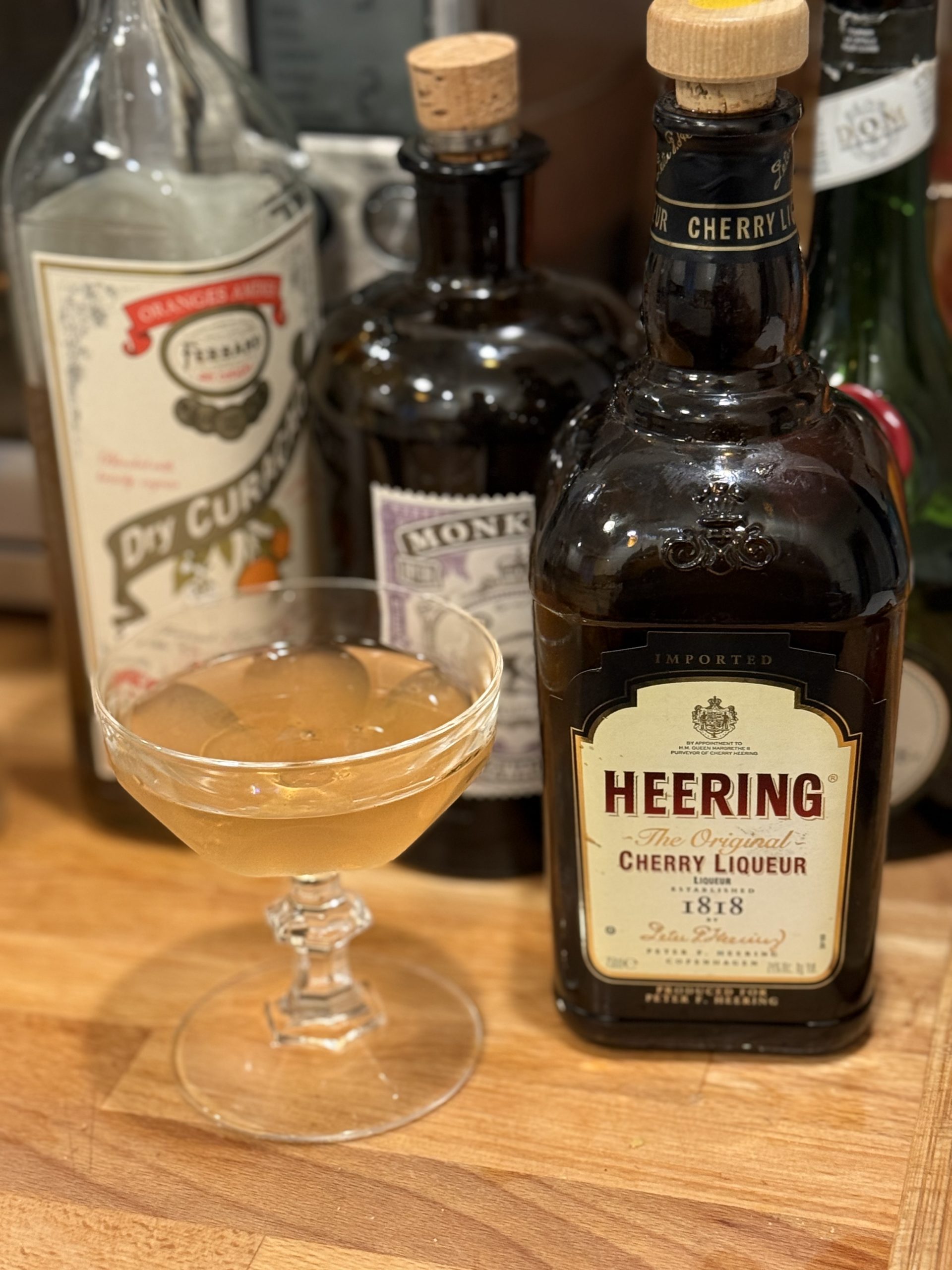
Cocktail Friday: Et Vitam Martuni

In which we create a cocktail to accompany Beethoven’s massive Missa Solemnis.

I have gotten something of a reputation among my fellow members of the Tanglewood Festival Chorus for creating cocktails that go with our major performances. So the speculation started early about what the cocktail would be that would go with this week’s performances of the Beethoven Missa Solemnis. This post is an attempt to document my creative process for these cocktails, in case any brave souls want to follow in my footsteps.

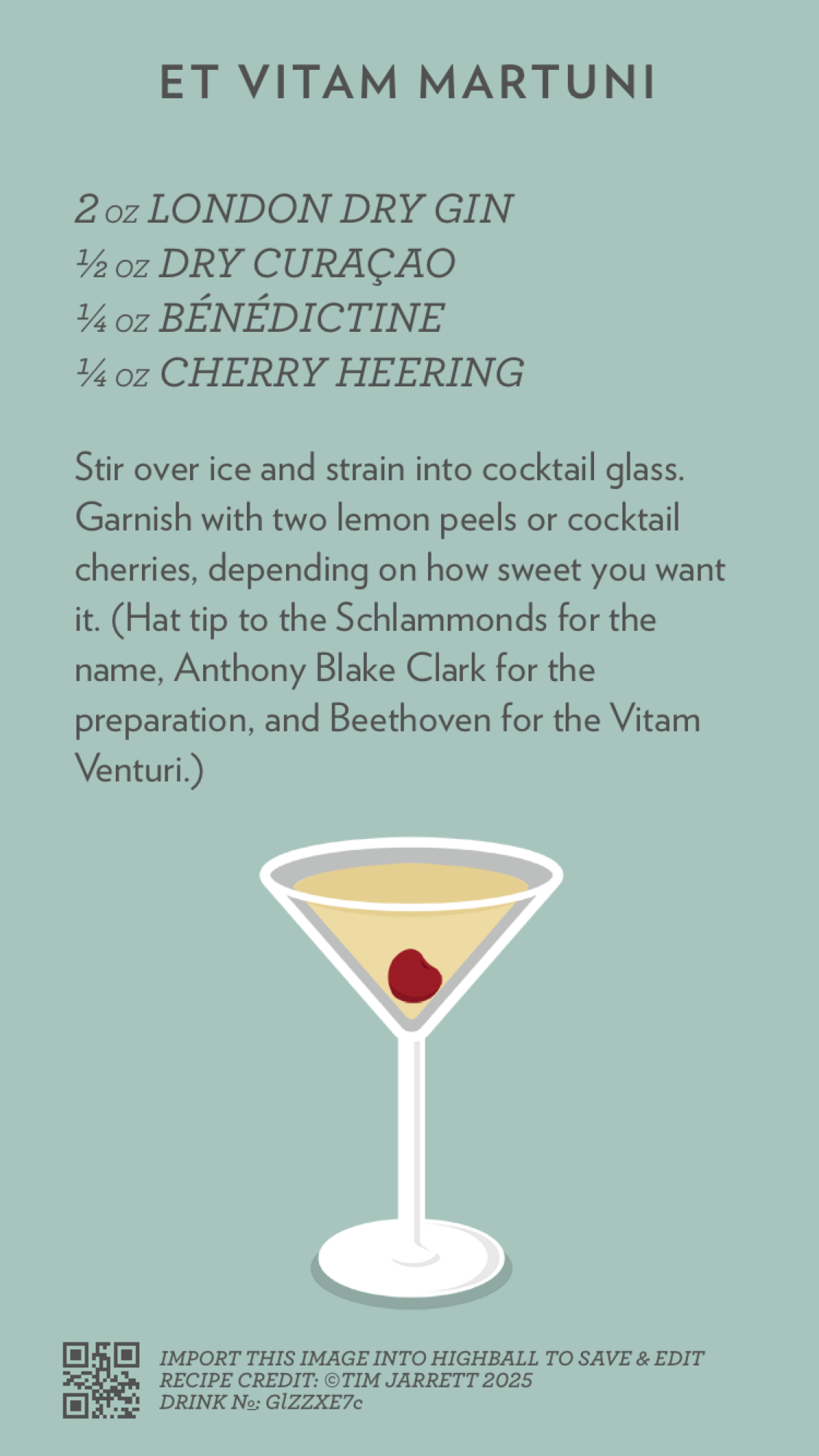
Name: Almost always, the name comes first, and almost always it’s a quote or a pun from the text of the piece. (Cf: Promisistini, Veni Creator Spiritous, Aufersteh’n, Sugar Rum Cherry No. 1 and 2.) So with this piece, it had to be “Et Vitam Venturi,” the part of the “Credo” that supports not one, but two fugues. And through the process of elimination, it became “Et Vitam Martuni,” because it was funnier than either “Et Vitam Martini” or “Et Vitam Negroni” (the two leading contenders).

Composition: So what was an “Et Vitam Martuni”? I started out using the Martini as a base, but it turns out that the liqueurs I pulled off my shelf did not go well with the Martini. At first I blamed it on the liqueurs; as I wrote to my collaborators on this cocktail, “The combination of vermouth and Cherry Heering does not work at all. I should have known better; with Beethoven, the Heering is never good.”

But it turns out I was blaming the wrong ingredient, and a shift in focus was beneficial. By reformulating the drink as an approximation of the Martinez—i.e. not requiring white Vermouth—I was able to make the ingredients work, even the Cherry Heering. So here’s to the “Et Vitam Martuni,” the drink so good you’ll want to have it twice, once slow and once damned fast.

Special thanks to my collaborators on this one, the Schlammonds, who suggested the name and were my rubber duck as I thought through the combinations. And special thanks to the TFC and our guest conductor, Anthony Blake Clark, who is the reason that the drink recommends a pair of something for the garnish.

As always, you can use the recipe card with Highball. Enjoy!
Mozart Requiem, and the Promisistini

Last night, my friends in the Tanglewood Festival Chorus and I wrapped up a series of performances of the Mozart Requiem with the Boston Symphony Orchestra (Dima Slobodeniouk conducting—we had previously sung Grieg’s Peer Gynt with him; Erin Morley, soprano; Avery Amereau, mezzo; Jack Swanson, tenor, substituting for Simon Bode who couldn’t get a visa; and the redoubtable bass Morris Robinson returning after performing it with the BSO in 2017). I had last sung the Requiem with Michael Tilson Thomas at Tanglewood in 2010 and in Symphony Hall in 2009 (with Shi-Yeon Sung substituting for an ailing James Levine), and before that in 2006 at Tanglewood with Levine; before that, I performed it in Bellevue, Washington, with the Cascadian Chorale in 2002 as part of a commemoration of the first anniversary of 9/11.

Which is to say, the piece and I have history.

What was distinctive this time (as my colleague Jeff Foley notes) was the amount of time we were able to spend refining our approach to the music and making effortless parts that often end up barked or belted in other performances. The work appears to have paid off, as the Globe specifically cited the sound of the tenors as a highlight of the performance: “With the ‘Requiem,’ the Tanglewood Festival Chorus gave a stunning and profound display of unity. Their quality of performance has been on a distinct upswing lately, and the fruits of their work showed in the precise intonation in the ‘Kyrie,’ explosive dynamic variation in the ‘Dies Irae,’ and elegant phrasing in the ‘Lacrimosa’ — staples of the choral repertoire where rough patches tend to make themselves visible. The tenor parts of the ‘Requiem’ choral book can be especially punishing, and the TFC tenors deftly shouldered the demands, letting their high notes bloom.”

Which is to say, that calls for a cocktail! This one borrows its title from the “Quam olim Abrahæ” fugue, which appears at the end of both the “Domine Jesu” and the “Hostias,” and I couldn’t resist a Martini variant. This is based on Louis Muckensturm’s “Dry Martini” from 1906, one of the only ones I know that uses curaçao.

The Promisistini can be as dry as you like, depending on the ratio of vermouth to Curaçao.

As always, you can import the recipe card photo into Highball. Enjoy!

Cocktail: Veni Creator Spiritous

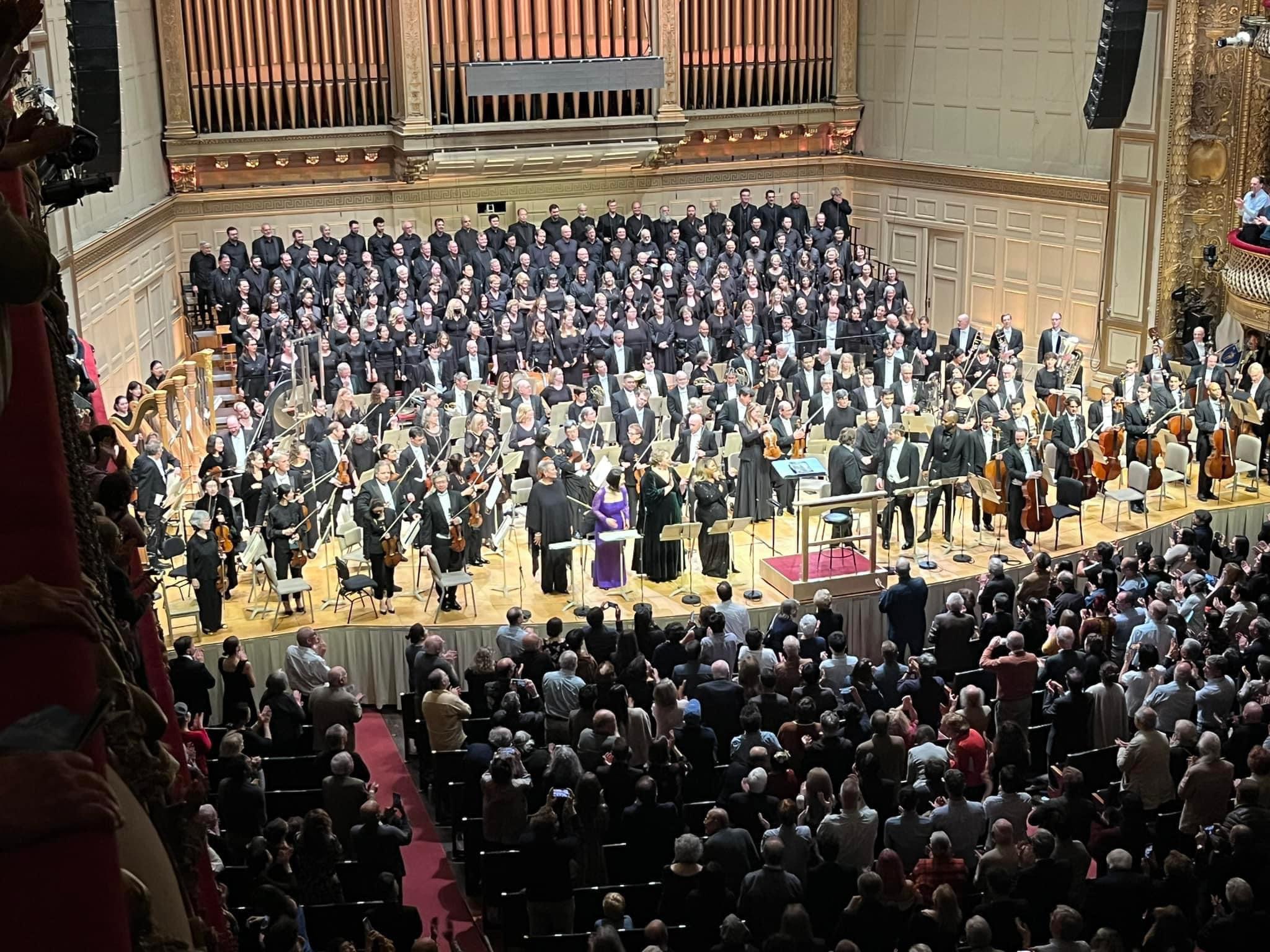
Photo courtesy Boston Globe

We’re doing Mahler’s 8th Symphony this weekend. It’s the first time for me since 2015 and only the second since I joined the Tanglewood Festival Chorus 19 years ago. (I wrote about that experience performing with James Levine, the late great Johan Botha, Deborah Voigt, and Heidi Grant Murphy (the soprano in the rafters) among others, at the time.)

The work remains galactic in its scope and stentorian in its volume. (We have a little grassroots decibel reading practice among the choristers; last night reached “only” 106 from my position on the fifth bench, and we’ve hit as high as 108 in rehearsal.) But it feels different. For one thing, years of in-rehearsal vocal coaching from the TFC’s music director James Burton have made it much easier to sing properly, and “bloomin’ loud” as he’s said on at least one occasion, without screaming. Which is a skill you need if you’re going to be hitting those decibels.

For another, I’m an experienced hand now. While I won’t have a special marking next to my name in the program book until I complete this year plus five more, there are far fewer in the chorus who have a double digit tenure than when I started.

And so, it felt appropriate to mark this weekend’s performances, again, with a special cocktail. As I did for Mahler’s Second, I took inspiration from the text. While it was tempting to just go with the memorable text from Part II’s opening (“Waldung, sie schwankt heran/Felsen, sie lasten dran/Wurzeln, sie klammern an/Stamm dicht an Stamm hinan/Woge nach Woge spritzt…”) and make a “spritzt,” that didn’t feel sufficiently … impactful for a piece that featured two full choirs and boys’ choir, offstage brass, eight soloists, four harps, a harmonium, a pipe organ, and two mandolins. (There were around 300 of us on stage last night.)

So I went with the opening text instead, and made a “Veni Creator Spiritous.” (Groan.) The jumping off point was a Sazerac, but I switched everything up while keeping the overall slightly boozy affect… and, as with the Aufersteh’n, made sure to include herbal liqueurs in honor of Mahler’s vegetarianism.

As always, you can import the recipe card photo into Highball. Enjoy!

Holiday Cocktails: Sugar Rum Cherry Nos. 1 & 2

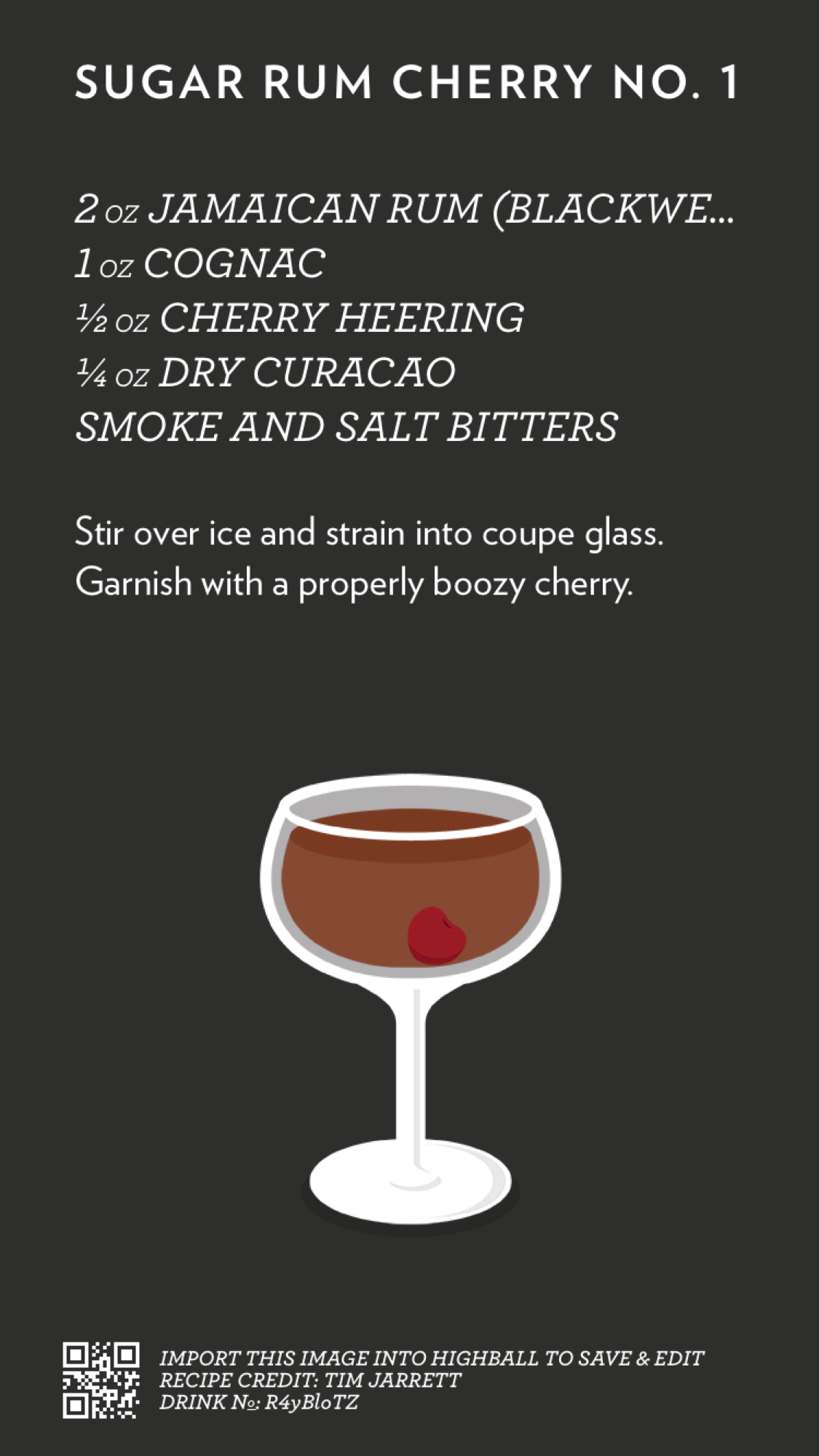
In December 2021, during the first Holiday Pops after a COVID-induced hiatus, the Pops brought out the Duke Ellington/Billy Strayhorn version of the “Nutcracker Suite.” In addition to brilliant jazz orchestration, the work also retitled all the movements—so “Dance of the Reed Pipes” becomes “Toot Toot Tootie-Toot,” “Arabian Dance” becomes “Arabesque Cookie,” and “Dance of the Sugarplum Fairy” becomes “Sugar Rum Cherry.”

Our director suggested from the podium that “Sugar Rum Cherry” sounded like it should be a cocktail, and basically dared me to create that cocktail. So I created not one, but two variations on a theme.

The first (Sugar Rum Cherry No. 1) is boozy and fruity, with a hint of smoke and other flavors rounding out the flavor profile (and, as a chorus colleague said last night, answers the question “What else can you make with cherry Heering besides a Blood and Sand?”). It also uses the lovely smoke and salt bitters (uneuphoniously named “Pooter”!) from Raleigh-based Crude.

The second (Sugar Rum Cherry No. 2) takes loose inspiration from Corpse Reviver No. 2, and pairs Demerara rum with Lillet Blanc and some Maraschino liqueur to provide the “cherry” part.

As always, recipe images can be used with the Highball app.

Suggestion: try one (or both) out while listening to Ellington and Strayhorn swing the Nutcracker. And Merry Christmas!

Cocktail Saturday: Aufersteh’n

He dared me.

When I made a signature cocktail for Holiday Pops one year, I shared some at the end of the run with our long-suffering interim chorus manager, and since then we’ve talked cocktails between performances. I saw Daniel at Symphony Hall while I was there to rehearse a performance of Mahler’s Second Symphony with the Boston University Symphonic Orchestra and Chorus, and he dared me to craft a cocktail for the performance run.

Of course, there was no question about what to call the cocktail. And once we had the name, the inspiration for the recipe was equally obvious.

In the last movement of this Resurrection Symphony, we sing “Aufersteh’n wirst du, mein Staub” (rise again you will, my dust). The utterance is so legendary, coming completely unaccompanied after over an hour of galactically bombastic music, that you just have to mention the word to most singers and they’ll respond with their finest pianissimo: “ja, aufersteh’n!” I had just finished a run of this work the year my daughter was born, and I quietly sang these lines to her the first time I held her in my arms.

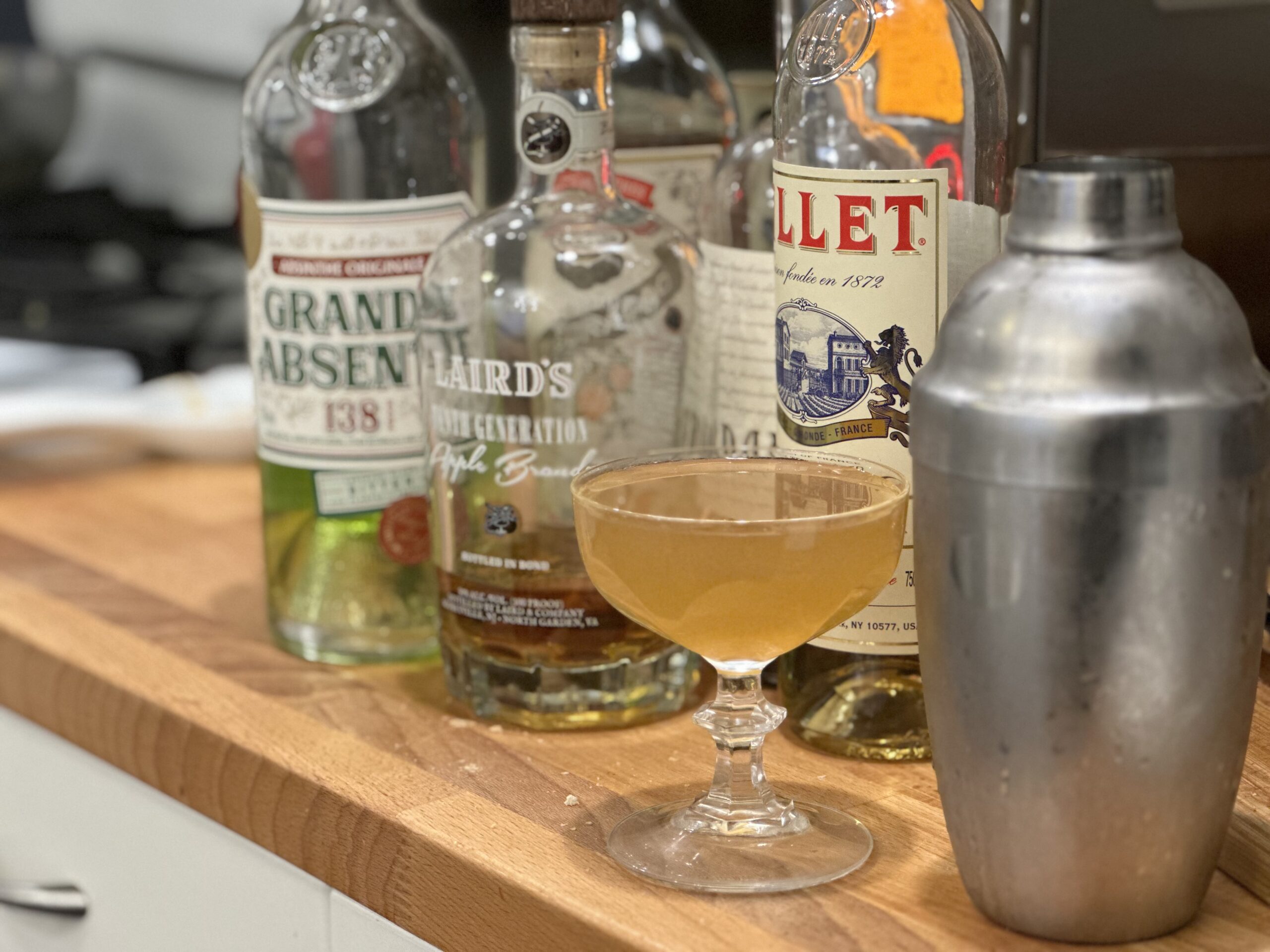
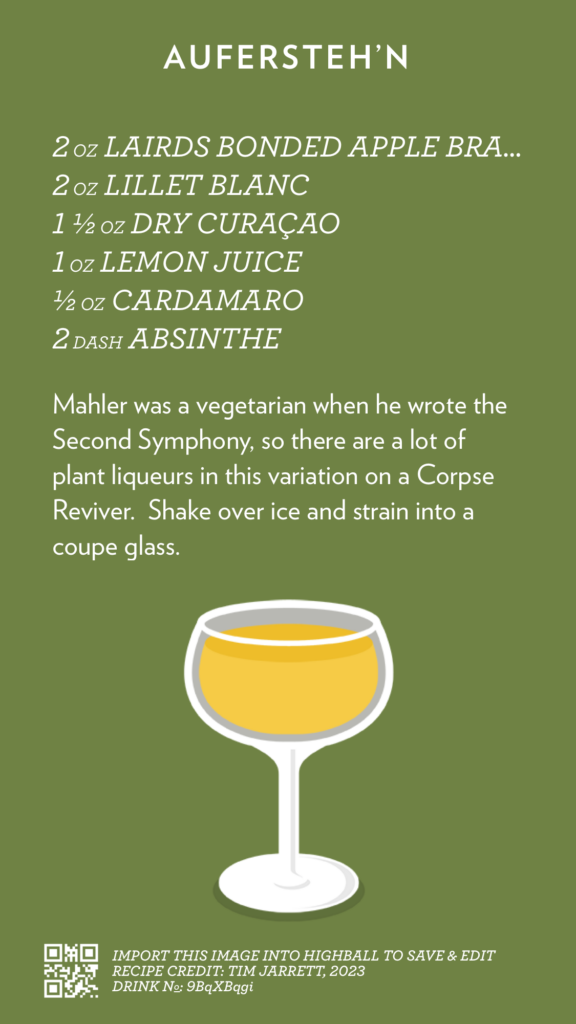
Once I had the name, the base recipe was inevitable. It clearly had to be a Corpse Reviver. (Pause for groans.) But what base spirit? Given that Mahler noisily flirted with vegetarianism in his early years, and preferred spinach and apples to meat, I used 100 proof apple brandy instead of gin, and replaced some of the orange spirit (I used dry curaçao — not blue! — instead of Cointreau) with artichoke based Cardamaro for a little more herbal flavor, and extra plants.

As always, here’s the recipe card for use in Highball. Enjoy!