John Coltrane, Ballads

Album of the Week, February 3, 2024

John Coltrane appears to have taken the criticism of his avant-garde work in the early 1960s to heart. In fairness, being called “anti-jazz” cannot have been good for the tenor’s ego. But Trane was self-aware enough about his work, and conscious enough about his progression as a performer, to have taken a more deliberate step into a different sonic world on this album. Or, as he told critic Gene Lees (as told in the liner notes to this album) when he asked why the change in sound, “‘Variety.’ Meaning a change of pace. And perhaps he wanted to apprise [sic] those who haven’t discovered it [sic] that he can be lyrical.”

Whatever the reason, Ballads is about as lovely and straightforward a reading from the Great American Song Book as you’re likely to find. Recorded in three sessions beginning December 21, 1961, about six weeks after the final recordings at the Village Vanguard that yielded Live at the Village Vanguard and Impressions and still featuring Reggie Workman on bass, and continuing into late 1962 (with the classic quartet featuring Jimmy Garrison, McCoy Tyner and Elvin Jones), the sessions interleaved with recordings for other projects, including Coltrane, Duke Ellington & John Coltrane, and some of the studio recordings for Impressions. Legendarily, the quartet walked into the sessions with a pile of music-store sheet music for the songs, never having played any of them before. Overwhelmingly, the impression is of Coltrane treating his saxophone like a voice and his solos like song.

Say It (Over & Over Again),” a Jimmy McHugh classic, sounds superficially in arrangement like the ballads we’ve just heard on McCoy Tyner’s solo albums, but listen closely and there are cues that Trane is still at the wheel. The suspensions in the pedal bass through the verse, the restraint of the group’s sound overall even as Tyner brings a gentle glissando through the middle of his solo, the opening feels tentative and even a little melancholy. But then comes the key change in the bridge and suddenly there are echoes of some of the soloistic choices on Coltrane’s Sound. The saxophonist’s solo trails off, as if in a reverie, and Tyner follows.

You Don’t Know What Love Is,” by contrast, brings some of the energy in the reading of the head that Trane used in My Favorite Things. But while the vocal sound of the track is full and warm, he keeps the pyrotechnics hidden away in favor of a straightforward reading of the tune. Not to say it’s boring. The syncopation he brings in the major-key middle eight of the tune, the explosions from Elvin Jones’ kit, and most of all the modal rocking in the piano as the group transitions out of the head and into the first solo all place this in the lineage of “My Favorite Things” and “Greensleeves.” Trane’s solo gets more impassioned, bringing bursts of sound from Jones, but then he reels it back in on the final statement of the head, with only (only!) one final octave jump and descending arpeggio to hint at the pathos of the tune. By comparison, “Too Young to Go Steady” is a cheery, straightforward reading of the Jimmy McHugh tune made famous by Nat “King” Cole. Only Jones’ slightly wide-eyed double-time snare work hints at anything more than the tune itself. You’d never know the tune was written (by Gene DePaul, lyrics by Don Raye) for an Abbott and Costello film.

Jones kicks off “All or Nothing At All” with a full kit workout that leads into a modal bass line and comping piano chords. Lees’ liner notes indicate that Trane was trying for an Arabic feeling in this cover of the Arthur Altman tune, and there’s certainly more development in the solo, with hints of the “sheets of sound” glissandos at phrase ends and in the minute-long outro. But where earlier recordings might have had those glissandos climbing for the stars, here they seem to turn inward as the track gradually fades out. It’s another one where you get a sense of the Coltrane of “My Favorite Things” waiting in the wings, but he never quite steps into the spotlight.

Harry Warren’s “I Wish I Knew” gets a quiet and contemplative treatment. Both Jones and Jimmy Garrison are relatively restrained in their accompaniment, while Tyner shows his well-earned reputation for elegance in his brief solo. Trane plays a little with the time in the return of the head, but otherwise plays it absolutely straight. The finest moment of the arrangement might be the two arrivals of a new key in the coda, hinting that the band might just explore the tune forever if you let them.

Bob Haggart’s “What’s New” is given a full verse intro by Tyner playing solo, before Coltrane joins on the melody. While the overall tempo is subdued, Jones keeps just enough pots boiling on the kit that things continue moving into the solo, where Coltrane picks up the energy as well. The band ramps things down almost as quickly as they start. “It’s Easy to Remember (But So Hard to Forget),” a Rodgers and Hart classic, follows closely behind. The only track from that 1961 session on the record, and the only one featuring Reggie Workman, the sound is remarkably of a piece with the rest of the album. Trane perhaps incorporates a little more flourish into some of his playing in the middle chorus, but it’s otherwise a concise statement of the tune, given presence by an Elvin Jones roll of thunder at the end.

Jimmy Van Heusen’s “Nancy (With the Laughing Face)” was originally recorded by Frank Sinatra in 1944 and is named after his daughter, but there are no boots, made for walking or otherwise, in Trane’s treatment of the tune. Trane’s saxophone seems to breathe like a singer, achieving an almost vocal tone. Garrison’s bass is a subtle accompaniment throughout. The band picks up the energy a little in the second bridge, but ultimately closes the tune, and the album, as gently as it started.

Ballads accomplishes its goal of showing a different side of Coltrane. He trades flashy technique for constrained intensity and achieves a different kind of mastery of his instrument in moments like “You Don’t Know What Love Is” and “All or Nothing at All.” Compare the performance to some of Trane’s earlier ballad work, for instance on Lush Life—there’s many fewer notes here, saying just as much if not more. By subtracting some of the complexity of the earlier performances, Trane seems to gain depth and intensity in each of the notes he does play. We’ll continue in this vein with another album from his band next week.

You can listen to today’s album here:
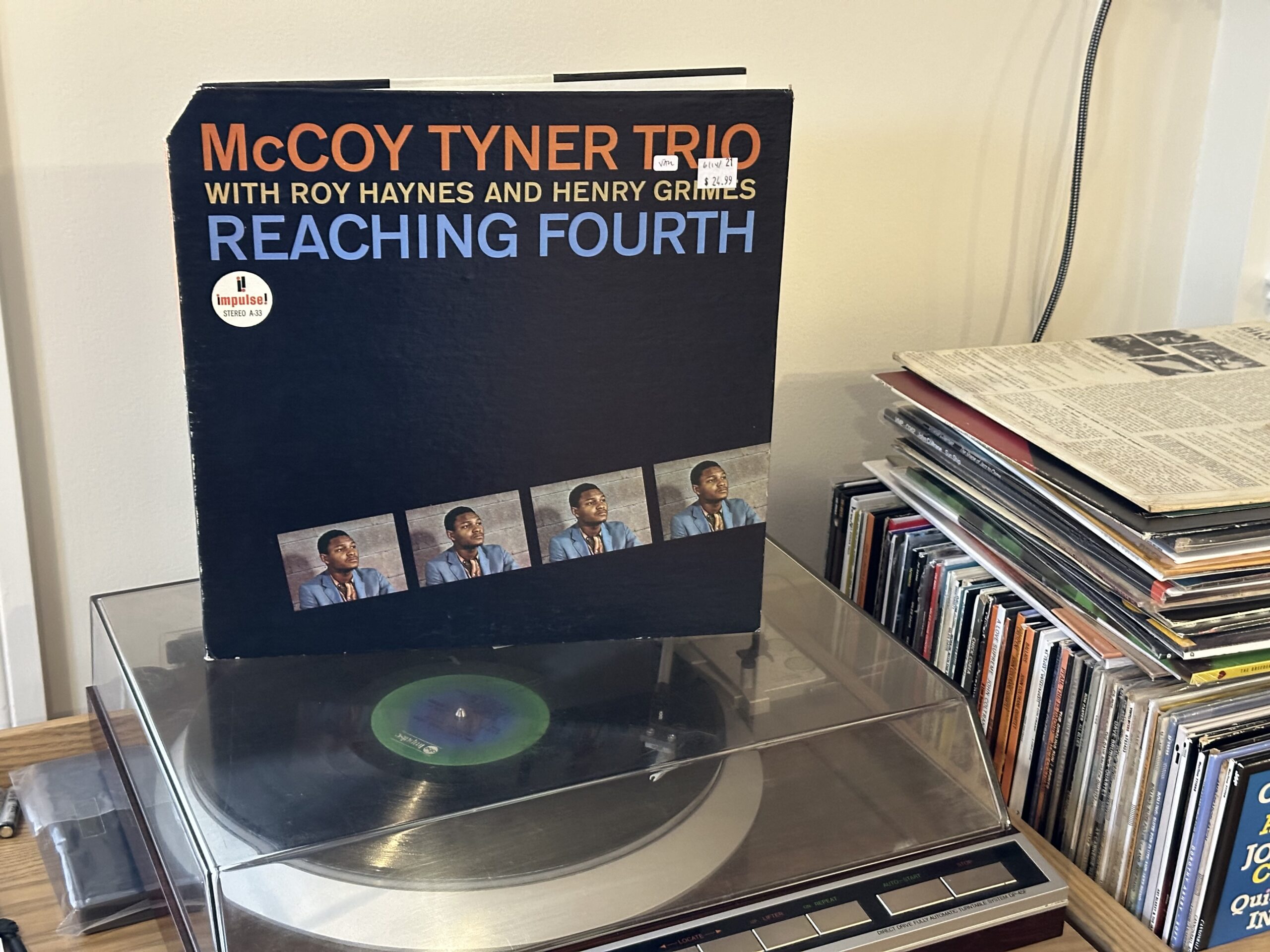
McCoy Tyner, Reaching Fourth

Album of the Week, January 27, 2024

The repercussions of John Coltrane’s reach into avant-garde jazz, and subsequent backlash from some critics, can be traced in his early career in the 1960s, as albums after Africa/Brass took a different approach and recordings from the 1961 residencies went unpublished for several years. It’s tempting to read McCoy Tyner’s Impulse! recordings through the same lens, imagining that his substantial talents in forcefully modal jazz were suppressed by the label. Some critics have read the early Tyner recordings as evidence that he was insufficiently innovative for Coltrane’s group, foresaging his eventual departure.

The truth of the matter appears to have been mundanely commercial. Creed Taylor had left Impulse! in the summer of 1961, and his successor, Bob Thiele, asked Tyner to record more straightforward jazz albums. —I should note something about the classic Impulse! recordings before I go any further. Like Blue Note before it and CTI after, Impulse! under Taylor and his successors created a distinctive graphic identity through the use of photography, typography, design, and the overall excellence of the physical package, and Reaching Fourth is no exception. Released in a gatefold cover with striking photography and text against a black background, and the orange, black and white “house style” design on the back, it’s a gorgeous package, and the design holds up even in my 1974 reissued copy.

Whatever the impetus of the album, Reaching Fourth is a mix of standards and intriguing Tyner originals, recorded as a trio with bassist Henry Grimes and drummer Roy Haynes. Grimes, who would go on to build an important career in free jazz as a member of groups led by Pharaoh Sanders, Steve Lacy, Cecil Taylor, Don Cherry, and others had come to fame at the 1958 Newport Jazz Festival and its accompanying documentary, Jazz on a Summer’s Day. Word spread about his amazing playing and he ended up playing with six different groups throughout the festival. Haynes, who had been playing since his debut in his native Boston in 1942, had recorded with Charlie Parker, Lester Young, Bud Powell, and Sarah Vaughan. (He is still going strong; his 95th birthday party in 2020 was cancelled due to COVID-19. I saw him play in that same 1993 jazz festival at UVA, where he clearly could outplay all the young musicians in his band.)

The title track is a Tyner composition that seems designed to showcase the more imaginative side of his writing and performance. It bears some of his early hallmarks—unusual modal voicings, a brisk tempo, high velocity runs. But it also benefits from the excellence of his collaborators. Haynes’ drumming stays on the off beat and punctuates Tyner’s solo with brisk snare rolls, while Grimes’ fiercely percussive plucked accompaniment turns into a fiery bowed solo. Haynes trades eights with both Grimes and Tyner, exploring the full tonal color of his kit in the process.

Goodbye”, written by Gordon Jenkins after the death of his first wife, changes the pace to a meditative rumination. The tune and chords swing from minor in the verse to major in the chorus and back, as though discovering different facets of grief in each new bar. Tyner’s playing has a sensitive touch even as he traces the contours and changes of the tune, and Haynes and Grimes are quietly supportive. It’s a deep sigh of a tune.

Theme for Ernie,” written by guitarist Fred Lacey for saxophonist Ernie Henry, is a bubbly tune that’s given a bouncy reading. Tyner’s playing pulls at the corners of the melody with brisk runs, accompanied by Grimes at his most buoyant. Grimes’ solo is melodically indebted to Scott LaFaro; indeed, this track brings to mind some of the telepathic interchange between LaFaro and Bill Evans on their trio recordings.

Tyner’s other original, “Blues Back,” is a straight blues, and Grimes especially plays it straight, sounding each note as though tolling a bell. Tyner, by contrast, shows how this blues swings into different modes almost with every measure, even creating a Mixolydian counter-melody in the fourth chorus of his solo. Grimes takes a two-chorus solo that explores some of Tyner’s melodic ideas before the trio returns to the theme once more.

Old Devil Moon” (which the track listing tells us is from the 1947 Broadway show Finian’s Rainbow) is more commonly remembered as a tune in Frank Sinatra’s catalog; before Sinatra, Miles recorded it in 1953 on his Prestige Records release The Miles Davis Quartet. Tyner takes the tune in a completely different direction, opening with a modal progression between bass and piano, before returning to the main melody. Grimes’ bass line remains constant between the more traditional sections and the modal interludes, providing a pedal point against which Tyner stretches the melody. Haynes helps the forward motion, keeping a steady rhythm with a little trip against the snare in the fourth beat of each measure. Together, the group seems to lean from the straight and narrow into more exciting territory, then to settle back into the straight paths as though with a grin.

Have You Met Miss Jones” closes out the album; Tyner takes the Rodgers and Hart classic from 1937’s I’d Rather Be Right and dispatches it at breakneck speed. In the coda, Grimes plays octaves around which Tyner improvises a modal melody, wrapping up the whole thing in less than four minutes. It’s a remarkable exercise in economy and a lot of fun too.

After listening to Tyner’s early work with Coltrane, listening to his early trio recordings for Impulse! can initially feel like a step back to an earlier, simpler conception of jazz. Reaching Fourth repays careful listening, showing off his innovative ear and unique compositional gifts; we’ll hear more of both as we listen to more of the recordings in the catalog. Next week we’ll pick up Coltrane’s story where we left off, finding him in a very different territory than the New York clubs that hosted his last explorations.

You can listen to this week’s album here:

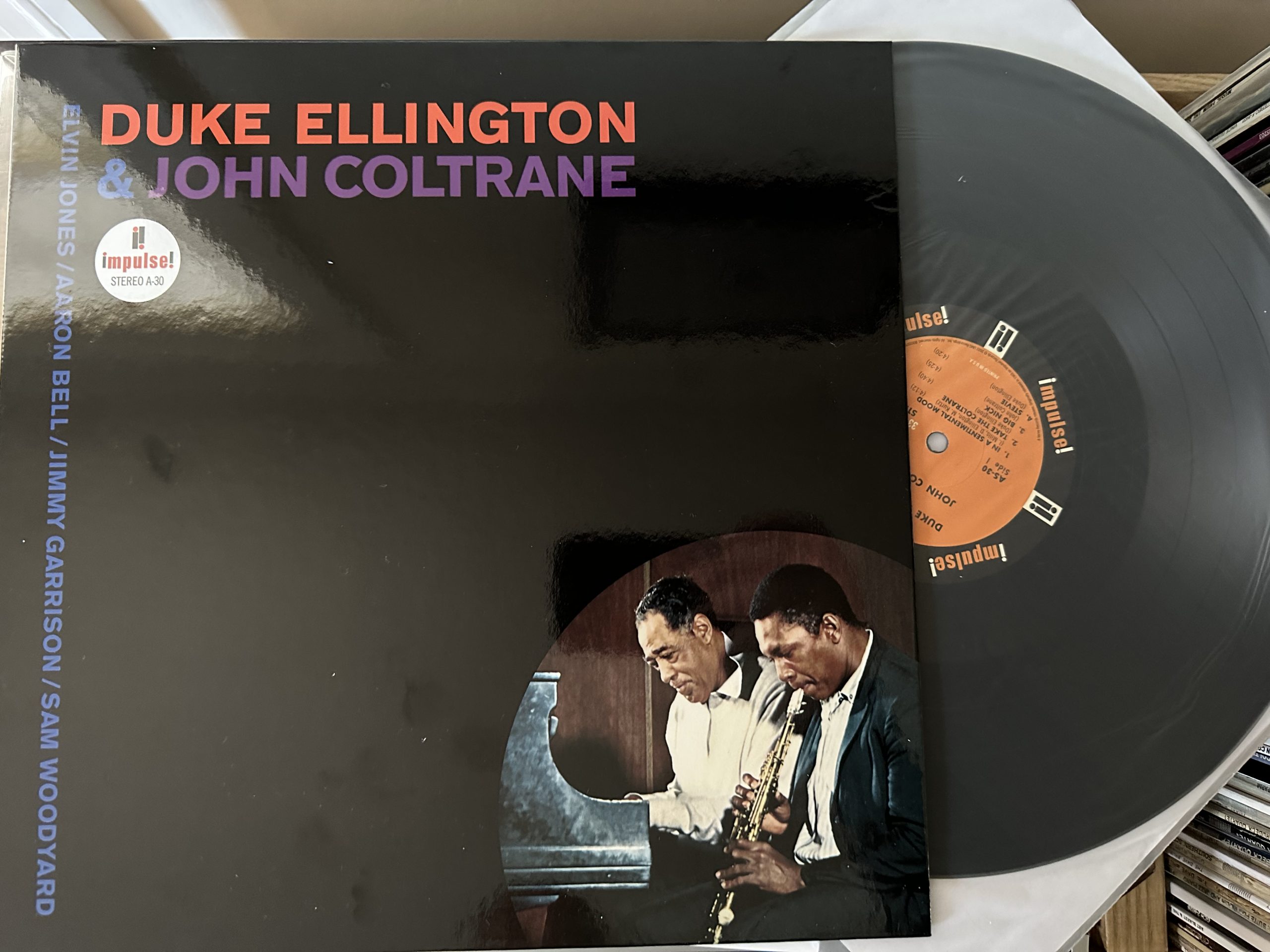
Duke Ellington & John Coltrane

Album of the Week, November 19, 2022

Duke Ellington’s run of albums for Columbia Records in the mid to late 1950s was spectacular. In addition to Masterpieces by EllingtonEllington at NewportBlack, Brown and Beige, and Ellington Indigos, the run also included such classics as Ellington UptownA Drum is a WomanSuch Sweet ThunderJazz Party (featuring the debut of the Billy Strayhorn tune “U.M.M.G.”), and the soundtrack to Anatomy of a Murder

However, by 1962 his contract with Columbia had come to an end, and in a way this ushered in an even more significant period in Ellington’s development, as he began to record sessions for other labels with an array of artists. From this period came his great collaboration with Max Roach and Charles Mingus, Money Jungle, and two collaboration albums on Impulse! Records, Duke Ellington Meets Coleman Hawkins and Duke Ellington & John Coltrane

It’s worth pausing for a second to acknowledge that we have stepped into the timeline of Impulse! Records. One of the undisputedly great jazz labels alongside Blue Note and Verve (and later, CTI), Impulse! was established in 1960 by producer Creed Taylor, who may be the most significant contribution to jazz music to have come from Pearlsburg, Virginia. At Bethlehem Records, his first recording, a session backing vocalist Chris Connors with Ellis Larkins’ piano trio, earned him the position of head of A&R for the label. He parlayed this brief but successful stint into a role at ABC-Paramount, where he created Impulse! as a subsidiary label with the tagline “The New Wave in Jazz.” Creating immediate success with records by Gil Evans, Kai Winding, Ray Charles, Oliver Nelson and others, Taylor’s lasting accomplishment was to sign John Coltrane to the label in 1960. Due to Coltrane’s long association with the label, it became known as “The House That Trane Built.” Taylor left Impulse! for Verve in 1961, leaving the session Coltrane recorded with Ellington to Trane’s long-time producer Bob Thiele and engineer Rudy Van Gelder. (We’ll see Creed Taylor again.)

Ellington did not bring along his orchestra, or even his usual horn players, to the session. Without a regular record contract, he could not keep the band together indefinitely. Instead, bringing drummer Sam Woodyard and bassist Aaron Bell, he met Coltrane on more or less equal footing.

This recording found Coltrane at an interesting point in his development. While still performing with the Miles Davis Sextet, he had recorded music with an increasingly avant-garde flavor, perhaps culminating in the residency at the Village Vanguard with Eric Dolphy, Reggie Workman, Elvin Jones and McCoy Tyner that saw a release as Impressions. Critics were bitterly divided over the work, misunderstanding Trane’s searching approach, and 1962 apparently brought some retrenchment, with a greater focus on ballads, but no lack of innovation in the playing. Trane had just stabilized the membership in his own Great Quartet, with Jimmy Garrison replacing Workman on bass; Garrison and Jones join Coltrane on this session, and indeed support Ellington on all but two of the numbers.

As with Money Jungle, Ellington paired with the new players brings a sense of fresh spontaneity and depth to the album, many of the selections on which are familiar Ellington standards. The opener, “In a Sentimental Mood,” could not be performed more delicately by the band, with Jones’ muscular but nuanced hand at the drums joining Aaron Bell on bass. Trane’s melodic playing seems to search through the key changes of the tune, but never goes “out” in the way some of his earlier work stretches beyond space and time. Instead, he seems anchored to our world through the combination of Ellington’s gentle arpeggiated introduction and Jones and Bell’s steady, subtle pulse.

Take the Coltrane” is one in a series of Ellington compositions devoted to musicians with whom he collaborated, and it’s a remarkable achievement, highlighting both Trane’s arpeggiated “sheets of sound” and a slyly modal melody. Elvin Jones does unnaturally wonderful things on the hi-hat throughout, and Trane’s solo is of a piece with the work he was recording on his own Impulse! recordings. This recording features both Bell and Garrison on bass, and both plus Jones support Trane under his solo while Ellington steps aside. When Duke returns, he slyly drops in a little “Ooh Pa Pa Da” as though in reference to the bop origins of the tune. It’s genuinely fun.

Big Nick,” the sole Coltrane original on the record, is a fun, loping melody that takes the harmonic ideas of “Giant Steps” and swings them, creating a slow blues that rides on Jimmy Garrison’s loping bass line. Coltrane’s solo takes off for something like the outer stratosphere but never loses the blues progression, so that when he yields the floor to Duke his more straightforward take on the blues feels like a continuation of the conversation, rather than a rebuke. But it really all comes back to the melody, one of the quirkiest and most fun that Coltrane authored.

Stevie” carries on the swing but in a more Ellingtonian harmonic language, swerving from a minor blues into a major key. His introductory choruses veer through at least three different modes before returning to the original minor. Trane mostly stays within the first minor mode for his solo, which carries flavors of “Impressions” in its blistering runs but never goes too far outside. Ellington’s initial take on the melody stays cool in contrast to Coltrane’s heat, finishing with a low tolling note to close out the first side.

My Little Brown Book” is one of the most gorgeous ballads on the record. The Ellington introduction, with Woodyard and Bell backing, revisits the feeling of “In a Sentimental Mood,” but when Coltrane enters on the melody of this Strayhorn composition, we’re suddenly swaying to a half heard melody on an empty dance floor somewhere near midnight. This is Trane at his most romantic, with echoes of his performance of “I’ll Wait and Pray” from Coltrane Jazz, and the rest of the band is there for him, with only small ripples from Ellington disturbing the serenity of the track.

Angelica” is, for me, the standout track here. Just listen to that opening beat from Elvin Jones, and the bounce that carries over to Ellington’s opening choruses, backed up by a jubilant Garrison. Coltrane’s entry keeps the swing going, and he plays it pretty safe for the first few choruses. Then on that fourth, after Ellington drops out and it’s just him and the rhythm, he cuts loose, with sheets of sound swirling around the beat, never losing the swing but somehow taking a step left through a door into, well, a John Coltrane record. After that chorus, he brings it back to the melody, and you can hear Ellington recalibrating his approach before he re-enters. It sums up so much about the connection between Coltrane’s approach and the harmonic and rhythmic innovations that had come before him, and is a complete blast to listen to. And maybe even dance: I want Elvin Jones playing that beat for my entry music as I stroll, sashay and jitterbug into heaven.

The Feeling of Jazz” brings us back to a slow blues to close out the album. True to its title, it bridges both Trane’s searching quality and Ellington’s formalism to give us something that feels like a little of both worlds. Trane’s solo continues throughout most of the song; we are reminded of the time he told Miles, the latter having asked why he played such a long solo, that “it took that long to get it all in.” At the end, Trane finally steps back from the microphone and Ellington and his rhythm section play through the fade-out, the elder titan getting the last word.

In the liner notes to the album, Trane famously remarked, “I would have liked to have worked over all those numbers again, but then I guess the performances wouldn’t have had the same spontaneity.” The whole session was recorded in a single day on September 26, 1962 at Rudy Van Gelder’s studio, just eight days after the recording of “Up ’Gainst the Wall” that rounds out Impressions. But the album speaks for itself, the meeting of two giants and of two sympathetic musicians who bring their separate conceptions of the music into a unified whole. It remains as spontaneous and fresh for me today as when I first heard it almost thirty years ago.

You can listen to the album here: