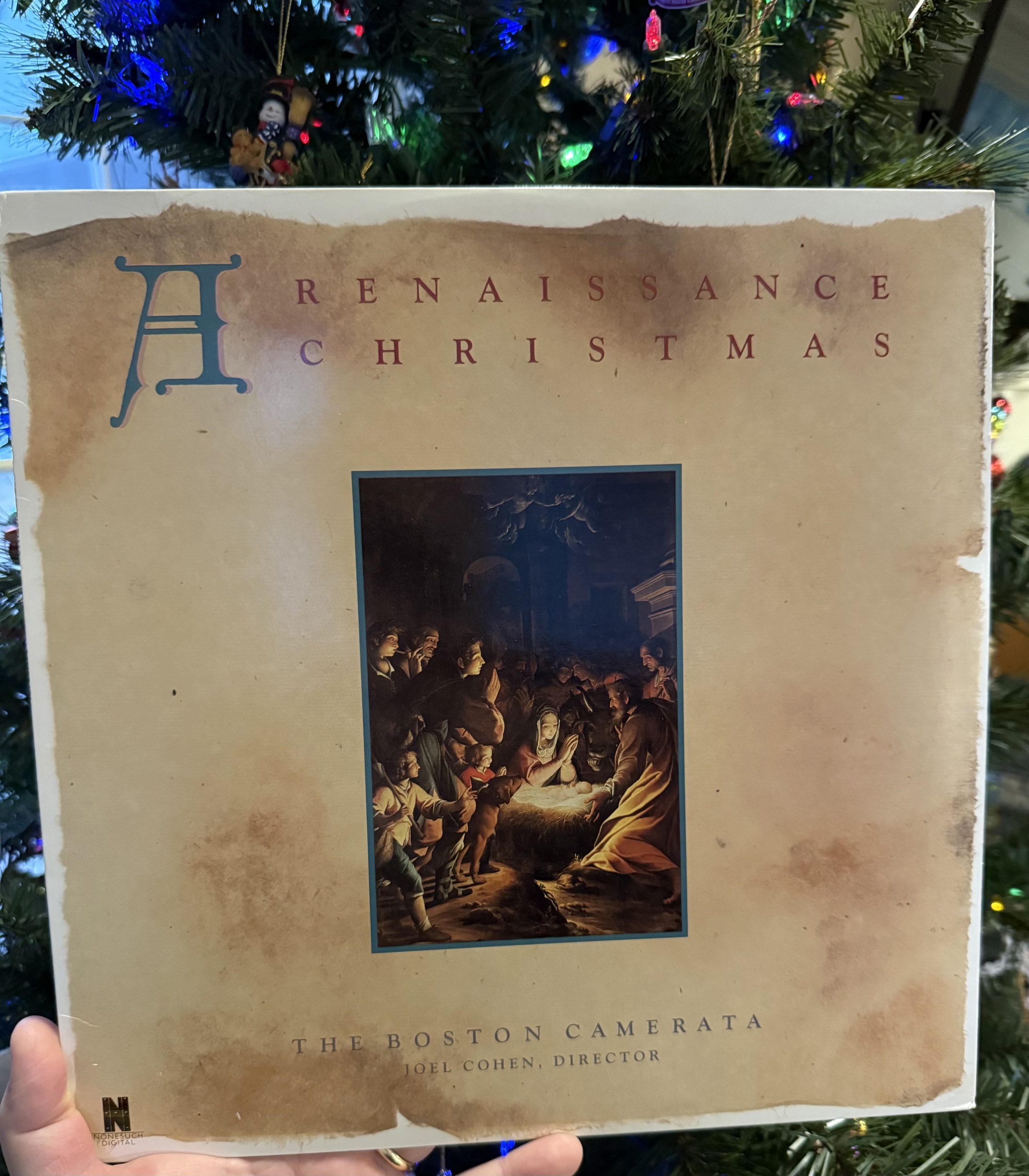
Boston Camerata, A Renaissance Christmas (1986)

A childhood favorite Christmas record, filled with songs familiar and strange and featuring the voice of an old friend.

Album of the Week, December 20, 2025

I have written about several Boston Camerata Christmas records: Sing We Noel, A Medieval Christmas, even an early A Renaissance Christmas from 1974. And each time I do, my friend Frank Albinder, formerly director of the Washington Men’s Camerata and member of Chanticleer, and current director of the Virginia Glee Club, says, “I used to sing with them! I recorded a Christmas album with them!” And: Yes, Frank, you did! This week’s post is for you.

Frank’s sojourn in Boston as a music grad student came in handy when Joel Cohen was assembling the musical forces for the 1986 release A Renaissance Christmas (true to the group’s name, the album was a local Boston production, recorded in Trinity Church in Copley Square in December 1985). Vocally speaking, there are no carryovers from Sing We Noel, the Camerata’s prior Christmas album—but there’s an eight-year gap between those two recordings, and one presumes that a great many Camerata members were, like Frank, graduate students who were passing through Boston on their way. One notable exception to the rule is soprano Anne Azéma, who began her recording career with the Boston Camerata with 1984’s La Primavera and is still with the Camerata today as its artistic director. (Along the way she married Joel Cohen.)

It is Azéma’s voice that leads off the album, with the 15th century English carol “Nowell: Dieus vous garde.” (Yes, English: Richard Smert wrote the carol in a mixture of English and Norman, as was appropriate for the court at the time.) The quartet of voices plus viol sings one of my favorite non-traditional Christmas carols, an early invocation of Father Christmas, with purity and compelling melodic line. The reverie is followed by “Gaudete, gaudete”, sung with vigor by the ensemble; this is one of the carols from the album that can be widely heard on other recordings, but the performance here blends expertise with vigor in a hallmark of these Camerata recordings.

Following a recitation in broad Middle English (here the narrator is tenor Edmund Brownless) that gave my family the in-joke “Hail, Mary, full of fescue,” we get the Kyrie from Guilliame Dufay’s “Ecce ancilla Domini” Mass, with Brownless, countertenor Kenneth Fitch, and bass Albinder providing the solos. Fitch’s voice is delightfully balanced and resonant, lacking some of the eccentricities of the countertenors on the 1970s Camerata recordings, and the overall impression is magnetic, particularly, when the ensemble cuts out at the end leaving the trio to provide the final “Kyrie.” We make our first stop in Spain with “E la don don,” performed with sparkling briskness, and then return to France with two instrumental settings of “Une jeune fillette.”

“Une jeune fillette” (in alteration with “Joseph est bien marìe”) leads us into the next set, with the women’s voices led by Azéma singing the latter carol with interludes of the former in a beguiling arrangement. A brief instrumental bridge of “Joseph, lieber Joseph mein” leads to the highlight of the first half, a performance of Joseph Galliculus’s “Magnificat quinti toni.” Sung bits of chant alternate with hypnotically fugueing renditions of familiar Christmas tunes in an astonishing reverie.

The second half is much more carol-focused, with Frank’s unaccompanied solo on “Esprits divins” leading off, followed by a reading and the original harmonization of “Es ist ein Ros’ entsprungen,” with lute and voice. An appropriately swaggering “Riu, riu chiu” follows, unaccompanied save for antiphonal handclaps until the final choruses.

Cohen constructs a mini-Praetorius set (Michael and Hieronymous) around the visit of the Magi. Michael Praetorius contributes the more familiar “Wie schön leuchtet der Morgenstern,” followed by a reading and the Hieronymous P. setting of “O vos omnes,” mourning Herod’s crime against the firstborn.

The set that follows celebrates the shepherds at the cradle, and is in some ways the most adventurous part of this adventurous record. Opening with a reading and a 16th century Italian dance played on the ocarina by Marilyn Boenau, the ensemble then plays a set of vigorous music from the French, Catalan and Provençal traditions. Nicholas Martin’s “Nouvelles, nouvelles” gives us a beautiful melody led by Azéma, while the Catalan “Tau garçó, la durundera” is all rhythm and close harmonies. Finally, the Provençal “Tura lura lura, lo gau canta” provides a high spirited and faintly comic call-and-response between Cohen and the men of the ensemble as they tell the story of a shepherd afraid to make the pilgrimage to Bethlehem.

Lastly, we get a trio of Renaissance masterworks, beginning with the final reading from Luke and the Tómas Luis de Victoria “O magnum mysterium.” The latter is far and away the most famous of the liturgical music on the record and is given a gorgeous reading by the Camerata. A pair of works by Michael Praetorius concludes the record, with Azéma trading phrases in call and response with soprano Roberta Anderson in “Singet und klinget, ihr Kinderlein” and the ensemble singing a Provençal text from 17th century Avignon to a dance melody by Praetorius in the final setting, “Bransle de Poictou/La bona novella.”

The Boston Camerata at this stage of their development was a remarkable ensemble, doing their own research and constructing programs that both instructed and enlivened the ear. A good many recordings have followed, even after Cohen’s retirement, and the ensemble itself carries on. (In fact, I’m taking the family to hear them perform some early American Christmas music tomorrow.) The individual musicians on this recording also had a variety of careers; viol and recorder player Jane Hershey recorded for many years with Hesperus, soprano Roberta Anderson with Boston Baroque, and both countertenor Ken Fitch and bass-baritone Albinder would go on to greater fame and fortune with Chanticleer.

Next week we’ll swerve back to something closer to jazz as we draw the mystery of the holiday to a close.

You can listen to this week’s album here:
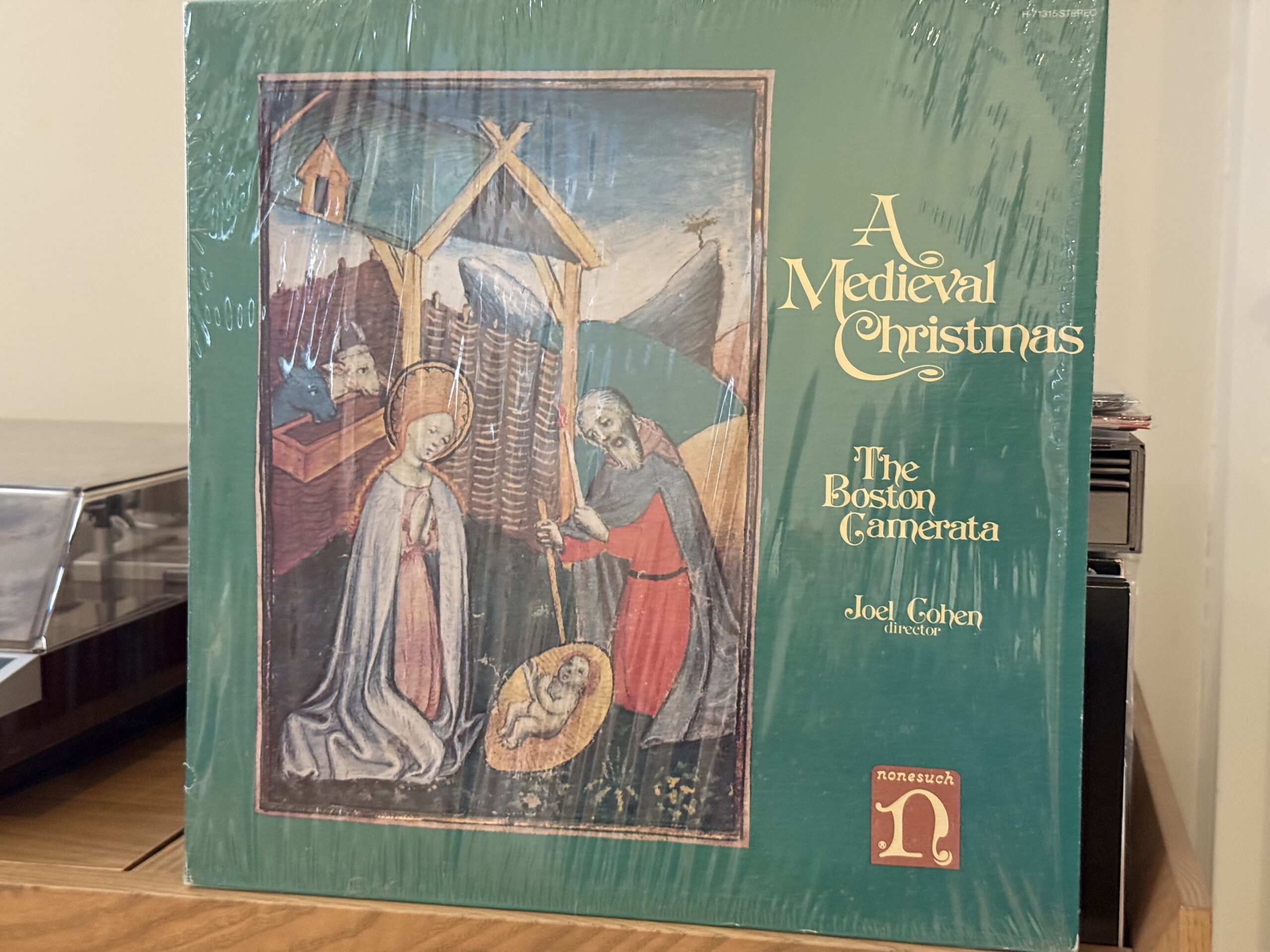
Boston Camerata, A Medieval Christmas

Album of the Week, December 21, 2024

I’ve featured the Boston Camerata in this series before (and even before this series was a thing). The early music ensemble, directed for many years by Joel Cohen, was responsible for introducing me to the sound of Middle English, Renaissance and Sacred Harp music, and a great many other things. And before I started collecting old records, I thought they had recorded three Christmas records for Nonesuch: Sing We Noel first, then A Renaissance Christmas, and finally A Medieval Christmas, which I thought had been released in 1991 when it came out on CD.

It turns out I had things backwards. As I wrote last year, the Nonesuch A Renaissance Christmas was a re-recording of an earlier performance from before the Camerata had signed to a major label. And it turns out that A Medieval Christmas was originally released in 1975, meaning that it precedes Sing We Noel by a full three years.

That difference is significant. Thanks in part to Cohen, as well as to British early music artists like Paul Hillier and David Munrow, the standards for early music performance were rising rapidly, and certain scarcities like authentic period instruments and unusual voice parts (like countertenors) were starting to be more widely available. Indeed, the scarcity of early instruments was, um, instrumental in the founding of the Camerata; it began as a group dedicated to demonstrating the rare antique instruments in Boston’s Museum of Fine Art, and this album was recorded at the MFA.

But during this transitional period, Cohen still had to work with the forces he could find, including some interesting vocalists. Charles Rhodes, the countertenor who is featured prominently on the Franco-Provençal setting of the prophecy of the Angel Gabriel, “Oiet, virgines,” is probably the most notorious example; he has an expressive voice, but his vocal production is a little uneven and he strays a little toward the pinched and strained side of the high tenor sound. But it’s still mesmerizing, and that’s due at least in part to the program and the instrumentalists.

Cohen can be reliably counted on to deliver the most incredibly obscure music, whether a cantillation of the Torah or a 10th century Spanish plainchant, and then to weave them together seamlessly into a single performance. When the conductus “Adest sponsus enters, it’s with great vigor that the percussion and the shawms set the tempo, as if for a procession; the album closing conductus “Orientus partibus” is actually performed as a recessional, which contributes greatly to the mood if not to the audibility.

There is also some fairly spectacular programming of related tunes together, with the familiar macaronic carol “In dulci jubilo” paired with its plainchant antecedent, “Congaugent hodie,” as well as readings in Middle English courtesy of Nicholas Linfield (who also did the readings on Sing We Noel).

The album as a whole can be taken as many things: a scholarly illustration of medieval musical practices (especially if you read Cohen’s comprehensive liner notes while listening), a window into alternate musical Christmas traditions, or just something to put on and meditatively listen. Or all of the above, which is what I plan to do this week. Next time, we’ll get to something a little funkier.

You can listen to this week’s album here:

Boston Camerata, A Renaissance Christmas (1974)

Album of the Week, December 10, 2022

The Boston Camerata was founded in 1954, but they didn’t enter my consciousness until the late 1970s, when my mother brought home a copy of Sing We Noel. The record, an unexpected combination of medieval and Renaissance English carols and 19th century American hymns for Christmas, was a hit in our house, sparking my love of Middle English (I can still sing “Nova, nova: aue fitt ex Eva” in the original from memory, and brought “Nowell, Out of Your Slepe” to the Suspicious Cheese Lords), early American hymnody (“Sherburne,” anyone?), and the Boston Camerata. Our household bought both the follow-up records on Nonesuch: A Renaissance Christmas and A Medieval Christmas, and I followed the group to their recordings for Erato and other labels. I’ve taken my kids to see them here in Boston. (I’ve also developed working relationships with at least one musician on that original series of recordings; the Virginia Glee Club’s director Frank Albinder sang as a graduate student on A Renaissance Christmas.)

So it was with a certain thrill that I found a Camerata record that predates all of the above, and hits some of the same repertoire from Sing We Noel and A Renaissance Christmas. Also called A Renaissance Christmas, this 1974 recording on the small Turnabout Records label proved to be an unexpected addition to our Christmas listening.

The biggest unexpected thing, perhaps, is the quality of the sound on the recording. The Nonesuch records featured impeccable balance and clarity of sound; this record, not so much. In several numbers, the wind instruments overpower the women’s voices, and there are moments of impaired pitch in some of the men’s singing, particularly in the Obrecht “Magnificat” when the men enter unaccompanied.

There are also, though, delightful moments, including the pairing of “Nova, Nova,” here sung in modern English, with the 15th century Czech carol “Salve, lux fidelium.” Here the voices are clear and strong, and full of personality. Indeed, this is one of the hallmarks that sets this recording apart from the Deller Consort record we heard last week, where the balance was delicate, sometimes overly so.

Most distinctively, the program for the recording covers an immense amount of ground inside the theme of “Renaissance Christmas,” from anonymous English carols to motets by Mouton, Victoria, Praetorius, Clemens Non Papa, Francesco Guerrero and others. And the repertoire is creatively sequenced, too, with all the Spanish motets and carols coming together to tell the birth of Jesus. This should come as no surprise, as even at this early date, about five years after he took leadership of the Camerata, music director Joel Cohen was already demonstrating his flair for creative programming.

The strongest performances, to my ears, come in the repertoire that Cohen would return to in Sing We Noel and in the 1986 version of A Renaissance Christmas, namely “Marvel Not, Joseph,” which except for its modern English text could be mistaken for the version that the group would perform four years later; the Victoria “O Magnum Mysterium,” which would return on the 1986 Renaissance; and of course “Riu, Riu, Chiu,” which swaggers appropriately just as it did on the later recording. (Unfortunately, there is only a single album-length version of this record available on YouTube; you’ll have to listen to the whole thing to get the samples from this 1974 version.)

But the vocal performances get stronger as the album goes on, including the “Virgen Santa” and “Sweet Was the Song the Virgin Sung,” featuring a countertenor solo that’s as lovely as anything I’ve heard from this group. All told, it’s a fun collection that is just familiar enough to trigger nostalgia for some of the Camerata’s later recordings, and just distinctive enough to be worth a listen on its own.

You can listen to the album here: