
During our vacation week in London, we walked by the church above probably half a dozen times. I was struck by the structure—the polychrome, the oval chapel—and by the odd coincidence of the church’s presence on Binney Street, which was the address of our first apartment when we moved to Cambridge, Mass.
I finally got around to looking up the church, intrigued by its odd name. The King’s Weigh House church was indeed built over the site of the King’s weigh house, but that was in Little Eastcheap rather than its current Mayfair site. (The original site first held St. Andrew Hubbard church, which was destroyed by the Great Fire of London, then replaced by a weigh house that became a chapel for dissenters in 1695 before moving up the street.)
The congregation was forced to move when the Metropolitan Railway purchased the land on Eastcheap, but the Duke of Westminster donated the current site. The new building was designed by Alfred Waterhouse, the architect responsible for the London Natural History Museum, a handful of buildings at Oxford, and, amusingly, Strangeways Prison.
Oh, and Binney Street? Turns out it’s named for English Congregationalist preacher Thomas Binney, explaining its reuse for a street in Congregationalist Cambridge. (Oh, and our apartment in the complex formerly called Worthington Place turns out to have been in a National Historic District!)

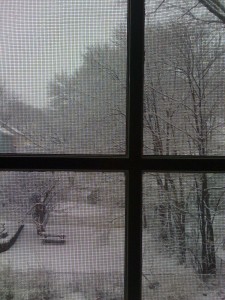 Words cannot express the emotions I felt, after a weekend in the 50s, I awoke this morning to see big fat flakes of snow coming down. I keep thinking that I’m used to it, but at heart I’m still a Virginia boy; snow is a rare treat at the beginning of winter and a stupefying chore at the end. I can tell my town is reeling a little bit too; our street wasn’t plowed, a fact I didn’t fully appreciate until I began the descent down the steep hill leading down to Mass Ave. The hill was completely covered in snow turning rapidly to ice, and I had to really jam on the brakes at the top of the hill to keep it a controlled descent.