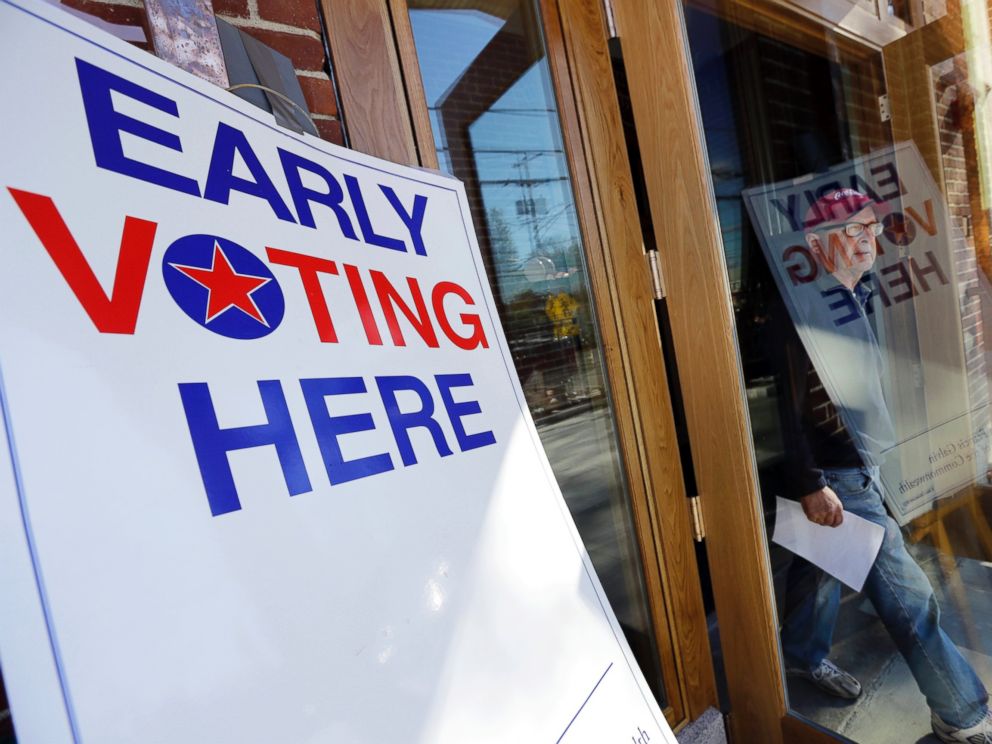
Vote early (not often)

Early voting sign in Andover, Massachusetts (AP)

I just did early voting for the first time this morning. It was easier than I expected.

My town offers one early voting location, in Cary Memorial Hall. I found a parking space in front (reserved for early voters) and entered the lobby, where there were about twelve other voters reading signs and standing in line to check in. About eight more were already inside voting.

I was given a ballot and an envelope that the poll worker marked with my precinct number. I voted, then signed the envelope and wrote my address on the outside, sealing my ballot inside. I turned in my ballot to a sealed box; because the ballot was sealed, there was no scantron and no counter, so I can’t tell you which voter number I was.

From a security perspective, the voting process seems no more or less secure than regular voting. It’s possible that someone could give a poll worker someone else’s name and street address, thus blocking their attempt to vote (just as they could on Election Day). It’s also possible that someone could register under their own name and then write someone else’s information on the early voting envelope and thus invalidate both ballots. But I think both outcomes are unlikely to be practiced at scale.

Massachusetts passed legislation in 2014 requiring that early voting be offered, and this is the first presidential election in which the law goes into effect. I’m hopeful that it will spark higher turnout. I’m wearing my “I Voted” sticker with the same goal.

The day after the election?

The New Yorker: Donald Trump and the Day After the Election. This is the thing I find most horrifying about the coming election: the prospect that in his ensuing tantrum, Trump will cement what a big part of the electorate already fears, that democracy is broken. When in fact, the most probable outcome is that democracy will be proven to work.

Leonard Cohen, as usual, is way ahead of us:

Everybody knows that the dice are loaded
Everybody rolls with their fingers crossed
Everybody knows that the war is over
Everybody knows the good guys lost
Everybody knows the fight was fixed
The poor stay poor, the rich get rich
That’s how it goes
Everybody knows

But also:

It’s coming to America first
The cradle of the best and of the worst
It’s here they got the range
And the machinery for change
And it’s here they got the spiritual thirst
It’s here the family’s broken
And it’s here the lonely say
That the heart has got to open
In a fundamental way
Democracy is coming to the USA

Preparing John Adams’ “Transmigration”

This coming weekend will mark the culminating celebration of the centennial of the Pulitzer Prize, with a two day series of symposia and concerts at Harvard University. I’ll be singing on Sunday night, not coincidentally the 15th anniversary of September 11, as part of a performance of John Adams’ On the Transmigration of Souls.

The Adams work was commissioned for the first commemoration of the 9/11 attacks and was first performed September 12, 2002. It’s a powerful work that combines symphonic and children’s choruses, orchestra, and tape of voices reading names of 9/11 victims, fliers that were left, and interviews with families. From a performer’s perspective, the great thing is that the music is so rich and demands so much attention for pitch and rhythm that it’s very unlikely that we’ll get swallowed by the subject matter and become too choked up to perform—which might otherwise be a very real danger.

It’s going to be a very atypical performance for the TFC, as it is not a BSO performance and is held in an unusual venue for us—though not a new one for me, as I performed in Sanders Theater in 1993 with the Virginia Glee Club, almost 23 years ago.

Some free tickets are still available. It should be a hugely worthwhile event. I’m only sorry I won’t be able to see Wynton Marsalis in his part of the event the night before.

Reaping the whirlwind

Talking Points Memo: SCOTUS denies NC request to halt ruling blocking voting restrictions.

The Republican strategy to win elections is to prevent blocs of voters from voting. That’s the conclusion one reaches by looking at the combination of photo ID requirements, cutbacks to early voting, elimination of same-day registration, prohibition of pre-registration of young voters, and other measures that the NC GOP engaged in. These were all strategies that were found by a federal appeals court to “disproportionately [affect] African Americans” and to target “African Americans with almost surgical precision.”

Without addressing the constitutionality or morality of such a plan,* the question one has to ask is, for how long does the GOP plan to win elections by disenfranchisement, rather than by addressing the issues of those voting blocks and bringing them into the fold? It seems as though the answer is: for as long as they can get away with it. And if they can’t get away with it, their candidate suggests, they should switch tactics to outright voter intimidation.

The only bright light I see is this reliance on disenfranchisement and intimidation seems like a de facto acknowledgement by the party that it is losing its ability to win elections legitimately. In the long run, if the GOP does not win the 2016 presidential election, it’s going to have to either confront this fatal weakness and change course, or dissolve. Buckle your seat belts. One way or the other, 2017 is going to be interesting.

* There are certainly other voices that have done that; see these notes on specific blunders North Carolina lawmakers committed that left smoking gun trails to point to the intent to suppress African American voting;  memos sent urging the state to vote on the party line to restrict hours for early voting and keep polling places closed on Sundays, which are disproportionately when African Americans vote; and unexplained and unannounced changes in polling locations, among other issues.

Exploring EPCOT’s Horizons ride from the inside

I have a new obsession: reading the archives of the Mesa Verde Times blog. This pseudonymous walkthrough of a series of surreptitious behind-the-scenes tours of the late, lamented Horizons future ride at Disney’s EPCOT is fascinating as much for the old-school blogging as it is for the actual content. Which, don’t get me wrong, is plenty fascinating, as it consists of pictures of hidden areas of the ride’s sets and maintenance areas, Easter eggs left by the ride’s designers (you’ll never guess what the designers hid in the fridge of the Desert Habitat Kitchen, next to the sausages).

Start at the beginning and read up.

Digital Yoknapatawpha

UVA Today: UVA spearheads efforts to digitally map Faulkner’s world. Stephen Railton and the fine folks at IATH are continuing their project to create an interactive way to access Faulkner’s writing. Some of the visualizations, like the Location-Character Graph, look like they have the potential to revolutionize study of his writings.

Thirty thousand feet over Peach Springs, Arizona

IMG_6320

Living in a densely populated state like Massachusetts, it’s sometimes a shock to be reminded that we have such immense areas of uninhabitable land in the United States. There’s nothing like a flyover of the Grand Canyon to bring that home.

And there’s nothing like following it up with a flyover of Lake Mead and a landing in Las Vegas to remind oneself of just how much we’ve changed the landscape of this country. And how much water matters.

Separating the artist from the art

I was in an interesting Facebook discussion last night. One of my friends was struggling to reconcile love for the works of Edgar Allan Poe with increased evidence that he was a virulent racist.

It occurred to me, as I thought about my response, that this is not unlike being a lifelong student of Thomas Jefferson while acknowledging that he not only owned slaves but fathered children with one of them.

What I’ve come to increasingly understand—not “appreciate,” but understand—is that this whole country is tainted with racism and slavery. It’s like Bob Dylan said: “Seen an arrow on the doorpost / Saying this land’s been condemned / All the way from New Orleans / To Jerusalem.” We are, all of us Americans, complicit in the original sin of America. That doesn’t mean, to me, that you throw out the whole thing; it means that you appreciate the moments of beauty that have managed to poke their heads above the horror all around them.