Exfiltration Radio: can’t we smile?

An hour of bliss at the intersection of spiritual jazz and jazz-funk, circa 1969-1976.

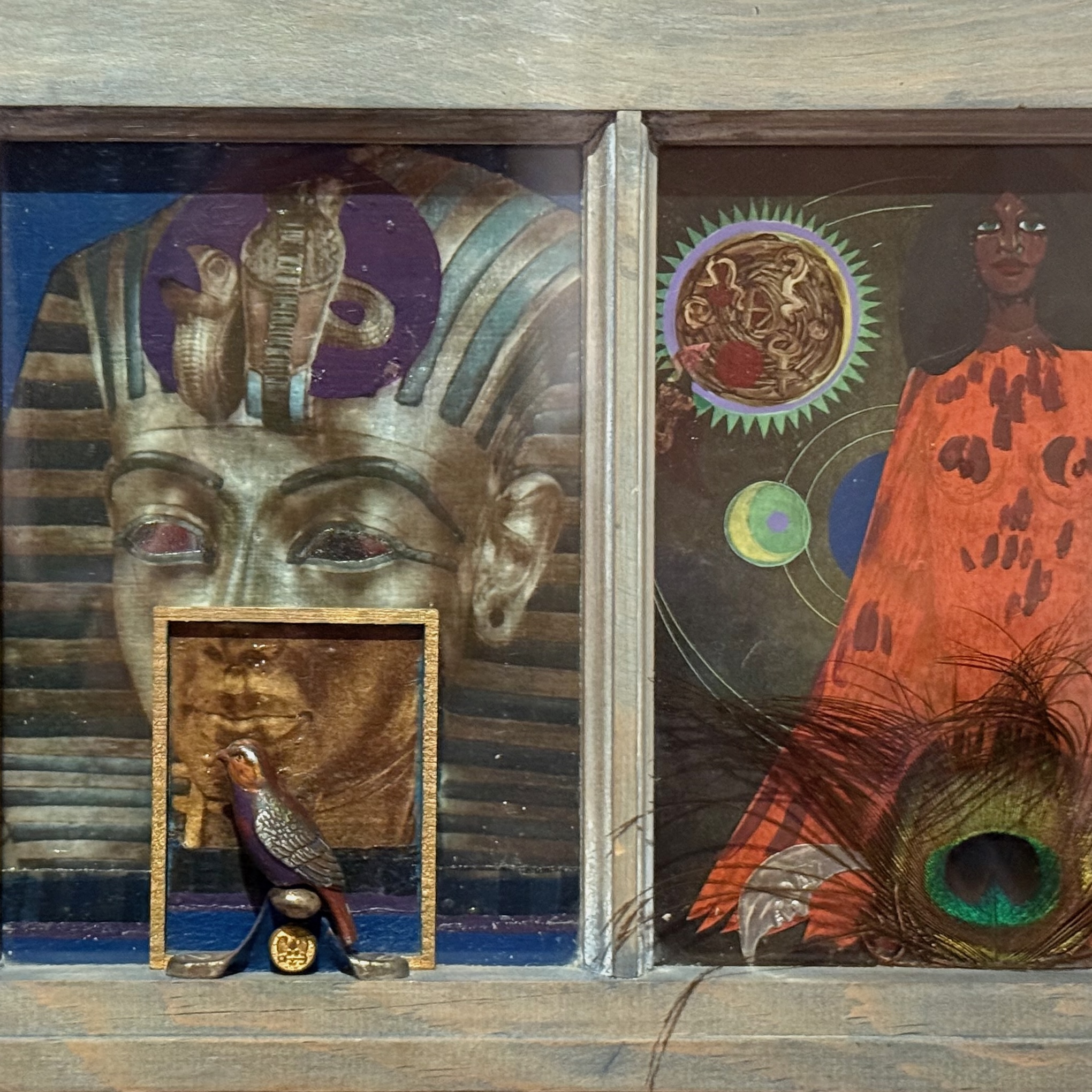
Detail from Betye Saar’s “Window of Ancient Sirens,” 1979

Not enough people talk about the through-line from spiritual jazz to smooth jazz.

That may seem like a strange, almost nonsensical thing to say, to compare Coltrane’s A Love Supreme to Grover Washington or Kenny G. Nevertheless, there’s a path there, and it runs through some artists that I’ve talked about on this blog many times before. Generally speaking, the sound I’m talking about, and that I explore in this hour of Exfiltration Radio, blends the soaring messages of hope of Pharoah Sanders’ Karma with the more cosmic sounds of the Fender Rhodes. Many of the works are more audibly optimistic, i.e. in a major key; many of them have lyrics; several have full-blown string arrangements. Some are more spiritual in focus, while others just enjoy the groove. And they almost all seem to come from the late 1960s to around the mid-1970s, with the sweet spot being from about 1969 to 1973.

That said, the overall driving force for this mix was definitely tunes that put a smile on the face and lower the blood pressure. So enjoy! The track listing:

Lonnie Liston Smith, “Expansions” (Expansions): The title cut from Smith’s 1975 album on the Flying Dutchman label, this is a darker groove than most of the songs on the show, but with that deep plea for peace at the heart of it: “Expand your mind to understand/we all must live in peace.” With a great band comprised of Cecil McBee on bass, brother Donald Smith on flute and vocals, Dave Hubbard on saxophones and Michael Carvin on drums.

Ramsey Lewis, “Bold and Black” (Another Voyage): This track from the perennially sunny improviser’s 1969 album points toward more smooth experiments, like 1974’s Sun Goddess, while providing a sunray of musical joy. Classic top-down, driving around music.

Norman Connors, “Carlos II” (Love From the Sun): Drummer, composer and arranger Connors spent most of his career in R&B and smooth jazz, but this, his third album as leader, is a fascinating, fantastic collection of straight ahead jazz with hints of spirituality poking through around the corners. A great line-up of players, including Herbie Hancock on Fender Rhodes, Gary Bartz on saxophones, Buster Williams on bass, Hubert Laws on flute, Kenneth Nash on percussion, Eddie Henderson on trumpet, and Carlos Garnett, who wrote this track, on tenor sax. Dee Dee Bridgewater guests on two tracks. The whole album is a great listen.

Azar Lawrence, “Theme for a New Day” (People Moving): Lawrence played on McCoy Tyner’s Enlightenment, Sama Layuca and Atlantis before recording his first album as leader. By 1976’s People Moving he was producing fully orchestrated sonic experiences that were full of spiritual energy and deep grooves.

Donald Byrd, “Places and Spaces” (Places and Spaces): By 1975, Donald Byrd was in a very different place than when he played on Herbie Hancock’s second album, or even his mid-1960s spiritual jazz outings for Blue Note. His 1973 album Black Byrd, produced by Larry and Fonce Mizell, was a jazz-funk fusion high point that for many years was Blue Note’s biggest selling album. Places and Spaces is the fourth of Byrd’s Mizell-produced albums, and cranks much of what made that album successful up to 11, including swooning strings and a guitar-driven hook that wouldn’t be out of place on an O’Jays record. The chant that drives the record isn’t quite P-Funk quality, but it gets the job done, and Byrd sneaks in a fully respectable trumpet solo amid the rest of the funk.

Bobbi Humphrey, “Harlem River Drive” (Blacks and Blues): Humphrey, a hugely talented flautist, also benefited from the Mizell brothers’ production on the 1973 Blue Note album Blacks and Blues, including their writing this ode to summertime cruising. The band here is mostly session players, including Jerry Peters on keyboards, Chuck Rainey on bass and the great Harvey Mason on drums, but Humphrey’s flute solo is the main thing here, a work of searing beauty in an otherwise light track.

Johnny Hammond, “Can’t We Smile?” (Gears): This work, by keyboardist and sometime jazz organist Johnny Hammond, née Johnny “Hammond” Smith, not only gave me the title for this hour but kicked off the process of putting it together, after Lisa asked me why I was listening to smooth jazz; defending the track made me realize how much I liked it and how much depth lurked beneath its smooth exterior. Released in 1975 on Milestone Records, it’s another Mizell Brothers joint with Mason, Rainey, Peters, and Nash, along with trombonist Julian Priester (from Herbie Hancock’s Mwandishi band) and avant-spiritual violinist Michael White.

Lonnie Liston Smith & the Cosmic Echoes, “Rejuvenation” (Astral Traveling): Before there was Expansions there was Astral Traveling. Smith’s first album with the Cosmic Echoes was recognizably straight-ahead jazz, with much the same crew as on Expansions, but again Smith’s composition leaned forward to the optimistic and hopeful, particularly in the ebullience of George Barron’s saxophone melody. Smith’s solo similarly feels extroverted in an almost soul-shouter kind of way.

Alphonse Mouzon, “Thank You Lord” (The Essence of Mystery): Mouzon’s first album, in 1973, has tinges of the same mystery that the drummer brought to the first incarnation of Weather Report, combined with a melodic and compositional sensibility that feels akin to with Smith was doing at the same time. It also feels like some of Keith Jarrett’s 1970s work, broadly anchored in major-key tonality with a swooping saxophone shining a light in the darkness.

Pharoah Sanders, “Astral Traveling” (Thembi): Before there was Astral Traveling, there was … “Astral Traveling.” The first track on Sanders’ 1971 album, his last with Smith, was legendarily composed by the band as Smith sat and played a Fender Rhodes for the first time ever in the studio. I like this version better than the one on Smith’s later album because I feel more wonder in the playing, as though the band is together exploring a new world. It’s also a welcome view of a side of Pharoah Sanders that we don’t often think of, but he could be as gentle as he was often fiery.

Leon Thomas, “The Creator Has a Master Plan” (Spirits Known and Unknown): This brings us to the last track. Vocalist and composer Leon Thomas collaborated with Sanders on the composition of “Creator,” and both Sanders and Smith are here on this recording. This version from Thomas’s debut album gives a good view of his approach: a wide-eyed spirituality, still with some of the ululating vocal flourishes of Sanders’s recording, but overall less cosmic brimstone and more bliss.

There is nothing wrong. We have taken control as to bring you this special show and we will return it to you as soon as you are exfiltrated.

The Ramsey Lewis Trio, More Sounds of Christmas

Album of the Week, December 7, 2024

There never seems to be enough time in the holiday calendar to write about all the Christmas music that there is. That’s partly because I like a wide variety of the stuff, of course, and partly because there is, in fact, an awful lot of it. Some Christmas albums are stone classics, and some … aren’t but are still pretty good.

Such is the case with today’s album, recorded in October 1964 and released just in time for that year’s holiday season. The title, a reference to the Lewis trio’s 1961 classic Sound of Christmas, screams “not putting in a lot of effort.” But this isn’t a run of the mill band going through the motions; this is the Ramsey Lewis Trio, and in fact the same trio that we heard on the 1961 recording, with Eldee Young on bass and Issac “Red” Holt on drums (with a little assist from Cleveland Eaton and Steve McCall on some of the tracks). The only difference is that Riley Hampton’s string arrangements don’t return; in their place are charts by bandleader King Fleming and saxophonist Will Jackson. The end product isn’t a stone classic, but it still has some great moments and is a good way to ease into the holiday.

Snowbound,” a song by bandleader Russell Faith with Clarence Kehner made famous by Sarah Vaughan, starts us off in a contemplative mood. Ramsey Lewis performs the tune with subtle accompaniment by the string orchestra, then improvises while the orchestra takes the theme. The effect is meditative and evocative; one can imagine Lewis staring out a window into the falling snow… at least until the trombone solo crests at the peak of the bridge. (Fun fact: Trombonist John Avant went on to play in the Sun Ra Arkestra.)

From the slightly obscure mid-20th-century pop vein, we drop right into full holiday mode with “The Twelve Days of Christmas.” The arrangement takes us through day three with the strings, sleigh bells, and celeste only, before Lewis’s piano enters with the rest of the trio, playing a bluesy chorus. If you’ve sat through (or, ahem, sung) a few too many rounds of 12 Days, this arrangement is a pretty good way to allow you to reimagine it, albeit by discarding the structure and tune of the song pretty completely after the first minute.

The Lewis original “Egg Nog,” played just by the trio, is a full-throated twelve bar blues in which the band demonstrates their completely soulful mastery. Stride piano styles? Check, in the bridge. In-the-pocket drumming? Check. Deeply swung bass rhythms? Check. Only the celeste, played by Lewis on the intro and outro, takes this into Christmas music territory. It’s a good opportunity to whip up a batch of Charles Mingus’s eggnog recipe and sit by the Christmas tree.

What is there to say about “Rudolph, the Red-Nosed Reindeer” that hasn’t already been said? Well, as I was reminded watching the classic 1964 Christmas special last night, maybe it’s worthwhile remembering that the beloved Christmas mascot first found life in a poem published by Montgomery Ward in 1939, written by Robert L. May, a copywriter who was deeply in debt due to his cost of his dying wife’s medical treatments for cancer. The poem became a book due to May’s persistence, who convinced reluctant book publishers (who figured there wasn’t a market for a poem that already had six million copies in print thanks to Montgomery Ward) to take a chance on the children’s book market. At the beginning of the baby boom, this was a good bet; the book sold like hotcakes, and May was subsequently able to convince his sister’s husband, Johnny Marks, to write a song about the red-nosed reindeer. In the initial recording, performed by an initially reluctant Gene Autry, Rudolph completed his ascension to the highest stages of the secular American Christmas pantheon. —Okay, so maybe there was a little to say about the song after all. In this case, Lewis’s trio and the orchestra swing the song hard, driven by Red Holt’s monstrous syncopated drumming. (I listened to this song five times as I wrote this and am convinced I’ll be feeling that anticipatory downbeat in my dreams tonight.)

The trio seems to take the heavy swing of “Rudolph” as a challenge to see if they can swing “Jingle Bells” even harder. This is a showpiece for Eldee Young, who solos the entire song with what must have been a finger-bleeding pizzicato, accompanied by some pretty first class scat singing, taking us out of the first half. And it’s Young’s bass that takes us into his composition “Plum Puddin’” to open the second side. Lewis and the trio take us on a quick ride through what’s essentially a jam, with Lewis executing filigreed runs that veer into blue notes and back out again as Young and Holt lock into a tight rhythm that never lets up throughout.

Snowfall,” a 1941 hit by Claude Thornhill and his orchestra, recaptures some of the mood of the album opener, but this time the strings are in control with less input from Lewis, until he starts jamming bits of what sound like a countermelody of his own “Sound of Christmas” at the end. Lewis’s trio arrangement of “We Three Kings” is more adventurous, driven both by Lewis’s bluesy piano and Holt’s heavily syncopated snare work. At the back of it all, Eldee Young’s bass weaves in and out with a descending line that echoes the magi’s journey all the way to the fleeting appearance of major-key tonality in the chorus, punctuated by huge drumrolls from Holt. Lewis closes it out in a minor mode with a trill on the minor third.

Lewis slides into Irving Berlin’s “White Christmas” with an eight-bar major key intro that suspends us on the fifth until he finally brings us down to the melody. It’s the sort of trick that “My Favorite Things”-era John Coltrane would have soaked in for half an hour or more; here it’s just another tool in Lewis’s belt. The rest of the performance is pretty standard for the trio, “just” outstanding bluesy swinging.

Little Drummer Boy” must surely be the weirdest example of the interconnectedness of the 20th century; how many Christmas songs have an indirect connection to the Nazi takeover of Austria? It was the Trapp Family Singers (of “Sound of Music” fame) who first performed Katherine Davis’s “Carol of the Drum,” before Harry Simeone took it and rearranged it into the form we know today. Lewis does a little rearranging of his own, with the strings playing a repeated drone on the downbeat before Lewis takes an extended bluesy jam out of the end of the first verse, and stays in that vein until he glissandos right into a key change. The arrangement has him continue to jam his way through the end, until he picks up the melody once more as a tag at the end.

More Sounds of Christmas provides sufficient evidence that the persistence of the Ramsey Lewis Trio—ten years, twenty-something albums, a top ten hit—had as much to do with Young and Holt as it did with Lewis. We’ll listen to more of their recordings another time. but this week I recommend you spin this platter of bluesy holiday cheer as you’re dragging those ornaments out of storage. Next time we’ll flip over to something a little more traditional.

You can listen to this week’s album here:

Ramsey Lewis, Sound of Christmas

Album of the Week, December 16, 2023

There are some jazz performers who make a career out of breaking boundaries, who record staggering works of genius that don’t connect with the public in their lifetimes but who are celebrated only by a marginally small audience. Ramsey Lewis is not among those performers. A classically trained pianist with populist instincts, he made a career over more than sixty years of recording popular, crowd pleasing jazz influenced by blues, soul, and pop. That’s not to say they weren’t also staggering works of genius in their own right. Case in point: his 1961 holiday album Sound of Christmas, which combines all those influences with the Christmas songbook, in both piano trio and orchestral arrangements.

Ramsey Lewis was born in 1935, half a generation younger than many of the 1960s jazz luminaries we’ve explored in this column, in Chicago to parents who had both migrated from the South. His father was a church choir director, and young Ramsey wanted to follow in his footsteps; when piano lessons were offered to his older sister but not to him, Lewis threw a fit until he was able to take lessons as well. He studied classical piano performance, played in a number of ensembles, and eventually formed his own trio. In October 1961, the trio entered the studio to record their ninth album, and first holiday-themed record. In addition to Lewis, the players included Issac “Red” Holt on drums and Eldee Young on bass, as they had since 1958. In addition to the trio, there was also a string section arranged by Riley Hampton, who was the house bandleader at Chess Records. Hampton had just provided Etta James with the string arrangements behind her career-making smash hit “At Last,” and his skills are on full display on this album… or at least on the second half; the first half is just the trio.

Merry Christmas, Baby” is a low-key opener. A blues written by Charles Brown and Lou Baxter and recorded by Brown when Baxter needed money for medical care, the lyrics of the song (“Merry Christmas, baby/You sure did treat me nice”) are what distinguish it from any other mid-tempo blues, and they’re not evident in this recording. But the performance here is sprightly and the interaction between Lewis, Holt and Young is electric.

Winter Wonderland” was written in 1934 by Felix Bernard, with lyrics by Richard Bernhard Smith; originally about a couple’s romance, later lyrics added in 1947 remade the song into a children’s winter fable. Lewis’s version rollicks all over, with help from “Red” Holt’s drumming.

We’ve written about the origins of “Santa Claus is Coming to Town” before, when Bill Evans featured it on Trio 64. Unlike Evans’ brisk romp, Lewis takes the song as a bluesy ballad, lending a late-night feel to the classic Christmas tune.

The Christmas Blues” should not be confused with the other “Christmas Blues,” written by Sammy Cahn and David Jack Holt. This version is written by the pianist and composer Skitch Henderson, and is a straightforward major blues, introduced by a mean Eldee Young bass solo with jingle bells added for flavor.

Here Comes Santa Claus” was written by Gene Autry, to a tune composed by Oakley Haldeman. Autry was no stranger to Christmas music, having written “Rudolph, the Red-Nosed Reindeer” in 1939—and he would go on to debut “Frosty the Snowman” in 1950, making him the single most Christmassy cowboy in America. Lewis’s rendition adds a little boogie-woogie and stride to the performance.

Flipping the record over puts us in a different soundscape, with Lewis’ composition “The Sound of Christmas” introduced by Riley Hampton’s string section and the sound of Lewis on the Celeste. But “Red” Holt’s syncopated beat links it with the first side, and the composition is a jaunty little holiday bop, mingling the flavors of traditional Christmas pop music with Lewis’s blues-flavored piano.

We wrote a bit about the origins of “The Christmas Song” a few weeks ago, and this is a more traditional rendition than Guaraldi’s, with the melody played first in the Celeste, then in the violin before Lewis’s piano takes over with some octave-spanning soulful flavor. The Celeste returns at the end to gently play us out.

God Rest Ye Merry, Gentlemen” is introduced on tubular bells, and then a hard cut into Lewis’s piano and the strings (so hard a cut that it sounds like it might have been an edit rather than part of the original arrangement). Lewis plays a set of blues variations on the ancient melody, bringing in snippets of “My Favorite Things” and a few other standards along the way. The arrangement swings hard, with the strings sounding like they had just come off a Wes Montgomery record.

Lewis’s version of “Sleigh Ride,” by contrast, is pretty straightforward, with the strings doing much of the heavy lifting in recreating the Leroy Anderson composition. Lewis blues some of the chords around the edges a little in his solo but otherwise plays it straight—appropriate since the original number swings pretty hard already.

The record closes with Frank Loesser’s “What Are You Doing New Years’ Eve?,” surely the most lovesick of the traditional holiday songs. As Loesser’s daughter Susan explained, her father intended that the narrator was asking for a commitment many months in advance: “It always annoyed my father when the song was sung during the holidays.” Lewis’s version incorporates jazz ballad style alongside a snippet of “Für Elise” to close out this bluesy, soulful romp through the Christmas songbook.

Lewis would go on to have a long and varied career in jazz, performing with both jazz trio and extended fusion ensembles (which we’ll hear later). Along the way he recorded a sequel to Sounds of Christmas, which we’ll hear another time. Next week we’ll veer back into the traditional lane for a personal favorite of mine.

You can listen to this week’s album here: