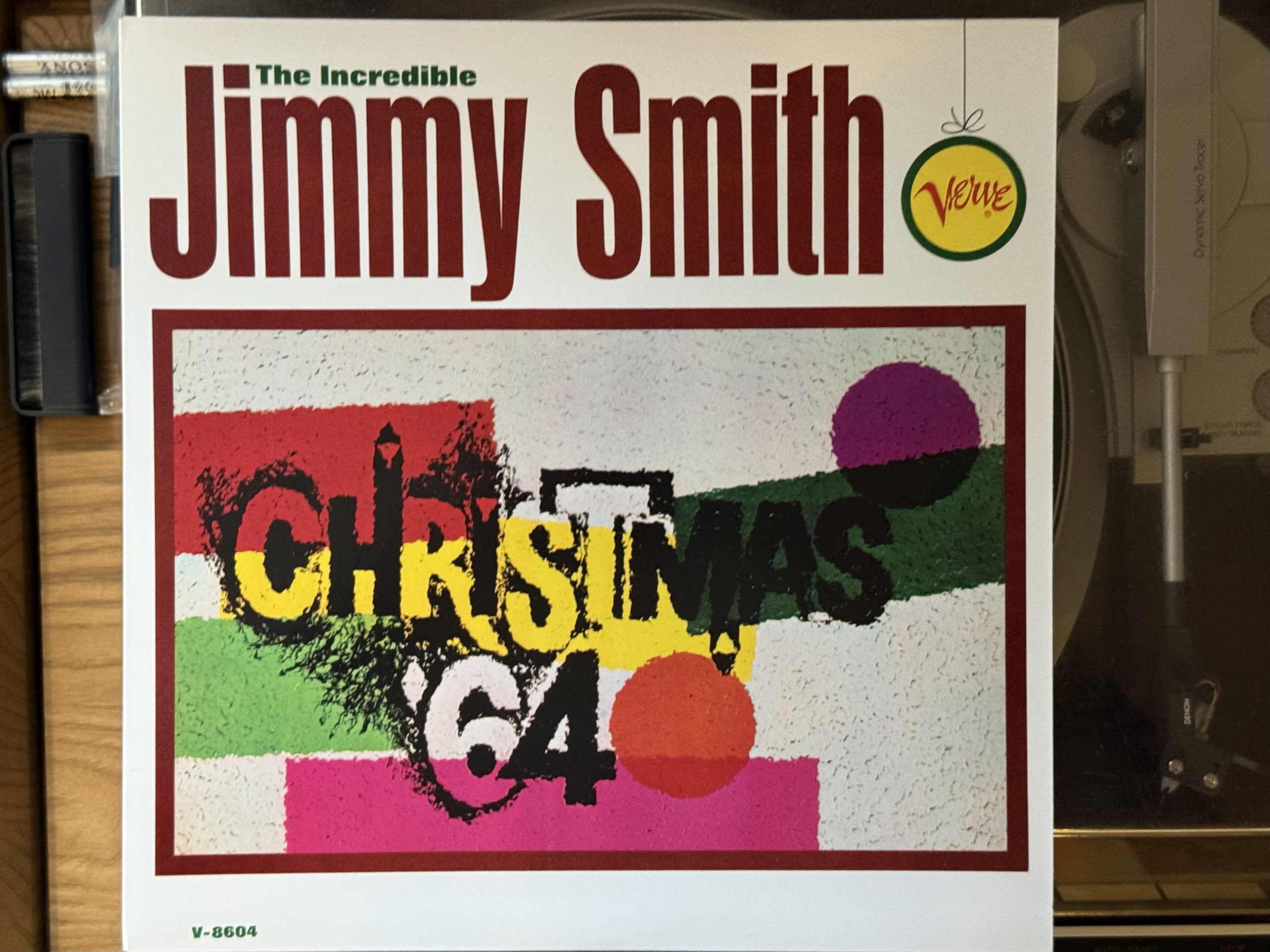
Jimmy Smith, Christmas ’64

One more organ record—maybe the best known of them all—brings us into this year’s holiday season.

November 29, 2025

Remember how I signed off last week saying we were going to “take a break for some seasonal music,” bringing this run of articles on the jazz organ to a close? Wanna know who our first purveyor of seasonal music is? (Squints) Oh yeah, Jimmy Smith. Had I planned better I could have set this up as a great segue from the organ combo articles into the holidays, but as it is you’ll have to settle for an absolutely spectacular album of both jazz organ and holiday music.

Jimmy Smith in 1964, on Verve, was at the height of both his musical powers and his bankability, and Creed Taylor was not the sort of producer who was above stretching the popularity of his artist for some additional revenue via the time-honored tradition of the Christmas album. Coming off his one-two punch of The Cat and Who’s Afraid of Virginia Woolf?, you’d be forgiven for expecting that Smith would take things easier on this holiday album. But with a band consisting of many of the musicians who made those great recordings, including Kenny Burrell (and Quentin Warren) on guitar, Art Davis on bass, Grady Tate (and Billy Hart) on drums—plus a whole orchestra that included Jimmy Cleveland on trombone and the elusive Margaret Ross on harp, among others—and charts by Billy Byers and Al Cohn, there was no room for slacking here. This is a seriously hot record, and a fantastic Christmas album to boot.

God Rest Ye Merry Gentlemen (Big Band version)” begins in big band fashion indeed, with a low-brass processional full of pomp and accompanied by the timpani, right up until “tidings of comfort and joy.” At which point the trumpets call a blue fanfare and Jimmy rolls in. The band continues with a “Slaughter on 10th Avenue” style take on the tune for one more verse, but then Jimmy takes the reins and plays a clean organ trio verse with Kenny Burrell and Grady Tate that is telepathically tight and funky. The horns rise up behind the trio like an incipient ambush until they take one more verse, but Jimmy gets the last word.

Jingle Bells” is a fine and mellow tune for the trio. Check Grady Tate’s subtle explosions behind the band as well as Jimmy’s understated organ part. The slow crescendos on the two held arpeggios are the only loud part of the arrangement, which fades out just as it gets going. It’s cool—something that can’t be said for the opening of “We Three Kings of Orient Are,” which sports a full symphonic brass arrangement that’s well-nigh Mahlerian, courtesy of saxophonist/arranger Al Cohn. But then it turns the corner into a gospel shouter and we’re really off and running. I would have been pleased to hear a side-long take on the middle bit of the arrangement, but here it’s bookended by an outro version of that opening.

The Christmas Song” is more swinging, with both Jimmy and the band in a laid back mood. The horns are swinging so hard they’re practically a beat behind, and Jimmy happily burbles bits of mood before playing a doggedly on-model melodic solo as the horns provide chromatically oracular pronouncements. A high chorus of trumpets brings us into a double-time solo wherein Jimmy stretches out over a frantic bit of Grady Tate drumming, then back to the chorus which slowly builds to a massive climax, punctuated by a chime before the final chorus.

The trumpets give us a “White Christmas” opening that could be played by the Boston Pops, key change and all, before Grady Tate takes us into bossa nova land. Jimmy’s solo is low key, in the baritone range, at least until the horns take it up a notch, at which point we get a little happy double time arpeggio, a final chorus, and a little “Jingle Bells” quote to wrap it up.

Santa Claus Is Coming to Town” is a trio number with Quentin Wells and Billy Hart, featuring Jimmy and Quentin trading off licks. The stereo separation (guitar in the left channel, organ in the right) is the only thing that helps to piece apart the players at the beginning, so close is the harmony, especially since Jimmy is soloing without much vibrato. Quentin Wells is a bluesier player than Kenny Burrell and he leans into that here, both in his solo and in the stabs of chords he plays under Jimmy’s solo. Jimmy starts out mellow but builds intensity through his usual tricks, particularly leaning on the tonic and playing bursts of arpeggios around the edges of his solo, all the way into the fade-out.

It’s another Pops-style arrangement for “Silent Night,” complete with bells and flugelhorn, then a handoff to Jimmy and the trio who do what they do best, a brisk, unsentimental swing through the tune. The horns make like “The Cat,” briefly, in the climax of their accompaniment to Jimmy’s solo—indeed, the only thing to criticize here is that they actually overwhelm the organ for the only time on record.

God Rest Ye Merry Gentlemen (Trio Version)” starts right in, sounding a bit like Jimmy’s version of “Greensleeves.” The trio with Quentin Warren and Billy Hart swings convincingly, with Billy’s snare work so powerful that it causes a secondary rattle somewhere between the snares and the ride cymbal. Jimmy spools off riff after riff in his solo, as Quentin Warren walks around the chords, keeping the rhythm going strong. At several points, it sounds as though the group will fade out, but the producers wisely keep rolling tape as the trio lands the hottest number on the whole record at the very end. Finally as the trio returns to the opening vamp, the engineers bring down the sliders and fade it out into the dark.
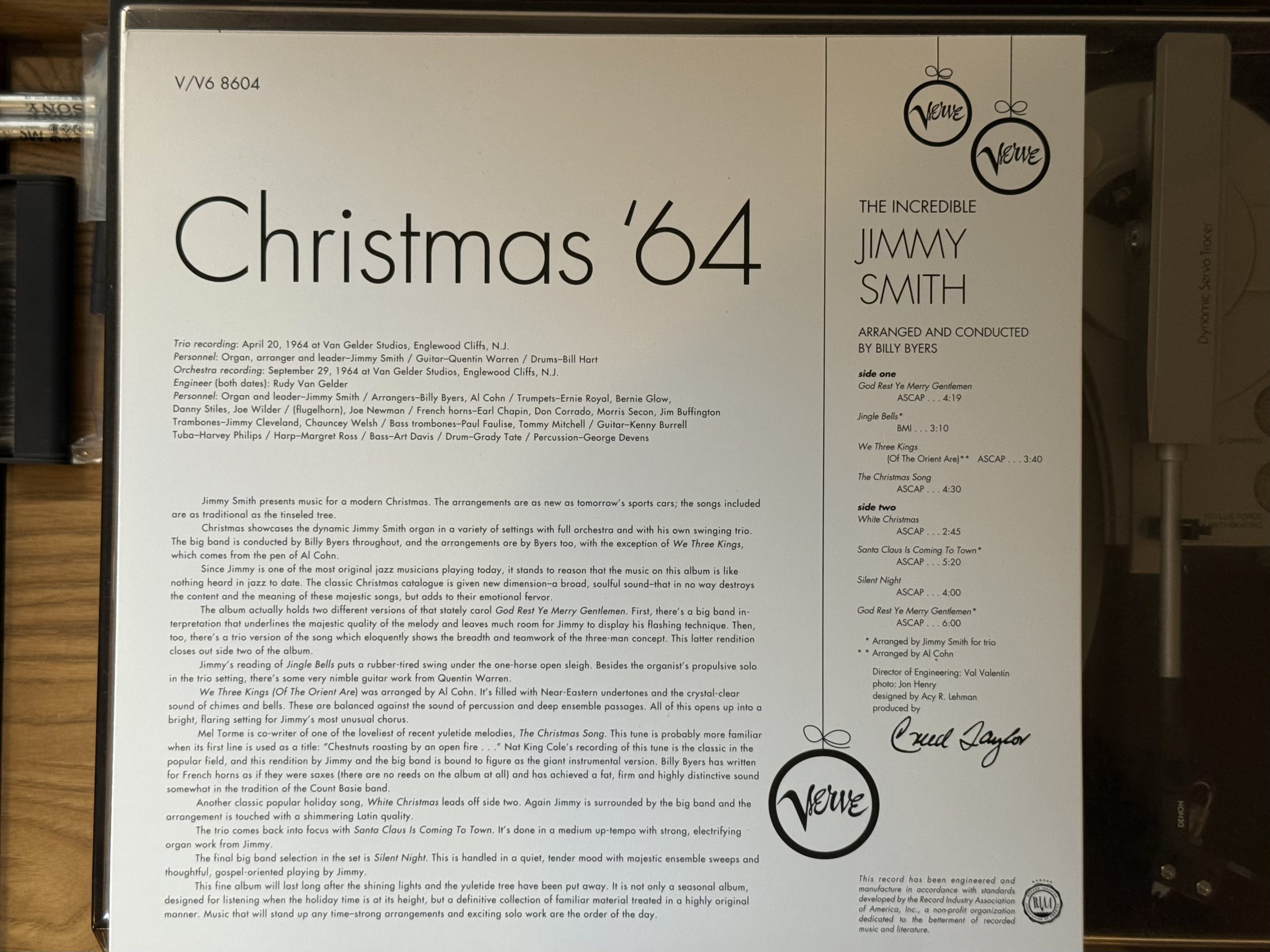
About the only thing wrong with Christmas ‘64 is the title; though it wasn’t the only Verve album to include the year in the title, it was clearly not a good choice for a title for a holiday album, which tend to sell between Thanksgiving and Christmas but can continue to rack up sales for many years. Retitled and with a new cover, the album had a long life under its new name, Christmas Cookin’, including in its CD reissue which included two other tracks, “Greensleeves” from Organ Grinder Swing and “Baby It’s Cold Outside” from Jimmy and Wes: The Dynamic Duo.

The better known cover and title for this week’s album as reissued in 1966, courtesy Discogs.

Next week we’ll stay in the jazz lane, with a holiday album by one of the players on this week’s set. You can listen to this week’s album here:

BONUS: This album and its related tracks cast a long shadow over holiday jazz records. The late great Joey DeFrancesco included a rearrangement of Jimmy’s “Greensleeves,” as “What Child is This,” on his superb 2014 album Home for the Holidays:

Jimmy Smith, Prayer Meetin’

Jimmy Smith and Stanley Turrentine take us to school in this coolly soulful recording from the organist’s years on Blue Note.

Album of the Week, August 2, 2025

This week starts a new series of posts about the records in my collection, and this time instead of concentrating on one player (or a group of related musicians) we’ll be listening to different takes on the same instrument – the organ.

I’ve long been a fan of the jazz organ sound, which I featured in an episode of Exfiltration Radio (in which you’ll hear a few of the tracks we’ll write about), and have sought out and found quite a few of its proponents. But today we’ll begin at the beginning, because you can’t talk about the jazz organ—namely, the Hammond B-3 organ—without talking about Jimmy Smith.

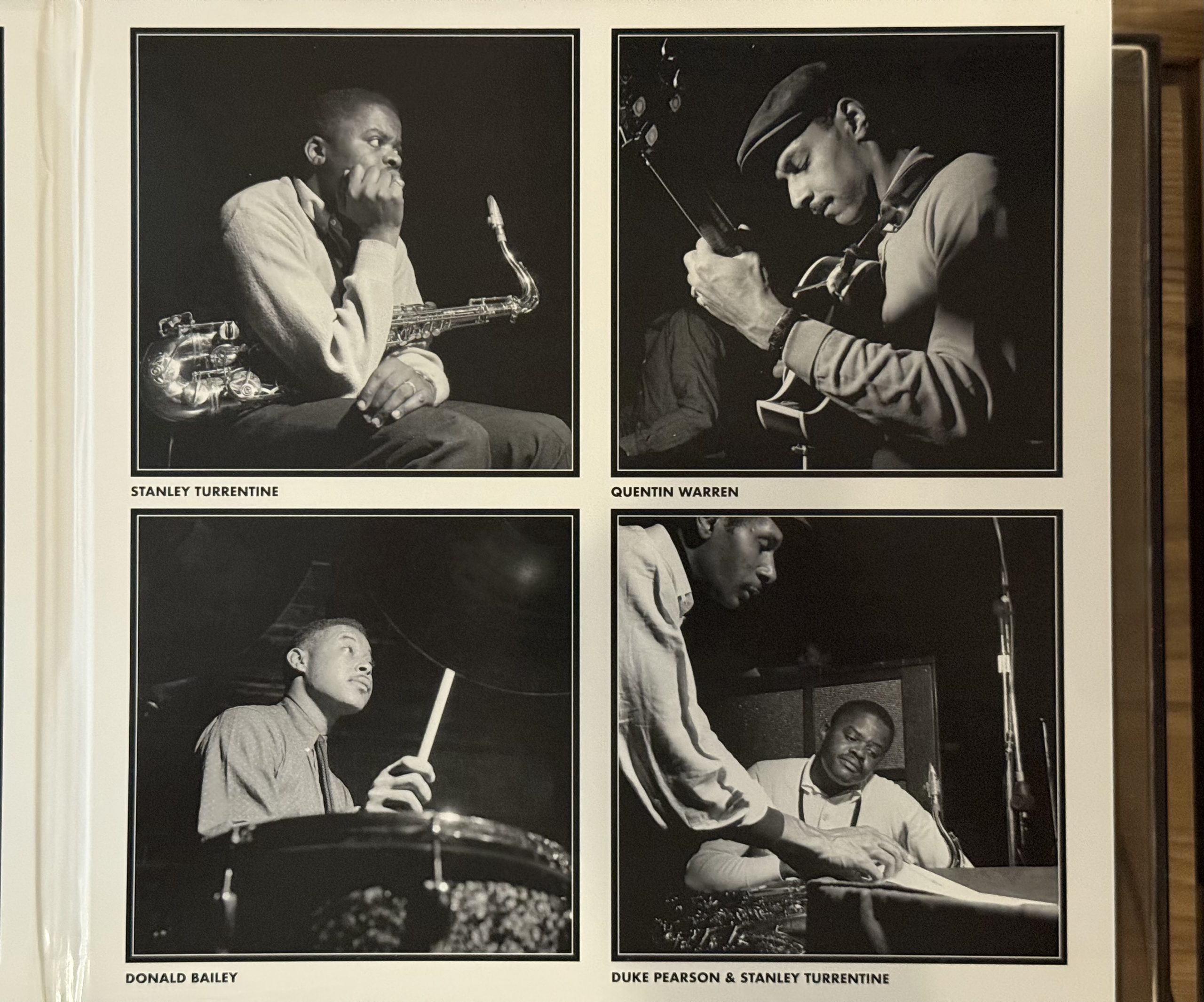
Like so much else in jazz, the jazz organ trio came about through a combination of technology, economics, and genius. The Hammond Organ Company had begun selling their electric organs to churches that couldn’t afford a traditional pipe organ, but gradually jazz players started adopting the instrument because of the richness of sound that could be produced, and jazz clubs started booking organ trios (with drum and guitar) because they were cheaper than larger combos but produced a bigger sound than piano trios. And Jimmy Smith, born in the Philadelphia suburb of Norristown in 1928, started exploring the sound of the instrument after honing his chops in the Royal Hamilton School of Music and the Leo Ornstein School of Music, and after several years playing boogie-woogie piano. He spent the latter half of the 1950s and the early 1960s recording for Blue Note, taping 40 sessions in eight years. The last of these studio sessions, recorded in early 1963 and released in 1964, was Prayer Meetin’, an organ trio with Quentin Warren on guitar and regular drummer Donald Bailey, plus the tenor saxophone of Stanley Turrentine.

Prayer Meeting,” one of two Smith originals on the album, gives us a meeting between the two leads as they take each other to church. The composition is a blues that’s also a showcase for Stanley Turrentine. After the laid back blues of the intro, he’s on fire—tossing off syncopated licks, firing off little moans in the high register, playing against the offbeat chords from Smith. Smith’s solo gives us that classic Jimmy Smith organ tone, made by pulling the first three drawbars all the way out (equivalent to setting the 16 foot, 5 1/3 foot, and 8 foot stops on a pipe organ). He starts by playing a countermelody against the accompaniment of guitar and drums, and then he starts preaching—he leans into the blue note for multiple measures, starts improvising in runs of full chords, gives a tremolo on chords for multiple measures, accentuated by a tossed-off arpeggio…  Turrentine’s closing solo on the melody is faded out; one wonders how much longer the duo could have gone on improvising like this.

I Almost Lost My Mind,” originally a 1950 R&B hit by Ivory Joe Hunter, opens with Turrentine and Smith playing the melody in three part harmony. Where the chart-topping single keeps a burner going under the slow melody with blues guitar licks, here it’s Donald Bailey’s implacable drumbeat that gives us the forward momentum as Turrentine swoons deep into the blues. Quentin Warren’s guitar keeps the chords moving under the first solo, freeing Smith to simmer under the saxophonist and hit rippling accents. When Turrentine’s solo comes to an end, the simmering organ cooks harder, with dashes of heat against the melody and another hard “lean” on the left hand across eight bars with a right hand tremolo. But it doesn’t shout; throughout, the band keeps it cool, even as Warren takes a clean, note-bending solo in the last two verses before the recap.

Stone Cold Dead in the Market,” by Trinidadian musician Wilmouth Houdini, was originally made famous by Ella Fitzgerald and Louis Jordan in 1946 in a West Indies accented performance. Here Bailey’s subtle bossa nova and the syncopation of the players carries the Trinidadian flavor without the murderous undertones of the original lyrics.

When the Saints Go Marching In” surely needs no introduction, and the players go right into it, with Smith playing the melody while Warren and Turrentine play a riff (in parallel fifths!) underneath. Here Smith and Bailey, especially, take the lid off, with the organist leaning into melodic improvisation over a bubbling backbeat from the drummer. Smith seems likely to go at this all day until Turrentine steps up to the plate, playing a continuous stream of eighth notes that swing hard against the groove established by the organ, drums and guitar. Smith picks it right back up after Turrentine steps back for another verse, and the combo cooks right down to the end (sadly faded out).

Red Top,” a tune by soul-jazz saxophonist Gene Ammons, starts out with Stanley Turrentine doing what he did best over dark chords from Smith. It seems like a straightforward blues number, but the scampering syncopation from Turrentine on the first improvisation verse and the leaned-into subtonic by both Turrentine and Smith across eight bars of the second verse signal that there’s some playful strangeness at work beneath the surface. The descending chromatic chords under Smith’s later solo reinforce the playfulness, as does the trading of thoughts between saxophonist and organist in the final verses as the tune fades out.

Picnickin’” gives us one last Smith original to go out on. This one is a blues by way of Broadway, and Turrentine swaggers up to the melody in his solo to signal that this one will go hard. Both Turrentine and Smith lean into the blues, but Turrentine shows off some of his rapid-fire chromatic work alongside the blues licks. Smith builds anticipation through repetition of suspended chords and the seventh, holding the leading tone for four to eight measures at a time in a favored trick from this session. The conclusion leads us out with the players reprising the melody in parallel fifths once more.

Prayer Meetin’ is a fair representation of Smith’s Blue Note recordings—deeply grooving, soulful, but always with a cool structure at its core. That signature sound was about to change as Smith parted ways with Blue Note for another label, known for jazz but also for stretching the boundaries of the music as it rubbed up against other styles. We’ll hear a prime example next time.

You can listen to this week’s album, with bonus tracks included on the CD reissue, here: