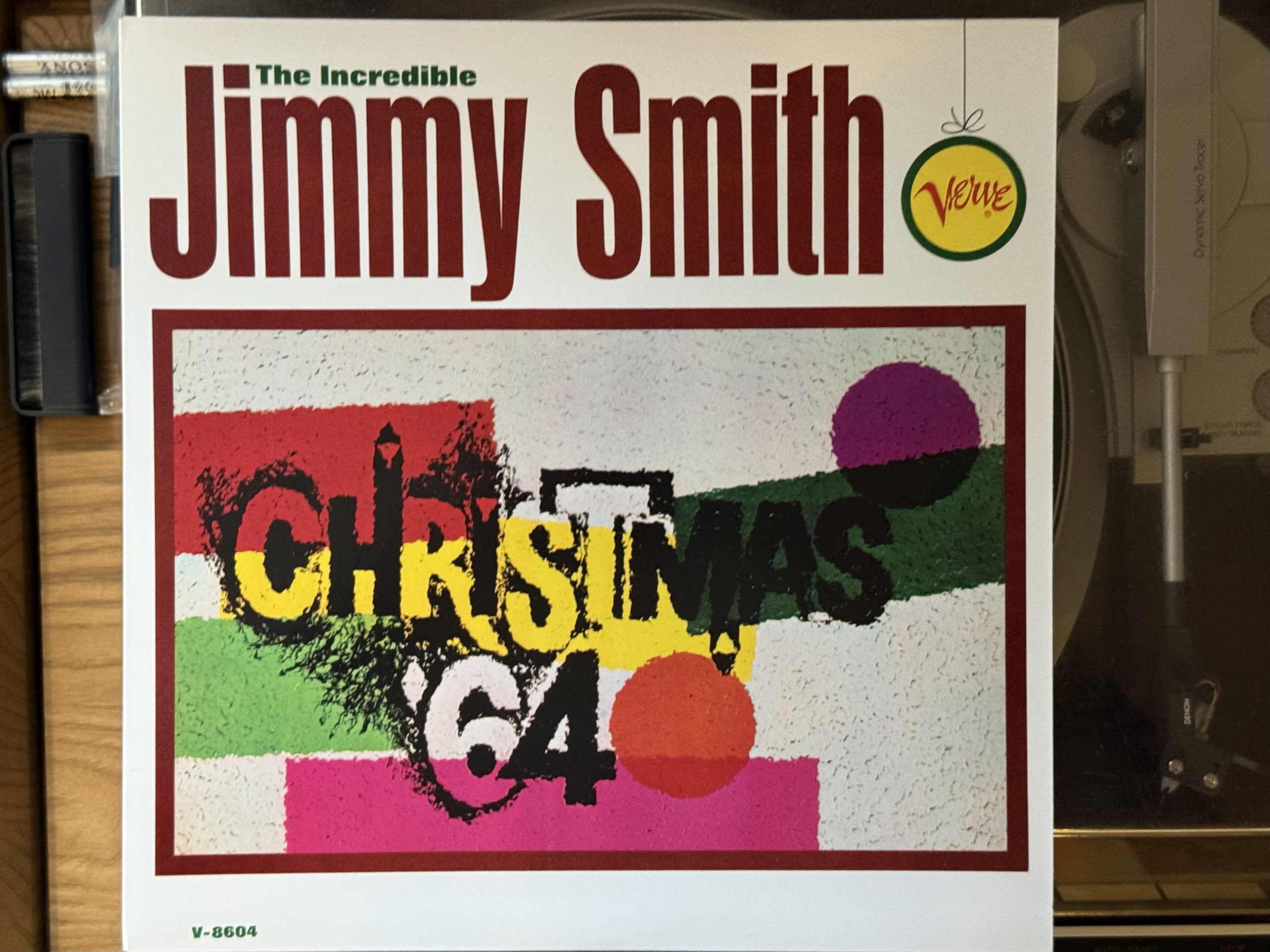
Jimmy Smith, Christmas ’64

One more organ record—maybe the best known of them all—brings us into this year’s holiday season.

November 29, 2025

Remember how I signed off last week saying we were going to “take a break for some seasonal music,” bringing this run of articles on the jazz organ to a close? Wanna know who our first purveyor of seasonal music is? (Squints) Oh yeah, Jimmy Smith. Had I planned better I could have set this up as a great segue from the organ combo articles into the holidays, but as it is you’ll have to settle for an absolutely spectacular album of both jazz organ and holiday music.

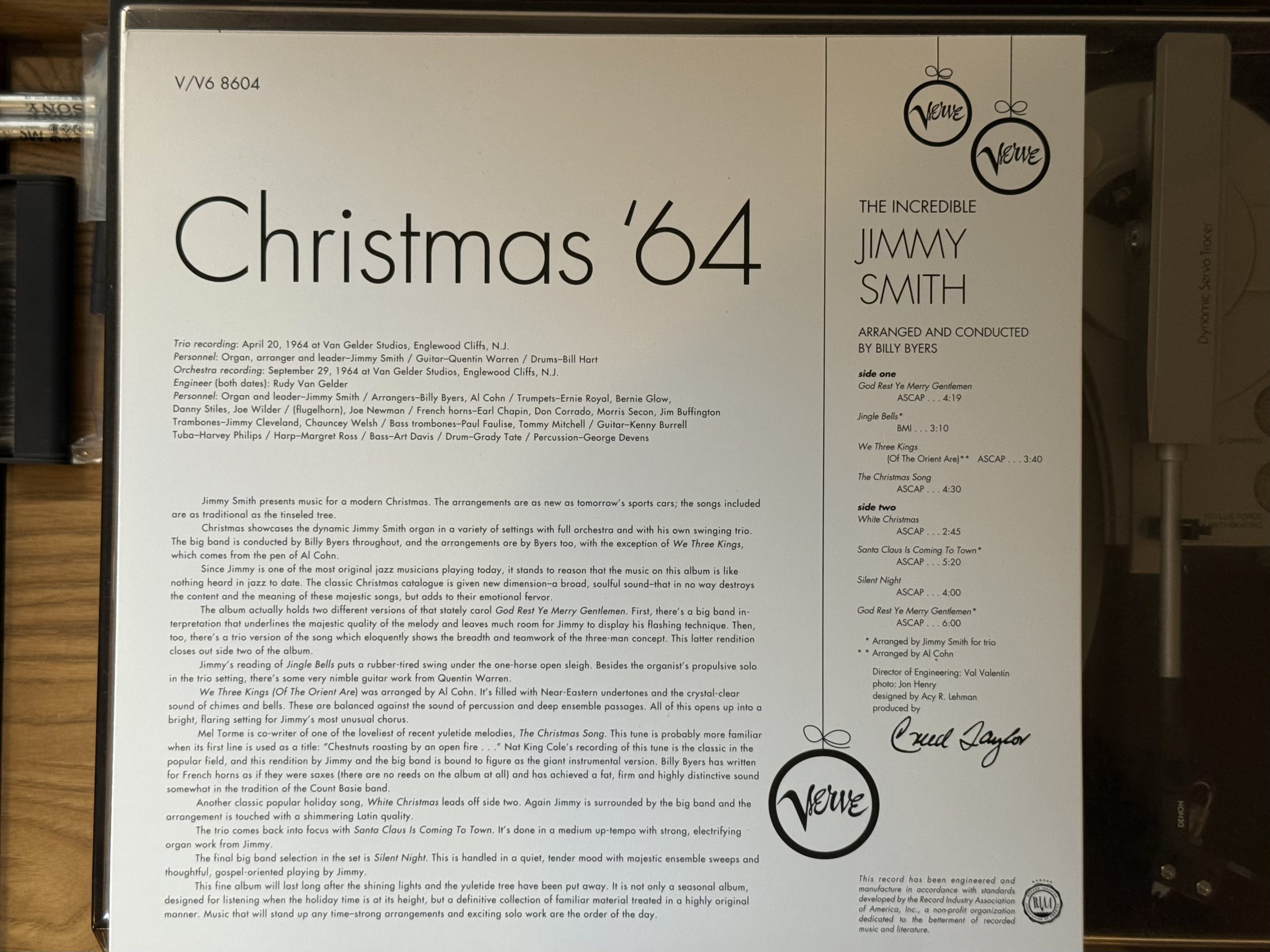
Jimmy Smith in 1964, on Verve, was at the height of both his musical powers and his bankability, and Creed Taylor was not the sort of producer who was above stretching the popularity of his artist for some additional revenue via the time-honored tradition of the Christmas album. Coming off his one-two punch of The Cat and Who’s Afraid of Virginia Woolf?, you’d be forgiven for expecting that Smith would take things easier on this holiday album. But with a band consisting of many of the musicians who made those great recordings, including Kenny Burrell (and Quentin Warren) on guitar, Art Davis on bass, Grady Tate (and Billy Hart) on drums—plus a whole orchestra that included Jimmy Cleveland on trombone and the elusive Margaret Ross on harp, among others—and charts by Billy Byers and Al Cohn, there was no room for slacking here. This is a seriously hot record, and a fantastic Christmas album to boot.

God Rest Ye Merry Gentlemen (Big Band version)” begins in big band fashion indeed, with a low-brass processional full of pomp and accompanied by the timpani, right up until “tidings of comfort and joy.” At which point the trumpets call a blue fanfare and Jimmy rolls in. The band continues with a “Slaughter on 10th Avenue” style take on the tune for one more verse, but then Jimmy takes the reins and plays a clean organ trio verse with Kenny Burrell and Grady Tate that is telepathically tight and funky. The horns rise up behind the trio like an incipient ambush until they take one more verse, but Jimmy gets the last word.

Jingle Bells” is a fine and mellow tune for the trio. Check Grady Tate’s subtle explosions behind the band as well as Jimmy’s understated organ part. The slow crescendos on the two held arpeggios are the only loud part of the arrangement, which fades out just as it gets going. It’s cool—something that can’t be said for the opening of “We Three Kings of Orient Are,” which sports a full symphonic brass arrangement that’s well-nigh Mahlerian, courtesy of saxophonist/arranger Al Cohn. But then it turns the corner into a gospel shouter and we’re really off and running. I would have been pleased to hear a side-long take on the middle bit of the arrangement, but here it’s bookended by an outro version of that opening.

The Christmas Song” is more swinging, with both Jimmy and the band in a laid back mood. The horns are swinging so hard they’re practically a beat behind, and Jimmy happily burbles bits of mood before playing a doggedly on-model melodic solo as the horns provide chromatically oracular pronouncements. A high chorus of trumpets brings us into a double-time solo wherein Jimmy stretches out over a frantic bit of Grady Tate drumming, then back to the chorus which slowly builds to a massive climax, punctuated by a chime before the final chorus.

The trumpets give us a “White Christmas” opening that could be played by the Boston Pops, key change and all, before Grady Tate takes us into bossa nova land. Jimmy’s solo is low key, in the baritone range, at least until the horns take it up a notch, at which point we get a little happy double time arpeggio, a final chorus, and a little “Jingle Bells” quote to wrap it up.

Santa Claus Is Coming to Town” is a trio number with Quentin Wells and Billy Hart, featuring Jimmy and Quentin trading off licks. The stereo separation (guitar in the left channel, organ in the right) is the only thing that helps to piece apart the players at the beginning, so close is the harmony, especially since Jimmy is soloing without much vibrato. Quentin Wells is a bluesier player than Kenny Burrell and he leans into that here, both in his solo and in the stabs of chords he plays under Jimmy’s solo. Jimmy starts out mellow but builds intensity through his usual tricks, particularly leaning on the tonic and playing bursts of arpeggios around the edges of his solo, all the way into the fade-out.

It’s another Pops-style arrangement for “Silent Night,” complete with bells and flugelhorn, then a handoff to Jimmy and the trio who do what they do best, a brisk, unsentimental swing through the tune. The horns make like “The Cat,” briefly, in the climax of their accompaniment to Jimmy’s solo—indeed, the only thing to criticize here is that they actually overwhelm the organ for the only time on record.

God Rest Ye Merry Gentlemen (Trio Version)” starts right in, sounding a bit like Jimmy’s version of “Greensleeves.” The trio with Quentin Warren and Billy Hart swings convincingly, with Billy’s snare work so powerful that it causes a secondary rattle somewhere between the snares and the ride cymbal. Jimmy spools off riff after riff in his solo, as Quentin Warren walks around the chords, keeping the rhythm going strong. At several points, it sounds as though the group will fade out, but the producers wisely keep rolling tape as the trio lands the hottest number on the whole record at the very end. Finally as the trio returns to the opening vamp, the engineers bring down the sliders and fade it out into the dark.
About the only thing wrong with Christmas ‘64 is the title; though it wasn’t the only Verve album to include the year in the title, it was clearly not a good choice for a title for a holiday album, which tend to sell between Thanksgiving and Christmas but can continue to rack up sales for many years. Retitled and with a new cover, the album had a long life under its new name, Christmas Cookin’, including in its CD reissue which included two other tracks, “Greensleeves” from Organ Grinder Swing and “Baby It’s Cold Outside” from Jimmy and Wes: The Dynamic Duo.

The better known cover and title for this week’s album as reissued in 1966, courtesy Discogs.

Next week we’ll stay in the jazz lane, with a holiday album by one of the players on this week’s set. You can listen to this week’s album here:

BONUS: This album and its related tracks cast a long shadow over holiday jazz records. The late great Joey DeFrancesco included a rearrangement of Jimmy’s “Greensleeves,” as “What Child is This,” on his superb 2014 album Home for the Holidays:
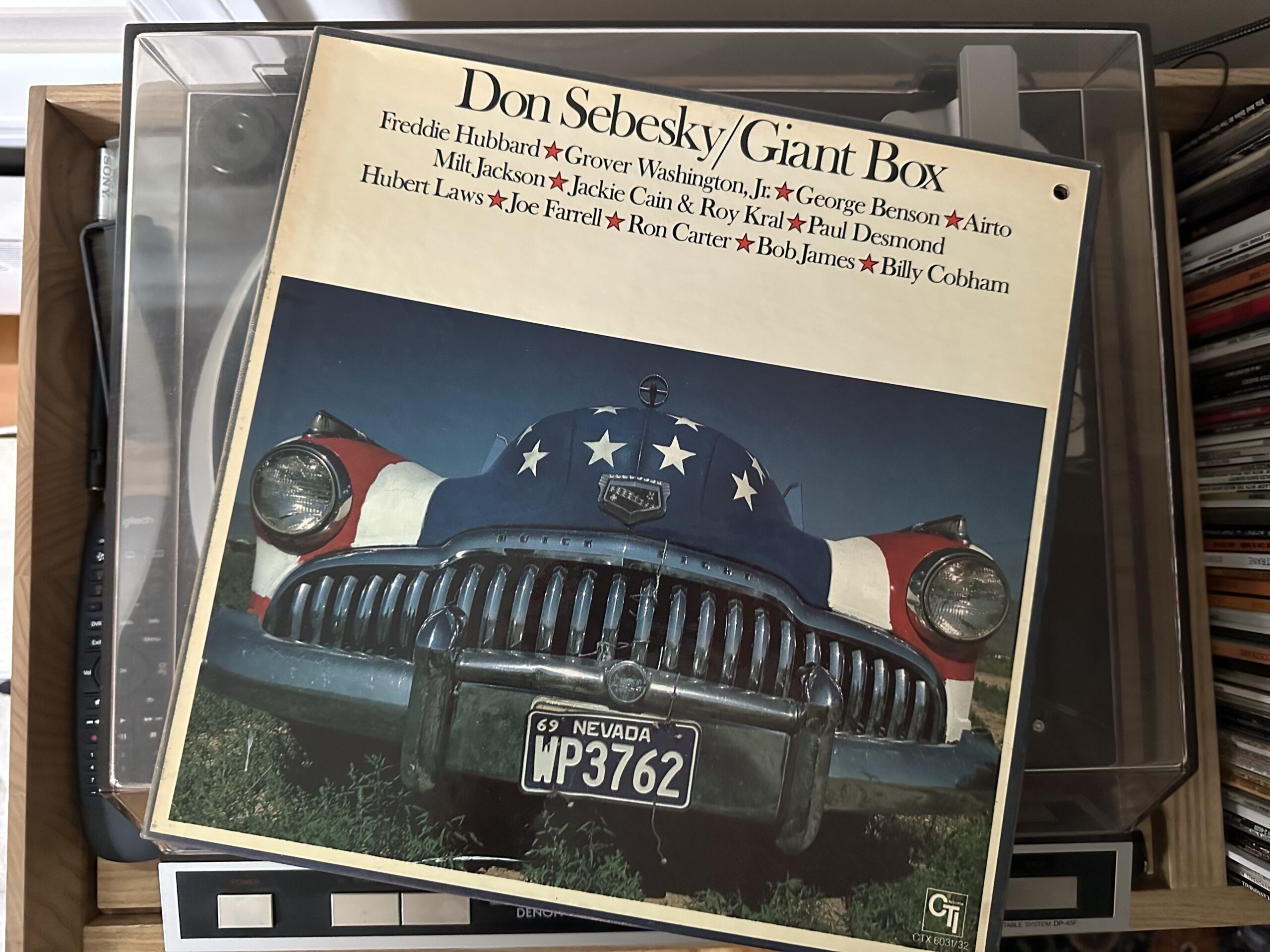
Don Sebesky, Giant Box

Album of the Week, July 22, 2023

Remember how I said, last week, that Deodato 2 represented the CTI Records sound dialed up to 11? Well, we’re going to redefine what “11” is. Giant Box, the biggest physical release that CTI ever did, lives up to its name in terms of packaging, scope, number of players, and sheer ambition. And it’s all wrapped up in the first of only two releases in the CTI discography credited to Don Sebesky as a leader, backed up by virtually every name on the CTI roster.

We’ve heard about Sebesky in a number of these reviews, and it’s worth taking a peek at his bio. Born in Perth Amboy, New Jersey, in 1937; a trombonist who studied at the Manhattan School of Music and played with Kai Winding, Claude Thornhill, Tommy Dorsey, Warren Covington, Maynard Ferguson and Stan Kenton; switched to arranging in 1960; had enormous success with his arrangements for Wes Montgomery on his 1965 album Bumpin’ for Verve Records, produced by Creed Taylor. By the time we find Giant Box in 1973, Sebesky had been working with Taylor for almost a decade, and the new success of the label enabled him to do this project.

And what a project it was! The seven tracks on Giant Box range from classical third stream crossover—only in this case it’s Stravinsky and Rachmaninoff; pop music (a Joni Mitchell cover); jazz-funk; and a handful of original compositions that channel a whole bunch of new influences, including Donald Byrd’s flirtations with spiritual jazz. There’s a choir on here, somehow. And there’s (deep breath) Freddie Hubbard, Grover Washington Jr., George Benson, Airto, Milt Jackson, vocalists Jackie Cain and Roy Kral, Dave Brubeck’s foil Paul Desmond, Hubert Laws, Joe Farrell, Ron Carter, Bob James, Billy Cobham, Jack DeJohnette, Randy Brecker, Warren Covington, and a full orchestra. Basically the whole roster of the label showed up, and it’s incredible.

Firebird/Birds of Fire” combines Igor Stravinsky’s orchestral score for The Firebird with John McLaughlin’s fusion classic “Birds of Fire,” the title track for the second album by the Mahavishnu Orchestra, which had been released just four months before the recording sessions started. It’s as bonkers as it sounds, with a purely classical opening that only hints, via slight hits of the rhythm guitar, at the madness that lies ahead. At the 2:15 mark, the classical orchestra parts like a curtain, revealing an ensemble anchored by the tight rhythm section plus George Benson and a completely bananas string section. Hubert Laws gets the first solo over this rhythm section, followed by Freddie Hubbard, whose solo dissolves into a swirl of freaked-out strings. The strings and rhythm section fade out, an orchestral statement triumphantly re-voices the ending theme, and then the rhythm section and swirling strings return in a two minute coda, tapering in a fade-out.

After the opening track, Joni Mitchell’s “Song to a Seagull” is a quiet breath, with Paul Desmond’s alto saxophone fading in unaccompanied. Bob James enters on Fender Rhodes, joined by Ron Carter. This is mostly a quartet track, with only a hint of orchestral backing between verses and under the final chorus. The track is meditative and quiet, basically the polar opposite of “Firebird/Birds of Fire”.

Free as a Bird” is one of the Sebesky originals on the album. The horn chart is straight out of the school of Gil Evans, but it falls away quickly to Bob James’ piano, in a trio with Carter and DeJohnette. Hubbard plays a brisk solo that’s quietly virtuosic, with all of the blaze and none of the screaming of his solo live work. Grover Washington Jr. plays a propulsive solo on the soprano sax, in only his second CTI appearance (he made his CTI debut on Randy Weston’s 1972 Blue Moses). The tempo changes to a 6/8 samba for about 30 seconds and then recapitulates the top of the tune. It’s a brilliant show.

Jimmy Webb’s “Psalm 150” was written for Revelation, a short lived Christian rock band, and first recorded on their 1970 self-titled debut album. Recast as a jazz number, it’s reminiscent of Donald Byrd’s spiritual jazz experiments on A New Perspective, albeit with slightly squarer vocals courtesy of Jackie and Roy, very approximate Latin pronunciation, and a little echo of the Beatles. Freddie Hubbard’s trumpet solo is tight, playing with meter as it weaves around the blues. When Ron Carter takes a piccolo bass solo, it shifts the whole composition into a blues jam. Bob James provides a quirky organ solo that continues to evolve the blues sound. After a final chorus, the whole thing ends in “loud, crashing cymbals.”

Paul Desmond again changes gears, with a tender rendition of Rachmaninoff’s “Vocalise.” I once went out with a girl in college who was an oboe player, who bitterly protested when she heard Branford Marsalis’s rendition of “Vocalise”: “The saxophones get all the solos! Let the oboe have this one!” Here Desmond applies enough English on his solo, alongside DeJohnette’s brilliant drums, to rightly claim the tune for the saxophone; Milt Jackson also comes at the tune sideways in his solo, evoking the underlying blues. Hubert Laws stacks on top of Jackson’s solo, then yields to the orchestra and a final chorus.

Fly/Circles,” another Sebesky original, opens in flights of flute, courtesy of Hubert Laws and an echo loop. Sebesky sings his composition “Fly” in one of the few bad choices on the album; his is a fine composer’s voice but not up to the material. Another round of echoed flute ensues, transitioning into “Circles,” a fast blues with the tune in doubled keys and soprano sax, this time played by Joe Farrell. After an extended Farrell solo, the orchestra comes back, then falls away for Hubert Laws with Carter and DeJohnette. A final orchestral take on the tune closes out the track.

The closing number, “Semi-Tough” represents the jazz-funk side of CTI quite ably, with Sebesky on a variety of keyboards, Grover Washington Jr. on sax, Billy Cobham on drums, Ron Carter on a rare electric bass, and George Benson on an effects-heavy guitar, plus orchestra and voices. The guitar effect pedal threatens to sink the track; fortunately Washington’s sax pulls the track back up to a higher standard of performance. It’s not the most successful jazz-funk track in the CTI catalog, but it’s a good closing number here.

Giant Box is not subtle, but it’s surprisingly effective at showcasing all the different elements of the CTI sound, thanks to a cast of thousands and some excellent arranging from Sebesky. We’ll hear his arrangements again, but our next few CTI albums will be smaller-scale affairs—though no less funky.

You can listen to the album here: