My travel plans have just firmed up–I’ll be driving down on the 17th (um, does anyone in the DC area have a couch I can crash on that Thursday night?), then heading into Charlottesville on Friday for a research day in the Special Collections Library. From then on, it’s the reunion activities. And it should be a lot of fun.
On the eve of the 140th anniversary of the Virginia Glee Club, whose founding date (1871) makes it one of the seven oldest collegiate glee clubs in the United States, it feels curmudgeonly to point out the relative lack of hard evidence for the 1871 founding of the Club, and the abundance of pointers to other prospective founding dates—1886? 1893? 1914? What about dates before 1871? Each has some degree of validity as a starting point for the messengers of harmony, love, and brotherhood. So, curmudgeonly as it feels, we should at least take a peek at the alternatives.
First, the official date of 1871 has been claimed since at least the 1970s, when the liner notes for A Shadow’s on the Sundial quoted an 1871 issue of the Virginia University Magazine as saying that the men of the Cabell House had made “great efforts, and we understand tolerably successful ones, to form a Glee Club.” On the basis of this description, assuming that the founding of the group happened in 1871 seems reasonable. To get forward to modern times, though, you have to connect the dots across a series of other groups that called themselves Glee Clubs but had no institutional connections between them, starting with the Claribel in 1874, through the Glee Club in which Woodrow Wilson sang in 1879-1880, and on and on. Let’s take a quick look at some of the other dates that have claims for posterity:
1886: In the early 20th century, the Glee Club looked back to this year as the year of its founding. Harry Rogers Pratt’s Glee Club counted 1935-1936 as their 50th anniversary year and celebrated it with a tour to New York as well as a 50th anniversary concert, held 75 years ago tomorrow. But no historical record remains to tell us what happened in 1886 save a single mention of a Glee Club tour in the Magazine, and that reference makes it sound as though the Club had been around for a while.
1893: The birth of the Glee Club (actually, the Glee, Mandolin, and Banjo Clubs) as a group that toured beyond the University precincts. Their six city tour in January-February 1894 resulted in press in the Atlanta Constitution among others. But there appears to be continuity between this group and its 1891-1892 predecessor, so while 1893-1894 was an important turning point for the Club it would be inappropriate to call it a founding date.
1914: After the Club disbanded in 1912-1913, it re-formed after a brief hiatus under A. L. Hall-Quest. This is one of the first few firm dates attested outside of the pages of College Topics, as it appears in Philip A. Bruce’s History of the University of Virginia. We can trace continuous activity of the Glee Club forward from this date, even through both World Wars; 1914 thus stands as a significant milestone in the life of the group.
So 1914 is the latest date that we should think about in terms of the (re-)formation of the Glee Club. But is there an earlier date than 1871? Would you believe two?
1870. A full 11 months before the Virginia University Magazine famously wrote decrying the lack of musical clubs, it was writing about … the Glee Club! Albeit satirically: “The [Glee Club], we are told, has succeeded in procuring most of the fragments of an ‘ante-bellum’ violoncello, and hopes are entertained of their ultimate union.” Apparently they also mistook rain for bouquets. But there was a glee club at the University before February of 1870, and it was well established enough to be called “the Glee Club.” And then there’s…
1861. Cited in several places, including the Shadow’s on the Sundial liner notes and Barringer’s 1906 University of Virginia: Its History, this was apparently a serenading group that came out of the student housing on Carr’s Hill, just as the Cabell House Men were themselves a boardinghouse group. Traditionally we have considered the 1861 group a “predecessor” and not part of Glee Club history; separated not only by ten years but also by the Civil War from the “official” group, the Carr’s Hill Glee Club might as well have been a century before.
So where, after all, does this leave us? Perhaps with this thought: If we are to accept the gaps in the Glee Club’s history after the 1871 date, should we not extend the founding date to 1870? Perhaps not all the way to 1861, but absent any other information, it seems as though the Club referenced in 1870 is the same as the one in 1871.
Or, perhaps, we should leave well enough alone, and leave traditions where they stand, and accept that, when you are tracing the foundation of a group of students, one beginning point is as good as the next.
All I know is that I’ve got a definite research agenda for when I head back to Charlottesville before the reunion. I’ve got to find that January 1871 Virginia University Magazine, and any other old records I can.
On Sunday I had to make my way back down to Virginia for a family emergency. While the cause was not pleasant, it was nice to be back in the town of my birth, for the first time in about ten years.
In the summer of 2000 my parents sold our family home and relocated to the family farm near Asheville, North Carolina. And that, I thought, was that, as far as visiting home. While I had friends in town, somehow I just couldn’t manage to make the trip from Boston, then later Seattle. So much of the town had changed since I grew up; it didn’t feel like I had a reason to come back.
But on Sunday, as I drove down from Dulles, around Richmond and into the hospital at Williamsburg, I started being aware of uncanny memories in my muscles. I knew where that on-ramp to 295 was; I knew how long I had before getting off on 64. After visiting in the hospital, I knew how to make my way down 199 into the center of Colonial Williamsburg and to drive around Merchant’s Square. I remembered the twists and turns to get back out of town on Rt. 60 (okay, my sister had to help a little with that one), and all the bits and pieces of the drive back into Newport News from there. And I remembered how to turn just there, off Denbigh Boulevard and up Old Courthouse Way, and take the back roads into the old neighborhood. As I turned onto Nicewood Drive it was a weird feeling, as though my parents would be there in the old house waiting with dinner made.
Muscle memory gave way to emotional memory, and I was riding my bike to the comic store, getting on the bus to go to school, washing the family cars in the driveway. Even the sight of someone else’s stuff through the big picture windows in the living room of the house didn’t break the spell.
But it was overlaid with different perspectives. I was conscious, really conscious, of a fact that had never seemed important when I was growing up: how close I was to the wetlands. Newport News is on a peninsula between the James and York Rivers, and at the edges is all estuary and wetlands. And somehow, growing up, my mental axes were aligned to the roads that led out of town; I never understood how close I was to those wet edges. Turns out, it’s darned close.
I drove to the family friends who were putting up my parents and sister, and when we got the call that other family friends were ready for me to come, drove down to Beechmont and after catching up went to bed.
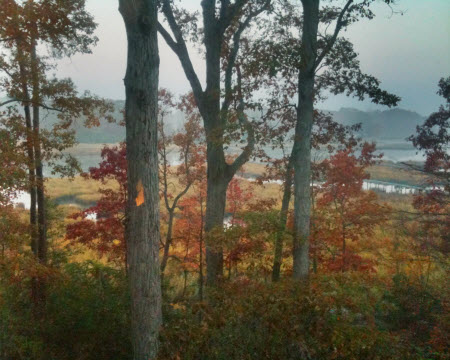
And in the morning, I opened the curtains in the guest bedroom and saw the picture above. And the trees and red leaves and reeds and the creek and all, and I suddenly missed the place I was born.
Linwood Lehman wasn’t a Glee Club member–he was an undergraduate during a period where the Glee Club was mostly dormant, graduating in 1915 (the club had just revived that year after several less fruitful seasons). But he was a triple Hoo, taking a bachelors, masters, and doctorate at the University, and then going on to teach Latin there until his untimely death in 1953.
What is perhaps more surprising is that when he became a professor in 1920, he was only the University’s second Jewish professor. It turns out that Virginia, despite Jefferson’s Statute of Religious Freedom, was not particularly welcoming for Jews. The University’s first Jewish professor, J.J. Sylvester, was hired in 1841 but lasted less than a full term; the faculty failed to discipline a rowdy student who challenged him, and he was subsequently attacked by the student’s supporters. At the time of his hiring, the Richmond-based Presbyterian newspaper The Watchman of the South protested, claiming he had been hired over 40 other qualified candidates and stating “We have often said that as infidelity became ashamed of its own colors, it would seek to form alliances with Papism, Unitarianism, Judaism, and other errors subversive of Christianity.”
Lehman’s humor is present in the “Virginia Yell Song,” written when he was an undergraduate. The only UVa football song with a parenthetical interjection, it sounds in places like a conversation between slightly jaded onlookers who will only cheer a winning team:
Down the field our team is dashing–fight, Virginia, fight!
Carolina’ll get a smashing right
We are out for blood today so yell, boys, yell!
(–Will we get it? –I should say so!) Yell like hell!
But the overall song, with its “Let’s give a yell, boys, and we’ll yell Wa-hoo-wah/and raise our voices loud and roar,” has proved a worthy addition to the UVa football song repertoire. It was recorded on the Glee Club’s first album in 1951, and has made an appearance on the most recent one as well.
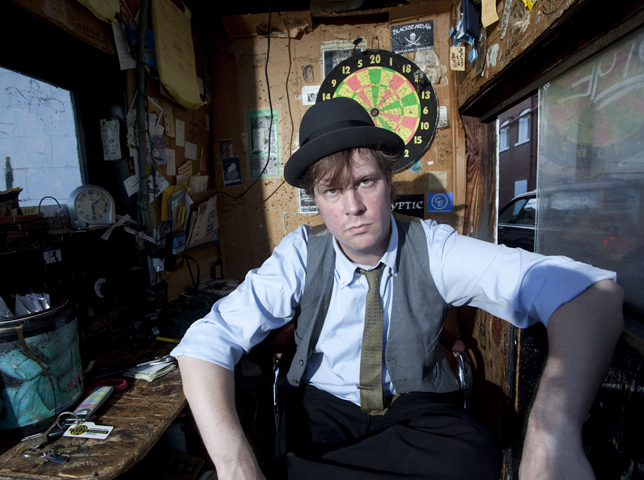
This week, the documentary The Parking Lot Movie hit the iTunes store for download or rent. A movie about the Corner Parking Lot in Charlottesville and the philospher-kings who work there, it features an appearance by Our Very Own D.R. Tyler Magill (that’s him above), with music by another friend, Sam Retzer.
I have rarely laughed so hard when listening to a soundtrack as I did when the first cut came on, Rikka Rikka’s “Life in a Nutshell.” To paraphrase does it no justice; you simply have to hear it.
There’s also a set of outtakes on YouTube: check this one that Tyler leads off:
I am going to have to start a whole new Glee Club history chapter about this thing; both Sam and Tyler sang with me, back in the day.
As I bask in a UVa football victory by a team that seems, for the first time in years, headed in the right direction, I am moved to consider why this is so.
I happen to be reading Philip Bruce’s History of the University of Virginia now, and there’s a bit in a chapter on the first decade of the 20th century that describes a deliberate shift in Virginia’s attitude to collegiate athletics, one that was to inform its approach for much of the next 100 years:
The committee earnestly counselled that the following resolutions should be at once passed: (1) that, in the opinion of the Faculty and students, the only proper basis of inter-collegiate athletics was that spirit of pure amateur sport which animates contests between gentlemen the world over; and that the true criterion which differentiated amateur sports from professionalism was the spirit which plays the game for sake of the game itself; (2) that membership in a team should be held only by actual students,— a rule which would exclude all who carried about them the odor of professionalism,— and by young men whose class records demonstrated their keen interest in their scholastic work; (3) that it was the part of gentlemen engaged in any amusement, sport, or game, to remember, at all times, that they were gentlemen first, and only incidentally, players,— that they were to follow, not the bastard honor which calls for victory at whatever price of fraud or brutality, but the voice of true honor, which prefers an hundred defeats to victory purchased by chicanery or unfair dealing,— that the Faculty and students were determined to discountenence and brand with their disapproval any intentional violation of the rules of the game by members of the University teams or any improper advantage taken by them of their antagonists, and that it was entirely immaterial whether these were detected by umpire or referee; (4) that it was to be assumed that the opponents of these teams were gentlemen equally with themselves,— that every presumption of honorable dealing was to be accepted in their favor until the contrary was conclusively shown,— and that they were to be looked upon as guests, and as such to be always protected from rough and inequitable treatment; (5) that the spectators on the home grounds should show fairness and courtesy towards opposing players and officials of the game; and that the more considerate and generous the behavior of the University teams on such occasions, the more nearly would their members approach the ideal of the true gentleman and the true sportsman.
Thinking about where we are now, vs. where we were during the Groh years, my conclusion can only be that Mike London knows his University history.
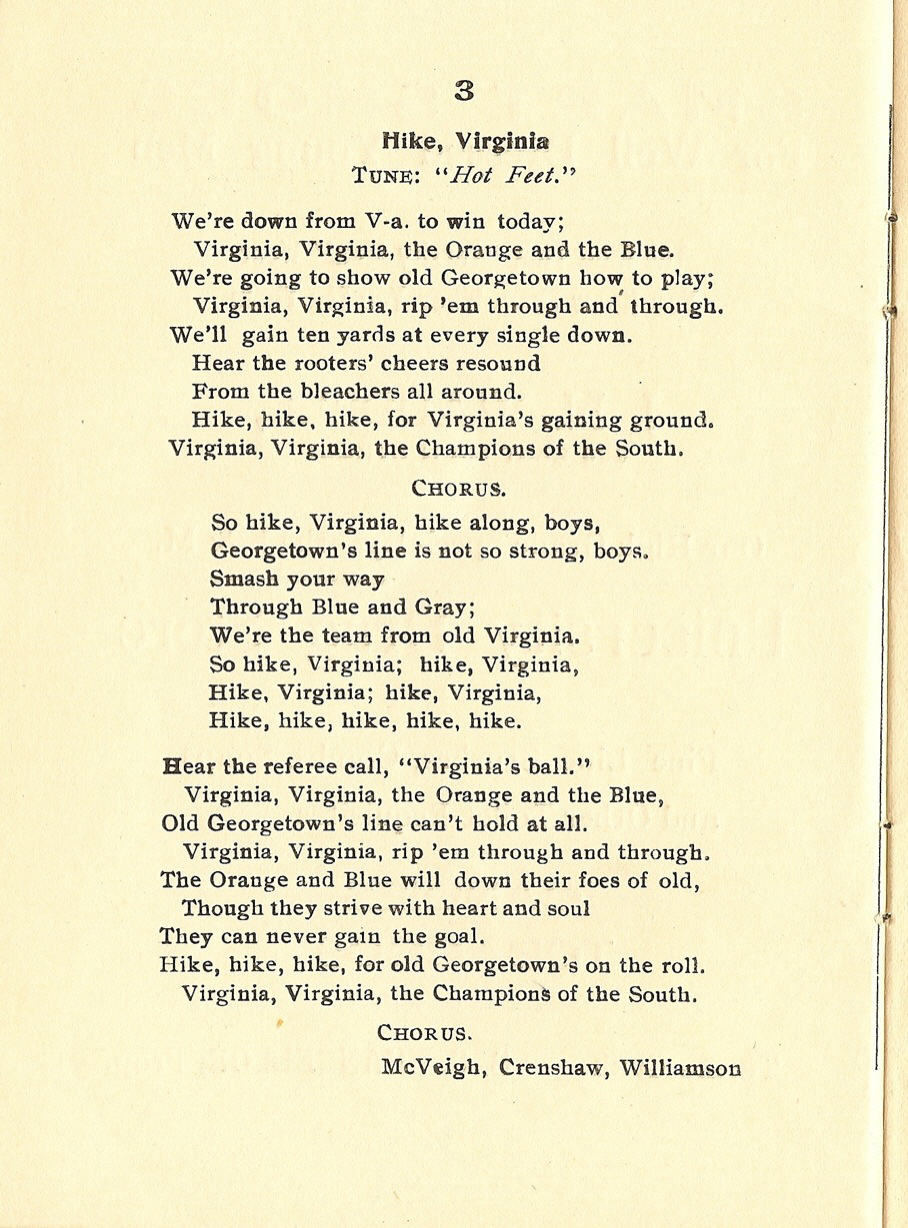
"Hike, Virginia" lyrics in a 1911 football song book
It’s first and ten for a new season of Virginia football, and for the first time in several years my heart is full of more than the usual blind optimism. With a new coach at the helm, I feel as though Virginia has a chance to shake loose the malaise that’s gripped the team for the past few years. In the spirit of blind optimism, then, I present a little history: the back story of a Virginia football song, “Hike, Virginia.”
As I noted earlier this year, spectators used to sing at Virginia football games. And not just “The Good Old Song”–there were songs for every occasion and for every foe. A 1911 football song book that has come into my possession indicates part of how they were able to pull this off, by having lyrics in front of every fan, but there was much more required to make it happen, from the presence of a band (or the Glee Club) at games to Virginia fans who would write songs to be sung by the crowd. One of these fans was L. D. Crenshaw, and the song was “Hike, Virginia,” cowritten by Crenshaw and C.S. McVeigh.
The story might end there, but I did a little sleuthing and found that L.D. Crenshaw was in fact Lewis D. Crenshaw, first secretary of the UVA Alumni Association, first to successfully accomplish a system of modern reunions, and the originator and host of the University’s bureau in Paris during World War I. He was fondly remembered by many alumni as a redoubtable host; a New Years Eve party in Paris was to continue “‘jusqu’au moment où les vaches rentrent chez ell’ (’til the cows come home). On the menu was ‘de l’egg nogg véritable.’” He was also instrumental in getting the centennial reunion together, with his goal being
to see that every human critter that can walk or hop or crawl or fly or swim, or even float down the Rivanna on his back, gets within calling distance of the old Rotunda… [searching for the] oldest living specimen of the genus alumnus Virginiensis, who we will have seated on the throne of extinct beer kegs [prohibition being in full force], and crowned with a chaplet of fragrant mint leaves.
Unfortunately, the infant Alumni Association could not afford to keep up Crenshaw’s salary, reports University historian Virginius Dabney–it seems alums were delinquent in their dues even in the beginning–so he resigned his post and returned to Paris indefinitely.
Less is known of C.S. McVeigh, save that he was in the Glee Club in 1905, per concert reviews in the spring of that year published in the Baltimore Sun and the Alexandria Gazette. (It is becoming axiomatic that just about every Virginia song I run across has at least one Glee Club man responsible for its authorship.) But together they produced a lesser known but still fun gem in the annals of Virginia songs.
“Hike, Virginia” was first recorded on Songs of the University of Virginia and can be heard on the Glee Club’s current record, Songs of Virginia, along with other Virginia songs.
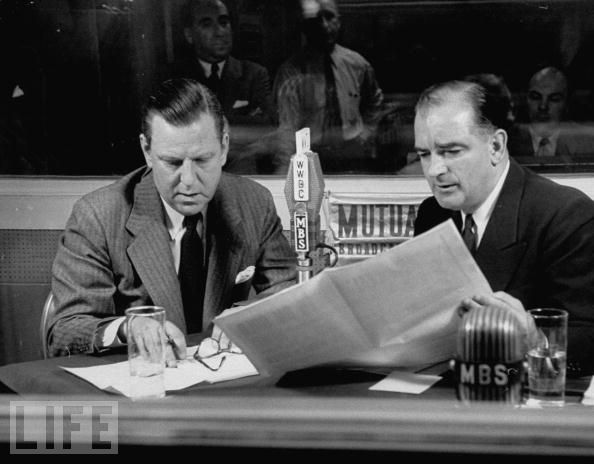
Fulton Lewis, Jr. with Joe McCarthy (source: Life Magazine)
Today’s odd moment in Virginia Glee Club history comes by way of that “other” official Virginia song, “The Cavalier Song.” While most alums today are familiar only with “The Good Old Song,” that collectively authored song-about-a-song set to the tune of “Auld Lang Syne” by Glee Club alum E.A. Craighill and sung by swaying Hoos at every touchdown, that song was never an official song of the University, though it has been the de facto alma mater since its introduction in 1895.
Instead, the University’s two official songs were chosen through a contest sponsored by College Topics (now The Cavalier Daily) in 1923. Seeking official University songs, the contest netted “Virginia, Hail, All Hail!“, by Glee Club alum John Albert Morrow, and “The Cavalier Song,” by English instructor Lawrence Lee and Glee Club alum Fulton Lewis, Jr. While most alums are familiar with “Virginia, Hail, All Hail!” only, if at all, through Glee Club performances, “The Cavalier Song” has been played at Virginia sports events by the various bands (University Band, Pep Band, Cavalier Marching Band) during the school’s history since its introduction. Because it’s typically performed as an instrumental, its lyrics have faded into obscurity, meaning that it is Fulton Lewis Jr.’s tune that we know best about the song.
It’s perhaps ironic that Lewis’s contribution to the University has been so long lasting, since many of his other contributions to history were decidedly less cheery. Described as “an indifferent student,” he left the University without a degree after three years and sought his fortune as a journalist, becoming a reporter and editor at the Washington Herald. After helping to unmask spy for Japan “Agent K” as Naval officer John Semer Farnsworth, he rose to fame as a conservative radio commentator, where at his peak he was syndicated on over 500 stations. As a commentator, he staked out a series of positions on the wrong side of history: against the New Deal and FDR, against America’s entry into World War II, and in support of Barry Goldwater and Joe McCarthy–backing the latter even after his nationwide disgrace.
Lewis’s ongoing support of McCarthy cost him his national audience, though he continued on the air until his death in 1966. He left behind him a noxious legacy and a reputation for subjective partisanship: the New Republic noted that his “wild charges were part of his campaign over many years to smear in every way possible the New Deal, the Fair Deal, and everybody not in accord with the most reactionary political beliefs”; the Washington Post memorialized him in 1987 as “one of the most unprincipled journalists ever to practice the trade”; and a profile on Salon calls him “a master of the partisan smear.” He called moderate Republicans, like Casper Weinberger, Communists. In many ways, then, he was ahead of his time.
I was pleased to download and check out the University of Virginia’s new iPhone app. “One stop” doesn’t begin to cover the scope of this app — Grounds directory, news, alumni clubs, reunions, alumni magazine, the Cavalier Daily, sports scores (and notifications)…
…and music. I was even more pleased to find the Virginia Glee Club‘s recording of “Vir-ir-gin-i-a” on the app’s list (along with marching band renditions of “The Good Old Song” and other Virginia tunes. While “Vir-ir-gin-i-a” seems an odd tune to represent Club–the recording from which the song was taken, Songs of Virginia, has many more familiar UVA related songs including the superb “Virginia, Hail, All Hail“–it’s actually an interesting tie to the past of both the University and the Glee Club.
“Vir-ir-gin-i-a” has many connections to the Glee Club. Featuring an arrangement by long-time Club conductor Donald Loach based on a tune by Handel, the text is by UVa professor Arthur Kyle Davis, Jr. (1897-1972). Davis himself sang in the Glee Club shortly after the group’s reformation by Alfred Lawrence Hall-Quest, serving as secretary during the group’s 1916-1917 season (during which Club performed the blackface musical “Oh, Julius!,” a minstrel-show story of life in ancient Rome). Davis went on to serve in the Army during World War I; went to Oxford on a Rhodes scholarship; and returned to the University as a professor in the English department in 1923.
And here’s where it gets interesting. Davis went on to his greatest fame as a folklorist, collecting three volumes of traditional ballad and folk songs through field research and becoming the archivist for the Virginia Folklore Society. The main thrust of his research was in showing that the English and Scottish ballads listed and enumerated by Harvard folklorist Francis J. Child (the “Child Ballads”) were alive and well on American soil for hundreds of years before their collection and numbering by Child.
While influencing numerous Virginia faculty, including Paul Gaston, his most unlikely influence was on folk singer and song collector Paul Clayton, a student of his in the 1950s, whose song “Who’ll Buy You Ribbons (When I’m Gone)” was “re-gifted” by Bob Dylan for “Don’t Think Twice, It’s Alright.” Of course “Who’ll Buy You Ribbons” was itself “re-gifted” from an Appalachian song called “Who’s Gonna Buy Your Chickens” which Clayton learned from Mary Bird McAllister, a song that was collected by Clayton while he was Davis’s student.
And “Vir-ir-gin-i-a”? Davis knocked it out in his spare time, apparently, in honor of the University’s sesquicentennial and premiered it himself at a meeting of the Jefferson Society. Loach arranged it for men’s voices for the 1972 Glee Club LP A Shadow’s on the Sundial, which financed the group’s first European tour, and it’s been in Club’s repertoire on and off since.
So while there are better known, and arguably better, pieces of Virginiana that could feature on future UVA app playlists, there are few that have so many interesting touchpoints to Glee Club, Virginia, and even pop music history.
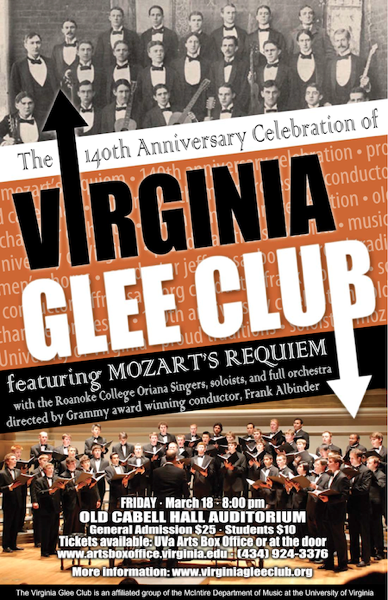
I got my official “save the date” mailer for the Virginia Glee Club’s 140th Anniversary celebration last night. I haven’t been to a reunion weekend since the 125th back in 1995, so am eagerly looking forward to attending.
Not least on the reasons that I want to return: the opportunity to sing under four great Club conductors. I haven’t seen John Liepold since 1996 or so, so am looking forward to renewing acquaintances. I only met Bruce Tammen once, at a Clubhouse party in the late 90s. I had a blast singing with Frank Albinder’s Glee Club this spring when the group came through on their Northeastern tour.
And I’m especially interested to sing with Donald Loach. While I came into the group at a time when there were still a lot of hurt feelings over the separation in 1989, the more I learn about his tenure as Club director (still the longest serving at 25 years), the more respect I have for him and what he was able to accomplish. It should be interesting to see what happens.
Today’s Virginia Glee Clubhistory moment is a look at the Concert on the Lawn. The Glee Club’s entry in the collegiate tradition of “step singing,” the Concert on the Lawn was inaugurated in 1936 as a community sing with an announcement in College Topics, featuring this trenchant quotation from conductor Harry Rogers Pratt:
Ability to sing is not a pre-requisite. Those who think they can sing are wanted especially. Tenors will be protected by Beta and Captain Mack. Baying, bellowing, and booing will be allowed. ‘Sweet Adeline’ will be sung as often as demand warrants.
The concert was a roaring success, with the review reporting:
With beer in front of them, beer in back of them, beer inside of them, “Pratt’s Boys” went to town last night and lifted the skies from the steps of the Rotunda.Some say the interlude was caused by a shortage of foaming brew, but whatever it was, either the Lure of the Lawn or the Radiance of the Rotunda, it was good!
Over the next sixty years, Club continued to mount free performances on the Lawn in spring afternoons, and surprises–whether community sing-alongs of Old MacDonald or four-voice performances of “Freebird”–abounded.
And then… the tradition died out. Reports are mixed on the cause: some say that a new Glee Club conductor feared his men couldn’t be properly heard in an outdoor venue (as if that were ever the point). Whatever the case, sometime in the late nineties was the last time there was a free Concert on the Lawn by the Glee Club. Here’s hoping that we will see another one sometime soon.
This weekend as a bunch of Tanglewood Festival Chorus members and I recouped our strength after the July 4 concert, we got to talking. One of the women was a Wellesley College alum from the mid-1980s who, upon learning that my friend and I were both from UVA, said, “I remember UVA, especially the Glee Club. The men were almost as nice as the cadets who would come sometimes, only they didn’t feel compelled to offer an arm to the women they found walking about campus.” She proceeded to say some highly complimentary things to the men of the Glee Club; they must have made quite an impression, over 25 years ago. The encounter gave me the motivation to dig into the Virginia Glee Club Wiki with renewed energy over the weekend.
The outcome: I added a bunch of new ways to look at the information on the Glee Club wiki. First, a milestone: we now have season pages for 70 years of Glee Club history; that’s half the Glee Club’s chronological age and more than half of the active seasons of the group’s history (given the hiatuses in the early part of the century). After last week’s president search, we now have pages for 49 Glee Club presidents, as well. (Next horizon there: the 1980s.)
I’ve also added some categorization to the wiki. You can browse the history by chronology, with sub-categories for every decade. There’s also a category (as yet incomplete) for Glee Club members who were Lawn residents, with a special focus on 5 West Lawn. You can also browse the available photographs (still working on clarifying the names of some of these).
And in the middle of all this organization, there’s still room for discovery. Today I found, in the Holsinger archive at the UVA library, a photograph of Malcolm W. Gannaway (see above), famous for serving as president in two discontinuous years and for providing the student leadership necessary to get the dormant Club up and running again in the Hall-Quest years. I would never have found him without the research already in the wiki, as his Glee Club affiliation is not mentioned in the archives. My hope is that as we continue to build out the records that have been begun in the wiki, we can continue to deepen our understanding of this group that affects lives so deeply.
Over at the Virginia Glee Club Wiki, I’ve embarked on a mini-project-within-a-project, trying to find and list as many presidents of the Glee Club as possible. So far, we’ve got 37 presidents named, including five whose last names begin with M and a full nine Bs. (Still working on getting a representative set of data to see if those distributions are skewed.)
In the meantime, you can help a VMHLB brother out by identifying any presidents who are missing. There is definitely some low hanging fruit–I’m missing many from the 1980s and late 1990s and almost all of them from the 2000s, for instance. Even better is if you have any other officer names from those years. Just leave a comment on this page, or–even better–put ’em in the wiki yourself.
Update: Thanks to Frank Albinder’s contributions, we now are up to 44 presidents, filling in most of the 2000s.
Thanks to Google, the UVA library, and other online resources there is now a wealth of information available about the early 20th century at the University of Virginia–so much so that we can start to trace the history of individual student leaders of the Virginia Glee Club, not just the group’s directors. Two examples stand out from the Glee Club of the period from 1910 to 1920–Malcolm W. Gannaway and DeLos Thomas, Jr.
Malcolm W. Gannaway bears the unique distinction of having been president of the Virginia Glee Club twice, in discontinuous years. He was there in 1910-1911, when the Club reformed under the direction of M. S. Remsburg, and graduated in 1911. He seems to have been not just a leader but also quite a fine singer, having been tapped to sing at Baccalaurate in June 1911. Leaving for a fellowship at Harvard, he picked up a Masters there, but seems to have been unable to escape the gravitational pull of Mr. Jefferson’s University. He returned to UVa as a summer session instructor for the years 1912-1914, then enrolled as a law student. While he was there, the Glee Club reformed again under the leadership of A. L. Hall-Quest, and Gannaway apparently stepped up again as president.
DeLos Thomas, Jr. was never president of the Glee Club, but was present as an officer in the pivotal 1915-1916 and 1916-1917 seasons when the Club got back on its feet for good after a spotty existence in the early part of the century. Thomas served as secretary and treasurer under Gannaway’s leadership in 1915-1916 and went on to serve as vice-president in 1916-1917. Then the Great War happened, and Thomas joined the Navy, eventually becoming an aviator. He was still flying at the end of the war, when he led a squadron that helped to prove the efficacy of aerial bombardment as an anti-submarine defense. Quite effectively, too: his squad was to have been the first of three to attempt to sink a captured U-boat, but the following squads never got a chance to attack it as the U-boat sank after being hit with only about a dozen bombs. Thomas’s story sadly ends in tragedy, as his aircraft disappeared on a flight back from Bimini in 1923.