
Album of the Week, December 20, 2025
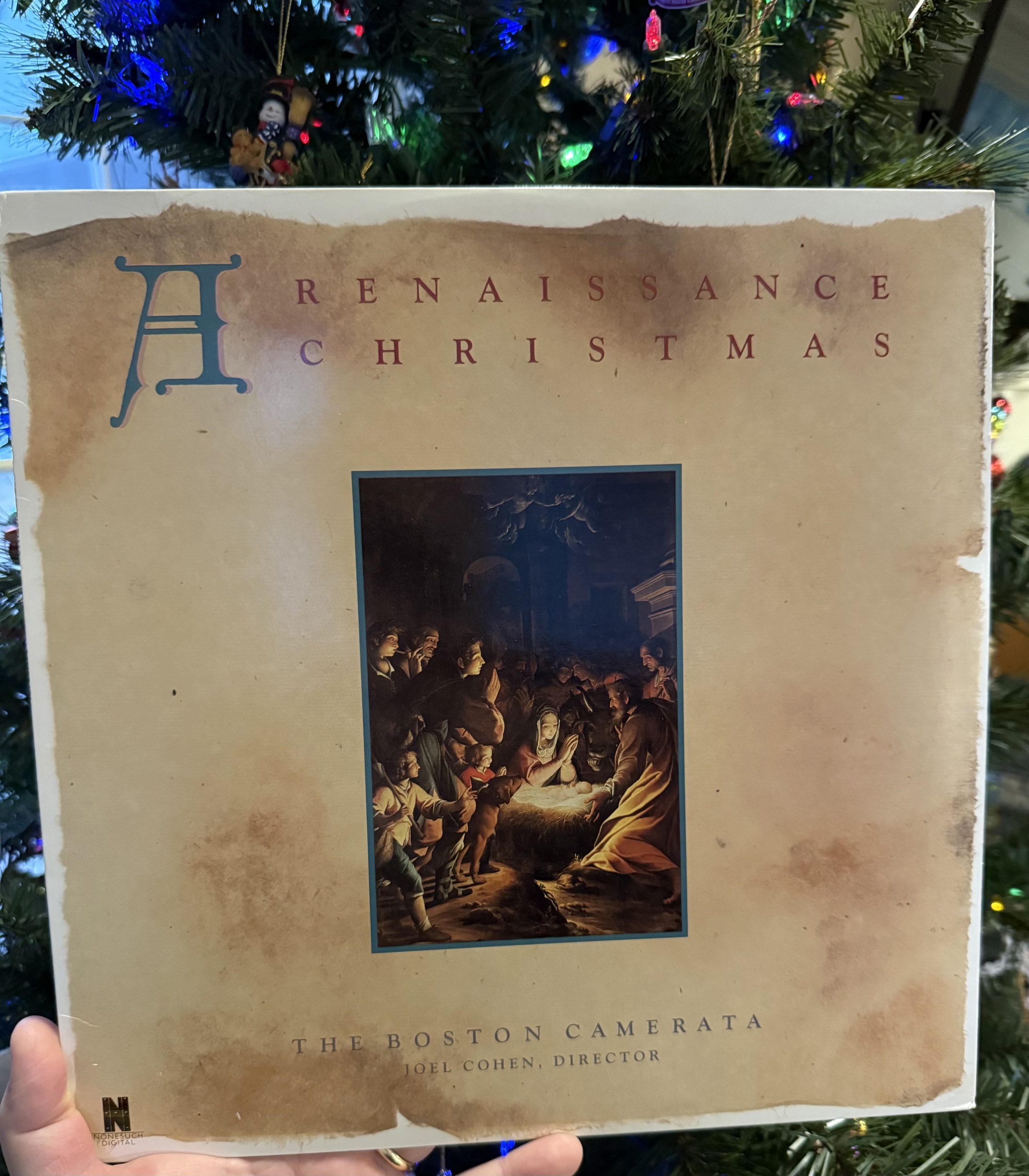
I have written about several Boston Camerata Christmas records: Sing We Noel, A Medieval Christmas, even an early A Renaissance Christmas from 1974. And each time I do, my friend Frank Albinder, formerly director of the Washington Men’s Camerata and member of Chanticleer, and current director of the Virginia Glee Club, says, “I used to sing with them! I recorded a Christmas album with them!” And: Yes, Frank, you did! This week’s post is for you.
Frank’s sojourn in Boston as a music grad student came in handy when Joel Cohen was assembling the musical forces for the 1986 release A Renaissance Christmas (true to the group’s name, the album was a local Boston production, recorded in Trinity Church in Copley Square in December 1985). Vocally speaking, there are no carryovers from Sing We Noel, the Camerata’s prior Christmas album—but there’s an eight-year gap between those two recordings, and one presumes that a great many Camerata members were, like Frank, graduate students who were passing through Boston on their way. One notable exception to the rule is soprano Anne Azéma, who began her recording career with the Boston Camerata with 1984’s La Primavera and is still with the Camerata today as its artistic director. (Along the way she married Joel Cohen.)
It is Azéma’s voice that leads off the album, with the 15th century English carol “Nowell: Dieus vous garde.” (Yes, English: Richard Smert wrote the carol in a mixture of English and Norman, as was appropriate for the court at the time.) The quartet of voices plus viol sings one of my favorite non-traditional Christmas carols, an early invocation of Father Christmas, with purity and compelling melodic line. The reverie is followed by “Gaudete, gaudete”, sung with vigor by the ensemble; this is one of the carols from the album that can be widely heard on other recordings, but the performance here blends expertise with vigor in a hallmark of these Camerata recordings.
Following a recitation in broad Middle English (here the narrator is tenor Edmund Brownless) that gave my family the in-joke “Hail, Mary, full of fescue,” we get the Kyrie from Guilliame Dufay’s “Ecce ancilla Domini” Mass, with Brownless, countertenor Kenneth Fitch, and bass Albinder providing the solos. Fitch’s voice is delightfully balanced and resonant, lacking some of the eccentricities of the countertenors on the 1970s Camerata recordings, and the overall impression is magnetic, particularly, when the ensemble cuts out at the end leaving the trio to provide the final “Kyrie.” We make our first stop in Spain with “E la don don,” performed with sparkling briskness, and then return to France with two instrumental settings of “Une jeune fillette.”
“Une jeune fillette” (in alteration with “Joseph est bien marìe”) leads us into the next set, with the women’s voices led by Azéma singing the latter carol with interludes of the former in a beguiling arrangement. A brief instrumental bridge of “Joseph, lieber Joseph mein” leads to the highlight of the first half, a performance of Joseph Galliculus’s “Magnificat quinti toni.” Sung bits of chant alternate with hypnotically fugueing renditions of familiar Christmas tunes in an astonishing reverie.
The second half is much more carol-focused, with Frank’s unaccompanied solo on “Esprits divins” leading off, followed by a reading and the original harmonization of “Es ist ein Ros’ entsprungen,” with lute and voice. An appropriately swaggering “Riu, riu chiu” follows, unaccompanied save for antiphonal handclaps until the final choruses.
Cohen constructs a mini-Praetorius set (Michael and Hieronymous) around the visit of the Magi. Michael Praetorius contributes the more familiar “Wie schön leuchtet der Morgenstern,” followed by a reading and the Hieronymous P. setting of “O vos omnes,” mourning Herod’s crime against the firstborn.
The set that follows celebrates the shepherds at the cradle, and is in some ways the most adventurous part of this adventurous record. Opening with a reading and a 16th century Italian dance played on the ocarina by Marilyn Boenau, the ensemble then plays a set of vigorous music from the French, Catalan and Provençal traditions. Nicholas Martin’s “Nouvelles, nouvelles” gives us a beautiful melody led by Azéma, while the Catalan “Tau garçó, la durundera” is all rhythm and close harmonies. Finally, the Provençal “Tura lura lura, lo gau canta” provides a high spirited and faintly comic call-and-response between Cohen and the men of the ensemble as they tell the story of a shepherd afraid to make the pilgrimage to Bethlehem.
Lastly, we get a trio of Renaissance masterworks, beginning with the final reading from Luke and the Tómas Luis de Victoria “O magnum mysterium.” The latter is far and away the most famous of the liturgical music on the record and is given a gorgeous reading by the Camerata. A pair of works by Michael Praetorius concludes the record, with Azéma trading phrases in call and response with soprano Roberta Anderson in “Singet und klinget, ihr Kinderlein” and the ensemble singing a Provençal text from 17th century Avignon to a dance melody by Praetorius in the final setting, “Bransle de Poictou/La bona novella.”

The Boston Camerata at this stage of their development was a remarkable ensemble, doing their own research and constructing programs that both instructed and enlivened the ear. A good many recordings have followed, even after Cohen’s retirement, and the ensemble itself carries on. (In fact, I’m taking the family to hear them perform some early American Christmas music tomorrow.) The individual musicians on this recording also had a variety of careers; viol and recorder player Jane Hershey recorded for many years with Hesperus, soprano Roberta Anderson with Boston Baroque, and both countertenor Ken Fitch and bass-baritone Albinder would go on to greater fame and fortune with Chanticleer.
Next week we’ll swerve back to something closer to jazz as we draw the mystery of the holiday to a close.
You can listen to this week’s album here: