I can’t believe that in all the time I’ve been blogging about music and cocktails, I’ve never written about Charles Mingus’ eggnog recipe. Pointed to it, a few times, but never discussed it.
That might be because it’s A Lot. Two shots of liquor per serving, plus whatever 151-proof rum makes it through the preparation of the eggs. One begins to understand why Mingus was prone to firing shotguns inside his apartment.
Still, aside from the sheer volume of booze to be had in each glass, the rest of the recipe—eggs, milk, cream, nutmeg—doesn’t seem that far-fetched. Well, except for the addition of ice cream at the end, but that only if you set it out at a party, to keep it chilled.
The recipe, as it was transcribed by Mingus’ biographer:
Separate one egg for one person. Each person gets an egg.
Two sugars for each egg, each person.
One shot of rum, one shot of brandy per person.
Put all the yolks into one big pan, with some milk.
That’s where the 151 proof rum goes. Put it in gradually or it’ll burn the eggs,
OK. The whites are separate and the cream is separate.
In another pot– depending on how many people– put in one shot of each, rum and brandy. (This is after you whip your whites and your cream.)
Pour it over the top of the milk and yolks.
One teaspoon of sugar. Brandy and rum.
Actually you mix it all together.
Yes, a lot of nutmeg. Fresh nutmeg. And stir it up.
You don’t need ice cream unless you’ve got people coming and you need to keep it cold. Vanilla ice cream. You can use eggnog. I use vanilla ice cream.
Right, taste for flavor. Bourbon? I use Jamaica Rum in there. Jamaican Rums. Or I’ll put rye in it. Scotch. It depends.
See, it depends on how drunk I get while I’m tasting it.
We’ll see if I get sufficiently inspired this holiday to actually make a batch of the stuff. But I think I’ll leave the experiment until we have a working dishwasher again (ours having bit the dust just before Christmas).
Gather your eggnog and sit by a warm fire. This latter-day classic has all the warmth of its namesake and an impeccable lineup of Christmas presents for the listener.
Album of the Week, December 27, 2025
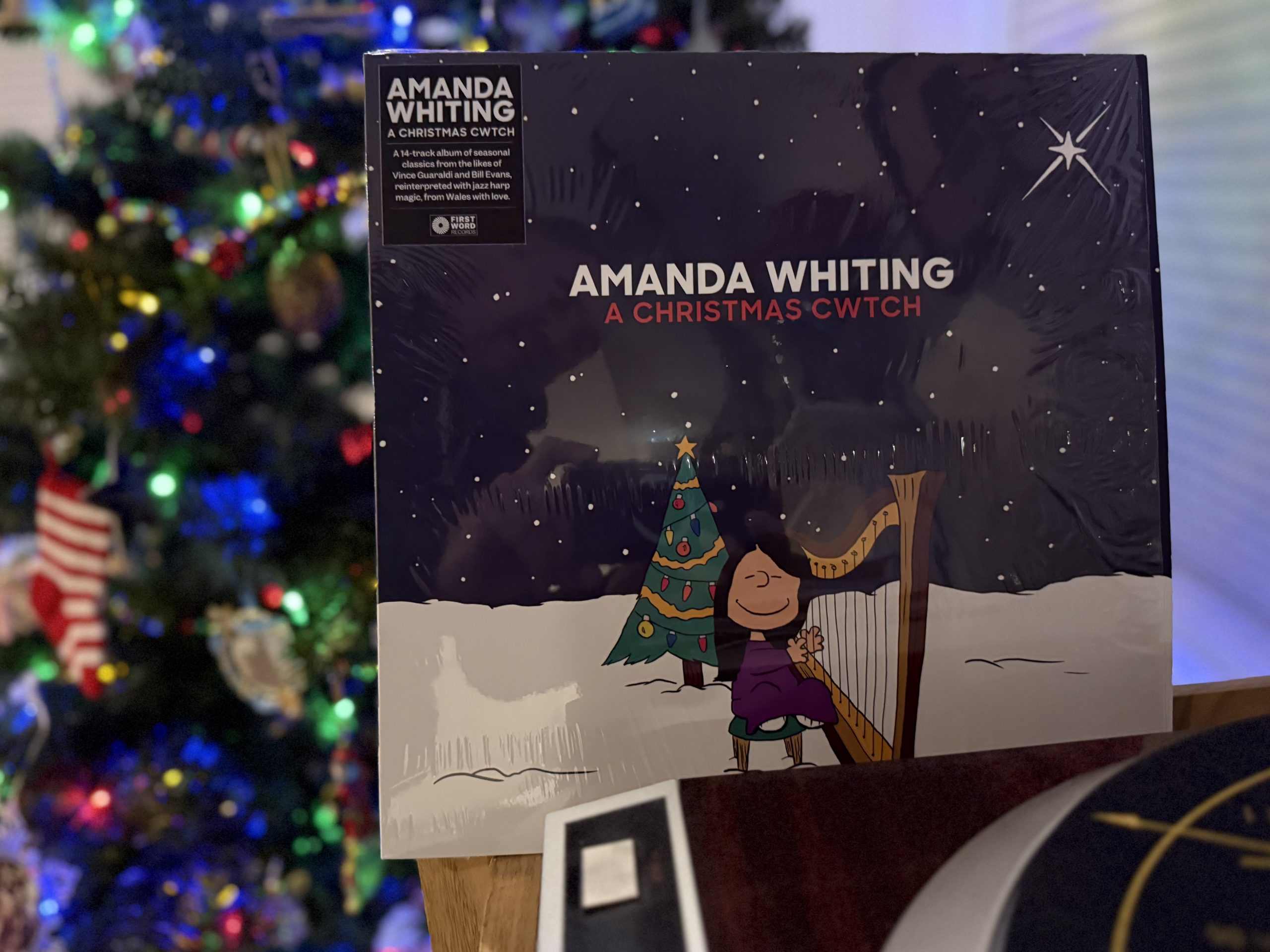
A Christmas what? Well, the Welsh word cwtch means a hug, but also a hidey-hole—it’s something close and intimate with implications of protection as well as comfort. It’s a perfect name for this modern Christmas jazz album, which combines covers of Christmas songs with some Christmas-adjacent jazz material—Vince Guaraldi but also Bill Evans—in a dreamy harp reverie.
Yes, harp. Amanda Whiting came across my radar with her albums for Jazzman Records; if you’ve read my music reviews, you know that a cover of Freddie Hubbard’s “Little Sunflower” is always going to get my attention, and her first Jazzman EP starts there. Before beginning her jazz career in 2013 with her earliest solo release, the Welsh musician had trained as a classical harpist, and her attention to performance and composition stands out in this set of Christmas and Christmas-adjacent tunes.
The album starts and ends with solo harp renditions of “Santa Claus Is Coming To Town,” but fairly quickly settles into a fireside mood with “In the Bleak Midwinter.” Amanda’s arrangement settles into a minor mood, riding diminished chords to strike a Guaraldi-like mood accompanied by cellist Lucia Capellaro, a meditative bass line from Aidan Thorne, and brushed cymbals courtesy of drummer Mark O’Connor.
The mood continues with a pair of Guaraldi covers, with “Christmas is Coming” striking a brisker note with the trio and “Christmas Time is Here” a more meditative counterpart. “Christmas is Coming” gets a proper harp solo that does more than just echo the improvisations that Guaraldi performed on the original, as Whiting’s harp seems to float up to a suspended ninth and stay there for an extended time, rocking back and forth across chordal boundaries and settling into an extended groove. Meanwhile, “Christmas Time is Here” gets more of a late night chat feeling with the dialog between the harp and Thorne’s bass—also a feature of Guaraldi’s original performance with bassist Monty Budwig.
Whiting picks up other threads of Christmas harp-lore, providing a meditative trio “Sugar Plum” à la Tchaikovsky. (It’s worth noting, for those budding harpists out there, that this and other tracks are based on harp arrangements that Whiting has published and that featured in her harp classes at Trinity College London.) Her arrangement doesn’t swing as hard as Ellington, but it definitely still swings and pulses with Thorne’s high bass solo and the rolling rhythms that O’Connor sets up.
Guaraldi’s “Happiness Theme” predates the Christmas special; it was one of the first Peanuts tunes that he wrote, alongside “Linus and Lucy,” “Oh, Good Grief” and “Pebble Beach,” all of which made repeated appearances as character themes and motifs throughout the animated specials. I have always had a soft spot for this wistfully beautiful tune, which here gets an atmospheric workout that evokes “Christmas Time is Here” and the notes of sleet against the windowpane.
“Little Elfy” is a brief original, a romp through snow drifts with someone who’s as likely to pelt you with a snowball as to bring you a present; it’s a good feature for the harp and an imaginative landscape to close out side 1. With “Skating” we return to Guaraldi once more, with the arpeggiated runs that gave even the pianist trouble seemingly unrolling without a ruffled hair from Whiting’s fingers.
Whiting released the next track, a cover of Bill Evans’ “Peace Piece,” as a single—never an unwelcome request. Here the meditative opening notes, so familiar from Evans and Miles Davis’ recasting of them for “Flamenco Sketches,” seem to spin an aleatory reverie as though they are spreading ripples in an open pond. The pond seems to freeze and crack in the air as Whiting digs deeper into the simple alternating chords. This one could have gone on forever for me.
The second half has a run of more ordinary Christmas carols that drift into reveries. The harp solo in “Deck the Halls” seems to take a side step toward a brown study for a while, while “The Christmas Song” pulls one inside just with the strength of the Mel Tormé/Robert Wells melody. “O Christmas Tree” bridges the ordinary and the Guaraldian worlds with its evocation of the pianist’s cover version, the bass and drums providing welcome rhythmic structure. And “We Three Kings” gives us a McCoy Tyner inflected take on the old carol, with plenty of low end to back it up. At the end we drift away with Santa Claus once more.
The thing about jazz harp albums is that the good ones contain unfathomable depths. You can think you’ve just put on a record to de-stress you and accompany that second glass of eggnog, when suddenly you find yourself contemplating the interplay between bass, harp and drums as a clue to the rhythmic foundations of the universe. Or maybe that’s just the eggnog! Next week we’ll pick up a new series on a notorious musician who would be sure to tell you that it’s both his music and his eggnog talking.
You can listen to this week’s album here:
The album is also streamable from Bandcamp:
BONUS: Amanda did a live charity concert earlier this month featuring much of the music on this album and from her other works; you can watch that here:
Three years ago today, I unleashed one of my most recent Christmas playlists, “Tinsel covered Christmas blues.” You can check out my Christmas playlists (three hours worth!) on SoundCloud today if you want to have some music to wrap presents by:
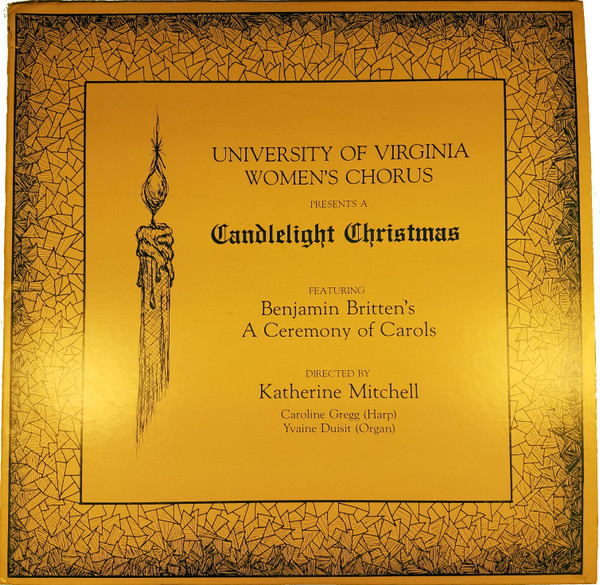
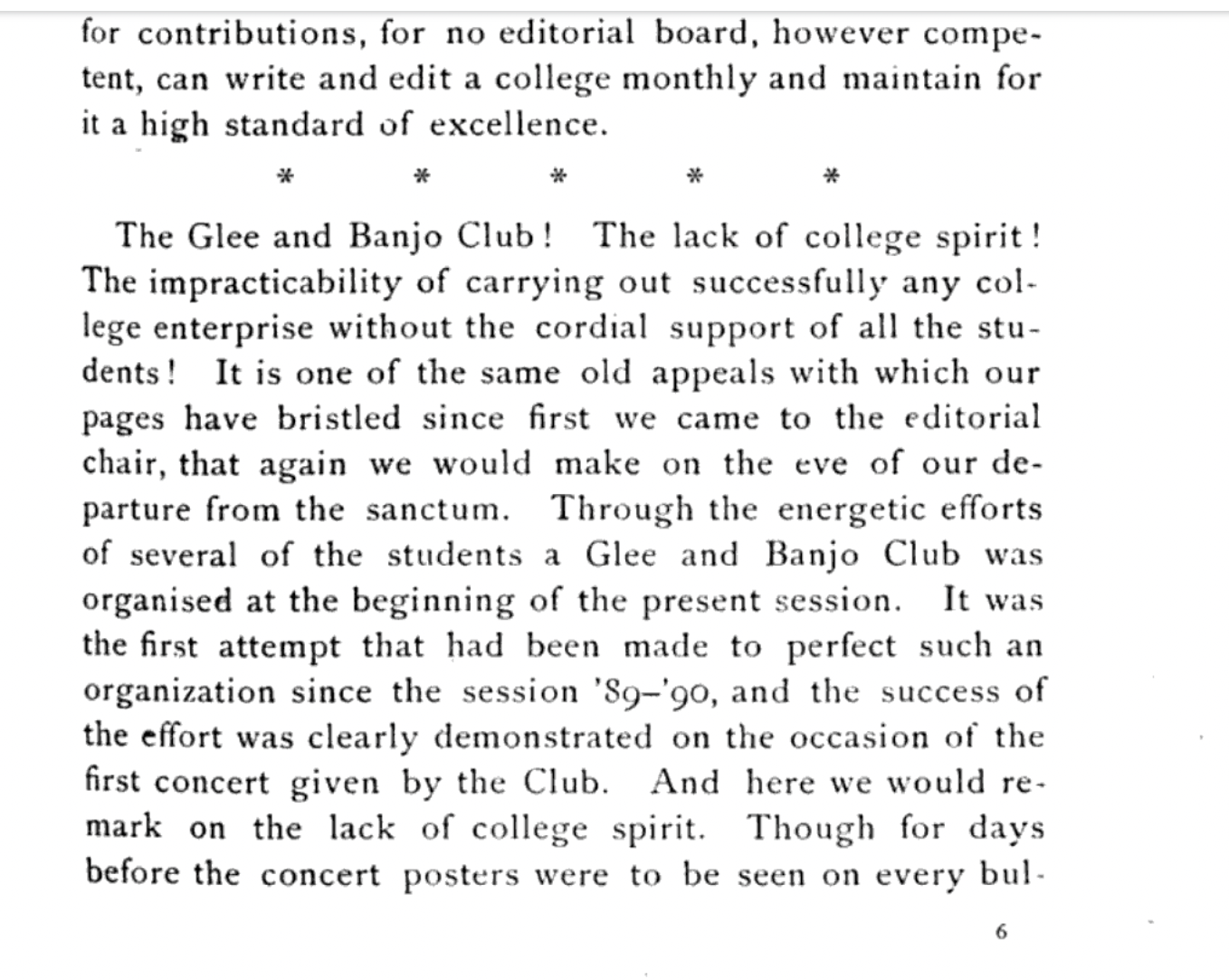
Fifteen years ago, I wrote about some Glee Club research (I was still putting the history together and hadn’t started writing Ten Thousand Voices). “The impracticability of carrying out successfully any college enterprise without the cordial support of all the students!” Indeed.
The Virginia University Magazine, Vol. XXXV, No. 3 (December 1891), p. 270.
Sixteen years ago, I posted a handful of pointers to some useful Excel statistical tricks, and some intriguing looking font games that alas don’t seem to be around any more. Sic transit gloria mundi.
That I’m still writing on this blog all these years later still feels like something of a Christmas miracle to me, even if the frequency has diminished and the word count per post has gone way up. Hope you all have great holidays! There will be at least one more post between now and the end of the year.
A childhood favorite Christmas record, filled with songs familiar and strange and featuring the voice of an old friend.
Album of the Week, December 20, 2025
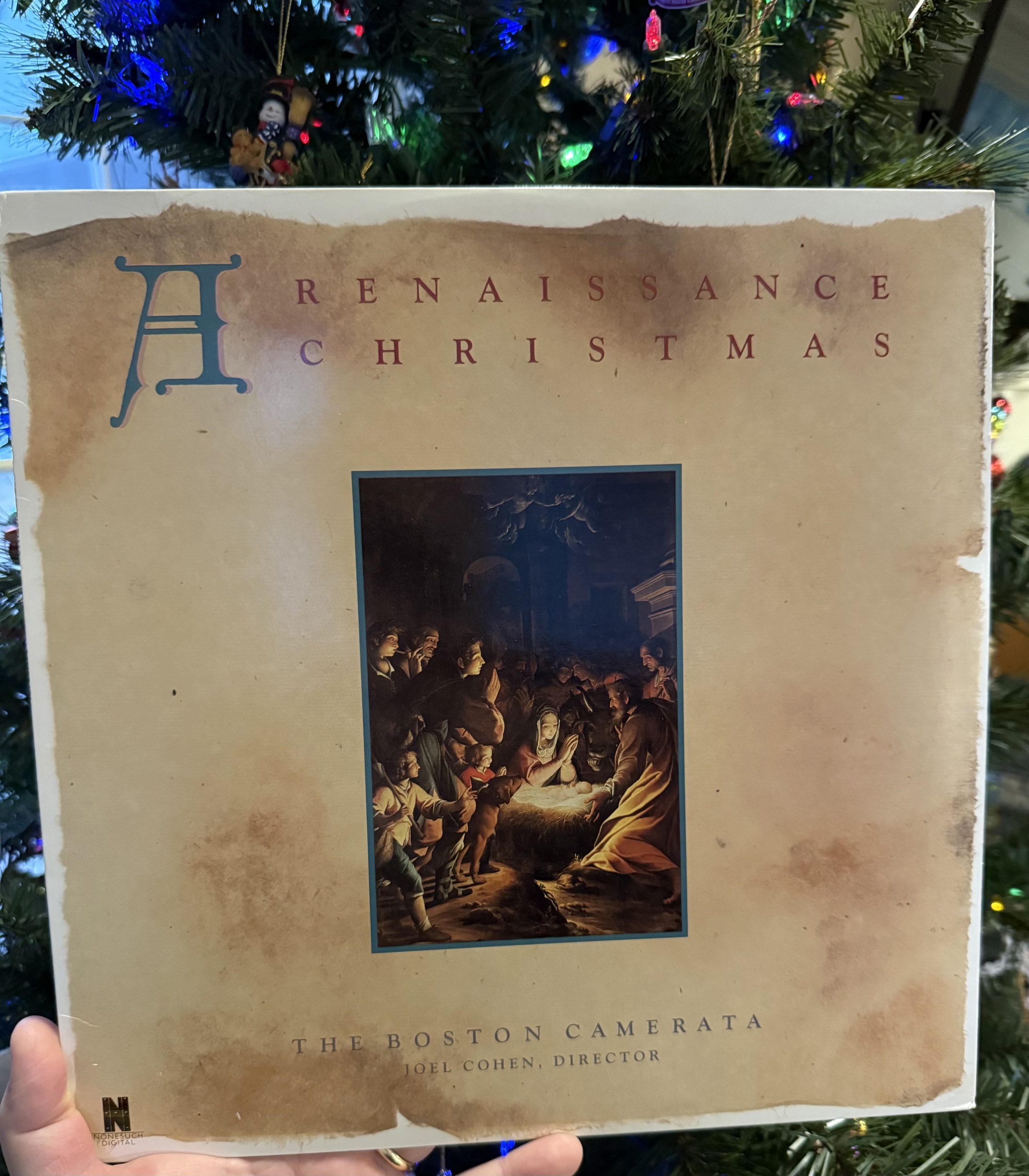
I have written about several Boston Camerata Christmas records: Sing We Noel, A Medieval Christmas, even an early A Renaissance Christmas from 1974. And each time I do, my friend Frank Albinder, formerly director of the Washington Men’s Camerata and member of Chanticleer, and current director of the Virginia Glee Club, says, “I used to sing with them! I recorded a Christmas album with them!” And: Yes, Frank, you did! This week’s post is for you.
Frank’s sojourn in Boston as a music grad student came in handy when Joel Cohen was assembling the musical forces for the 1986 release A Renaissance Christmas (true to the group’s name, the album was a local Boston production, recorded in Trinity Church in Copley Square in December 1985). Vocally speaking, there are no carryovers from Sing We Noel, the Camerata’s prior Christmas album—but there’s an eight-year gap between those two recordings, and one presumes that a great many Camerata members were, like Frank, graduate students who were passing through Boston on their way. One notable exception to the rule is soprano Anne Azéma, who began her recording career with the Boston Camerata with 1984’s La Primavera and is still with the Camerata today as its artistic director. (Along the way she married Joel Cohen.)
It is Azéma’s voice that leads off the album, with the 15th century English carol “Nowell: Dieus vous garde.” (Yes, English: Richard Smert wrote the carol in a mixture of English and Norman, as was appropriate for the court at the time.) The quartet of voices plus viol sings one of my favorite non-traditional Christmas carols, an early invocation of Father Christmas, with purity and compelling melodic line. The reverie is followed by “Gaudete, gaudete”, sung with vigor by the ensemble; this is one of the carols from the album that can be widely heard on other recordings, but the performance here blends expertise with vigor in a hallmark of these Camerata recordings.
Following a recitation in broad Middle English (here the narrator is tenor Edmund Brownless) that gave my family the in-joke “Hail, Mary, full of fescue,” we get the Kyrie from Guilliame Dufay’s “Ecce ancilla Domini” Mass, with Brownless, countertenor Kenneth Fitch, and bass Albinder providing the solos. Fitch’s voice is delightfully balanced and resonant, lacking some of the eccentricities of the countertenors on the 1970s Camerata recordings, and the overall impression is magnetic, particularly, when the ensemble cuts out at the end leaving the trio to provide the final “Kyrie.” We make our first stop in Spain with “E la don don,” performed with sparkling briskness, and then return to France with two instrumental settings of “Une jeune fillette.”
“Une jeune fillette” (in alteration with “Joseph est bien marìe”) leads us into the next set, with the women’s voices led by Azéma singing the latter carol with interludes of the former in a beguiling arrangement. A brief instrumental bridge of “Joseph, lieber Joseph mein” leads to the highlight of the first half, a performance of Joseph Galliculus’s “Magnificat quinti toni.” Sung bits of chant alternate with hypnotically fugueing renditions of familiar Christmas tunes in an astonishing reverie.
The second half is much more carol-focused, with Frank’s unaccompanied solo on “Esprits divins” leading off, followed by a reading and the original harmonization of “Es ist ein Ros’ entsprungen,” with lute and voice. An appropriately swaggering “Riu, riu chiu” follows, unaccompanied save for antiphonal handclaps until the final choruses.
Cohen constructs a mini-Praetorius set (Michael and Hieronymous) around the visit of the Magi. Michael Praetorius contributes the more familiar “Wie schön leuchtet der Morgenstern,” followed by a reading and the Hieronymous P. setting of “O vos omnes,” mourning Herod’s crime against the firstborn.
The set that follows celebrates the shepherds at the cradle, and is in some ways the most adventurous part of this adventurous record. Opening with a reading and a 16th century Italian dance played on the ocarina by Marilyn Boenau, the ensemble then plays a set of vigorous music from the French, Catalan and Provençal traditions. Nicholas Martin’s “Nouvelles, nouvelles” gives us a beautiful melody led by Azéma, while the Catalan “Tau garçó, la durundera” is all rhythm and close harmonies. Finally, the Provençal “Tura lura lura, lo gau canta” provides a high spirited and faintly comic call-and-response between Cohen and the men of the ensemble as they tell the story of a shepherd afraid to make the pilgrimage to Bethlehem.
The Boston Camerata at this stage of their development was a remarkable ensemble, doing their own research and constructing programs that both instructed and enlivened the ear. A good many recordings have followed, even after Cohen’s retirement, and the ensemble itself carries on. (In fact, I’m taking the family to hear them perform some early American Christmas music tomorrow.) The individual musicians on this recording also had a variety of careers; viol and recorder player Jane Hershey recorded for many years with Hesperus, soprano Roberta Anderson with Boston Baroque, and both countertenor Ken Fitch and bass-baritone Albinder would go on to greater fame and fortune with Chanticleer.
Next week we’ll swerve back to something closer to jazz as we draw the mystery of the holiday to a close.
A contemporary Christmas jazz classic from a young vocalist with an old soul.
Album of the Week, December 13, 2025
In my memory it was the middle of the pandemic (it actually turns out it was January 2022), and I was doomscrolling through TikTok. And I stopped in my tracks, because here was a TikTok user who was singing jazz. And she was good. A low alto, her phrasing reminded me of Ella, and she knew classic ballads. I just scrolled through her whole timeline, and with each video I grew more convinced that she was the real thing. She seemed impossibly talented, and impossibly young.
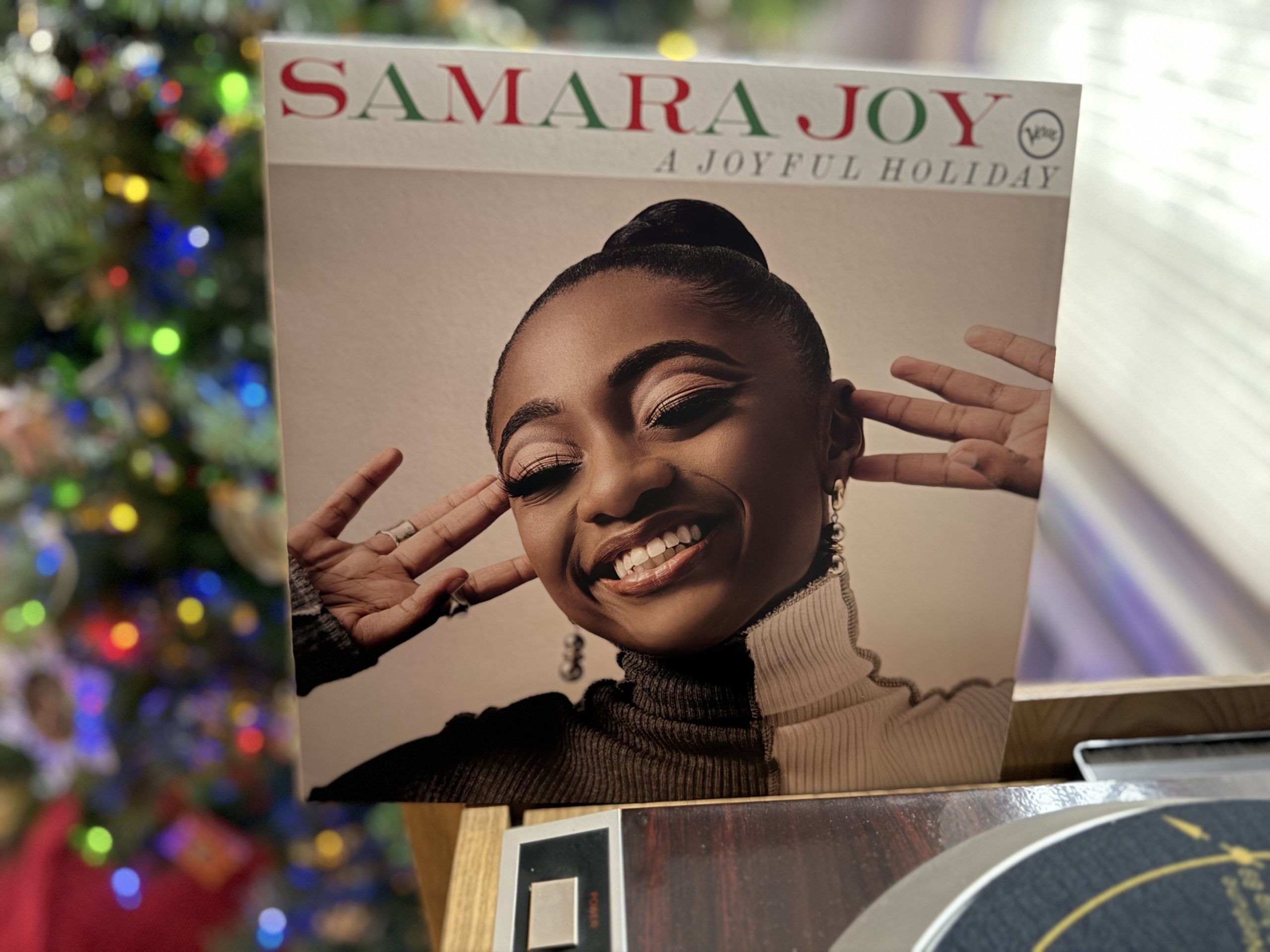
I was a little late to the bandwagon, because her first album, Samara Joy, had come out the previous summer, and Joy (then performing as Samara McLendon) had won the Sarah Vaughan International Jazz Vocal Competition in 2019, when Christian McBride described her as a “once-in-a-generation talent.” But I got on the bandwagon before she got to the majors; she signed with Verve Records later in 2022 and released her second album, Linger Awhile, which won the 2023 Grammy Award for Best Jazz Vocal Album and won her a Best New Artist award (beating out Wet Leg, among others). And that winter she released this EP, featuring guest Sullivan Fortner (whom we’ve seen accompanying Cécile McLorin Salvant) on piano and Hammond organ, drummers Kenny Washington and Charles Haynes, bassists David Wong and Eric Wheeler, pianist Shedrick Mitchell, and Antonio McLendon.
“Warm in December” is a lesser-known composition by Bob Russell, better known for co-writing “Concerto for Cootie” with Duke Ellington as well as lyrics to dozens of tunes including his last hit “He Ain’t Heavy, He’s My Brother.” With Sullivan Fortner, Kenny Washington and David Wong backing Samara Joy on this performance, a strong argument is made that the song ought to enter the holiday repertoire. A gentle out-of-tempo introduction by Joy and Fortner is followed by a swinging verse with Washington and Wong in cheeky form. Samara Joy’s vocals are at once intimate, requiring the listener to lean in, and knowingly smiling in the way of the best of Ella’s performances. Sullivan Fortner again proves he is the best living accompanist of great jazz vocalists with his sensitive introduction and jubilant solo.
“Twinkle Twinkle Little Me,” co-written by Ron Miller and William O’Malley and originally performed by the Supremes in 1965 and Stevie Wonder in 1967, is here performed by Samara Joy and Sullivan Fortner as an aching ballad. Joy’s vocal control is marvelous, with a single high note underscoring the promise “If you give unselfishly/I’ll always shine for you.” It’s no wonder this performance won Joy and Fortner the Grammy for Best Jazz Vocal Performance.
“The Christmas Song” is as warm a performance of the Mel Tormé/Bob Wells classic as you’re likely to find. Joy’s vocal style here demonstrates several signatures of her style, including her quiet volume, careful use of glissando, masterful control of her low range, and phrasing behind the beat in the best possible way, to say nothing of her sense for the finely timed key change at the very end. It also offers an opportunity to hear the steady, forthright sensibility that young bassist David Wong brings to the session; nothing extraneous, just forward motion with his deeply resonant notes.
“Have Yourself a Merry Little Christmas” is the last of the numbers featuring Washington and Wong, here joined by Italian guitarist Pasquale Grasso, who collaborated with Joy on her first two albums. He proves every inch as sensitive an accompanist as Fortner, easily following her shift from a slow waltz time into a swinging double-time across the song’s bridge. On the last verse, as she sings “Until then, we’ll have to muddle through somehow,” she imperceptibly crescendoes to her loudest forte of all the small-combo numbers, then finishes on a stunning barely-sung high note sustained with impossible clarity.
I am not the world’s biggest fan of “O Holy Night”; I find most performances overwrought and triumphalist in a way that feels inappropriate for the hushed miracle of Christmas Eve. In that regard, Joy’s choice to perform here with her father Antonio McLendon (who brings a gospel richness to their harmonies) and her gospel-singing legend grandfather (Goldwire McLendon co-founded the Philadelphia gospel group the Savettes) seems inspired. The outro, with its modal choir building slowly to a climax and a rare Samara Joy high note, might be my favorite part of this Christmas album. She finishes the EP with another collaboration with Antonio, “The Christmas Song (Live Duet),” with Charles Haynes, Eric Wheeler and Shedrick Mitchell backing, which is lovely for many reasons, including father and daughter shouting each other out during the applause at the song’s end.
Not everything on A Joyful Holiday is an instant Christmas classic, but enough of it is great that it’s well worth seeking out. Also: great1 new Christmas albums from young artists are rare enough that I recommend grabbing them when you find them. And going to hear them perform, as well. (You can imagine my dismay when I was unable to perform this year’s Boston Pops concert for corporate sponsors, only to learn that the guest artist was none other than Ms. Samara Joy.)
You can listen to this week’s album here:
BONUS: Here’s a version of Joy with Antonio McLendon and pianist Luther Allison performing “O Holy Night” live for Vevo:
BONUS BONUS: A slightly funkier live version of “Twinkle Twinkle Little Me” from Joy’s YouTube channel still carries the intimacy of the recorded version:
Mediocre ones, on the other hand, are a dime a dozen. ↩︎
A cool Yule is in the brilliant and sure hands of this master guitarist.
Album of the Week, December 6, 2025
The dirty little secret of Christmas albums is that a lot of them sound the same. You tend to hear the same arrangements, or arrangements of the same arrangements, of the same Christmas carols and holiday songs over and over again. When an original voice comes along in the genre, it’s a welcome improvement. Such is the case of Have Yourself a Soulful Little Christmas, the sole holiday album by guitarist Kenny Burrell, released on the Cadet label (home of Ramsey Lewis) in 1966 and arranged by bassist, composer and producer Richard Evans.
We’ve encountered Kenny Burrell many times, all in the company of Jimmy Smith so far. But the guitarist was so much more than a sideman. As a leader, he recorded sides for Blue Note, Prestige, New Jazz (with John Coltrane!) and Verve before recording his first record on the Cadet label (formerly Argo Records, the jazz subsidiary of Chess Records) in 1966. This holiday album followed the same year. Backed with an uncredited orchestra, Burrell’s performances over Davis’s arrangements give both blues and soul, but also unexpected tenderness.
“The Little Drummer Boy” is an unlikely opener, combining the familiar Harry-Simeone-via-Trapp-Family-Singers carol with a steady rhythm section that is, honest to goodness, a direct lift from Ravel’s “Bolero.” Burrell gives us a fairly straightforward reading of the tune, but the solo soon stretches out into a bluesy groove as he takes the guitar higher and higher, with splashes of soul jazz piano and a horn section that grows in prominence but never overwhelms. It’s a masterpiece of a slow burn, with the cool hand of Burrell at the center of it all, right up to the fadeout.
“Have Yourself a Merry Little Christmas” is a quieter, more introspective take on the dark side of this familiar Hugh Martin/Ralph Blane tune. Burrell’s playing is absolutely straight here, with the subtlest of string arrangements underscoring the melancholy of a Christmas song whose original lyrics ran “One day soon we all will be together, if the fates allow/Until then, we’ll have to muddle through somehow.”
It surely took a fair amount of gumption to assay a jazz version of “My Favorite Things” in 1966, following John Coltrane’s definitive rendering of the tune in 1961. Burrell and Evans take the tune to a bluesier place, starting with the time signature, a swinging four-four instead of the waltz. But there is some of the transcendence of the Coltrane version in the brief few measures of the bridge before Burrell’s guitar rips through a series of fiery blues licks up until the fade-out.
“Away In a Manger” begins with a solo prelude by Burrell, into the first verse which is played entirely by him and a string section. The bass joins on the second verse; the entire thing is played like a quiet offering, with just enough gospel around the edges to make it a delight.
“Mary’s Little Boy Chile” was not exactly a Christmas-album mainstay even in 1966, but was still widely recorded elsewhere. Introduced by Harry Belafonte ten years earlier, it was written by the great composer and arranger Jester Hairston, who was also responsible for the spectacular arrangement of “Amen” that appeared in the Sidney Poitier film Lilies of the Field. Here the arrangement is simple, just Burrell with percussion and a restrained string section, allowing the calypso to shine forth. The woodwinds join in the last chorus to add a little more gentle oomph.
Burrell’s “White Christmas” is cool and relaxed, with an extremely laid back bassist, piano, and brushes on the drums the only accompaniment. But it carries power and intensity through its simplicity, closing out side one.
“God Rest Ye Merry Gentlemen” is a more full-bodied opener for side two, with touches of “Greensleeves” (which Burrell had just recorded earlier that year with Smith) in the arrangement. Burrell’s playing here is cool and precise against a steady backbeat from the rhythm section, but the overall arrangement moves along. “The Christmas Song” has a similar vibe but with more varied instrumentation; French horn and xylophone curl cosily at the edges of the strings, leading into a double-time solo by Burrell that raises the heartrate a good 10-15bpm before relaxing back into a chair by the fire.
“Children, Go Where I Send Thee” is another less traditional choice in a spectacular arrangement. The tune is played with equal parts gospel—every bit as much of a rave-up as the Fred Waring version with full choir—and Blues Brothers-style R&B, with a Hammond organ peeking through the horns.
“Silent Night” gets a mighty gospel arrangement, anchored by the bass and a rolling gospel piano. Burrell’s solo sings without shouting, using chords and octaves for emphasis and power without ever losing the tenderness at the heart of the tune. The “Twelve Days of Christmas,” by contrast, is playful, Burrell’s guitar breakdown on the second day mercifully taking us away from the monotony of the repetitious arrangement. The playing is enough fun that one regrets the band only goes through four days (and three key changes).
“Merry Christmas Baby” is an R&B Christmas song written by Lou Baxter and Johnny Moore; the latter’s Three Blazers recorded the tune with Charles Brown providing vocals and it’s since become a staple of blues and R&B Christmas recordings. Here it provides a purely blues closer, with piano, Hammond, bass and drums providing the accompaniment for the first two verses and the horns building a mighty crescendo under the third and fourth. Burrell’s bluesy guitar gets the last word, bringing the album to a close.
Burrell, remarkably, is still with us. The former Director of Jazz Studies at the UCLA Herb Alpert School of Music, he still appears on new recordings, the most recent a collaboration with Teri Roiger, John Menegon and the late Jack DeJohnette released last year when Burrell was 93, despite health challenges and some controversy about the funding needed to pay ensuing medical bills. This album is a spectacular testament to his playing and his taste, but there are many more worth seeking out—that collaboration with Coltrane for starters. Next week we’ll stay in the jazz lane, with a joyous recent recording by an emerging artist.
You can listen to this week’s album here:
BONUS: From ten years ago, a great trio performance of “My Favorite Things” from Westwood Music.