
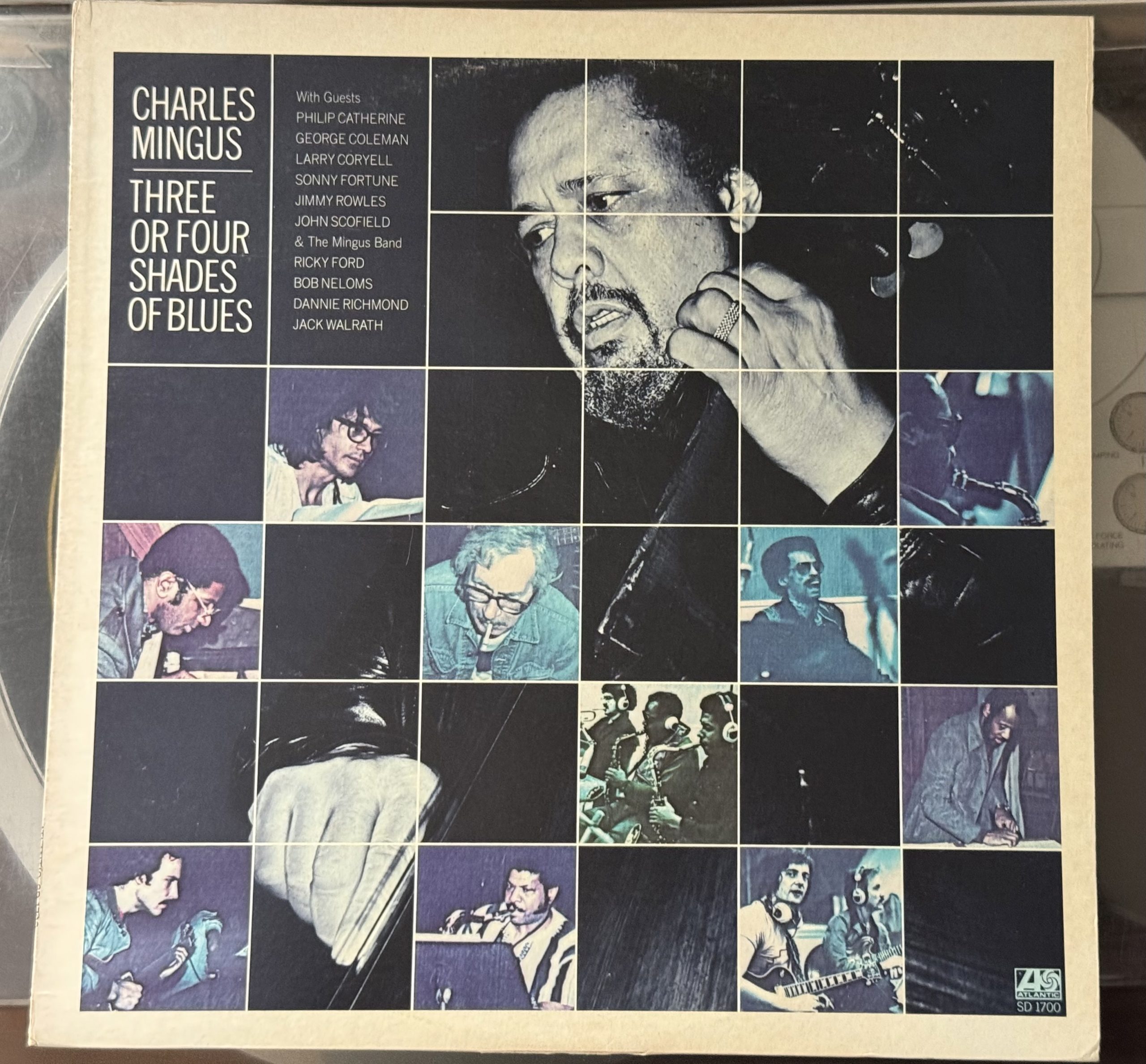
Charles Mingus, Three or Four Shades of Blues

An electrifying, bluesy late work from the great bassist takes us on a sort of survey of the many forms of the blues.

Album of the Week, February 21, 2026

Charles Mingus was unwell. The cruel progression of ALS had robbed him of most of his technique on the bass, and of his ability to stand. But he could still play, a bit, and he could lead a band. And so he brought a nonet (and later a, um, tentet) to a New York City studio on March 9-10, 1977 to record tracks for what would become one of his last albums.

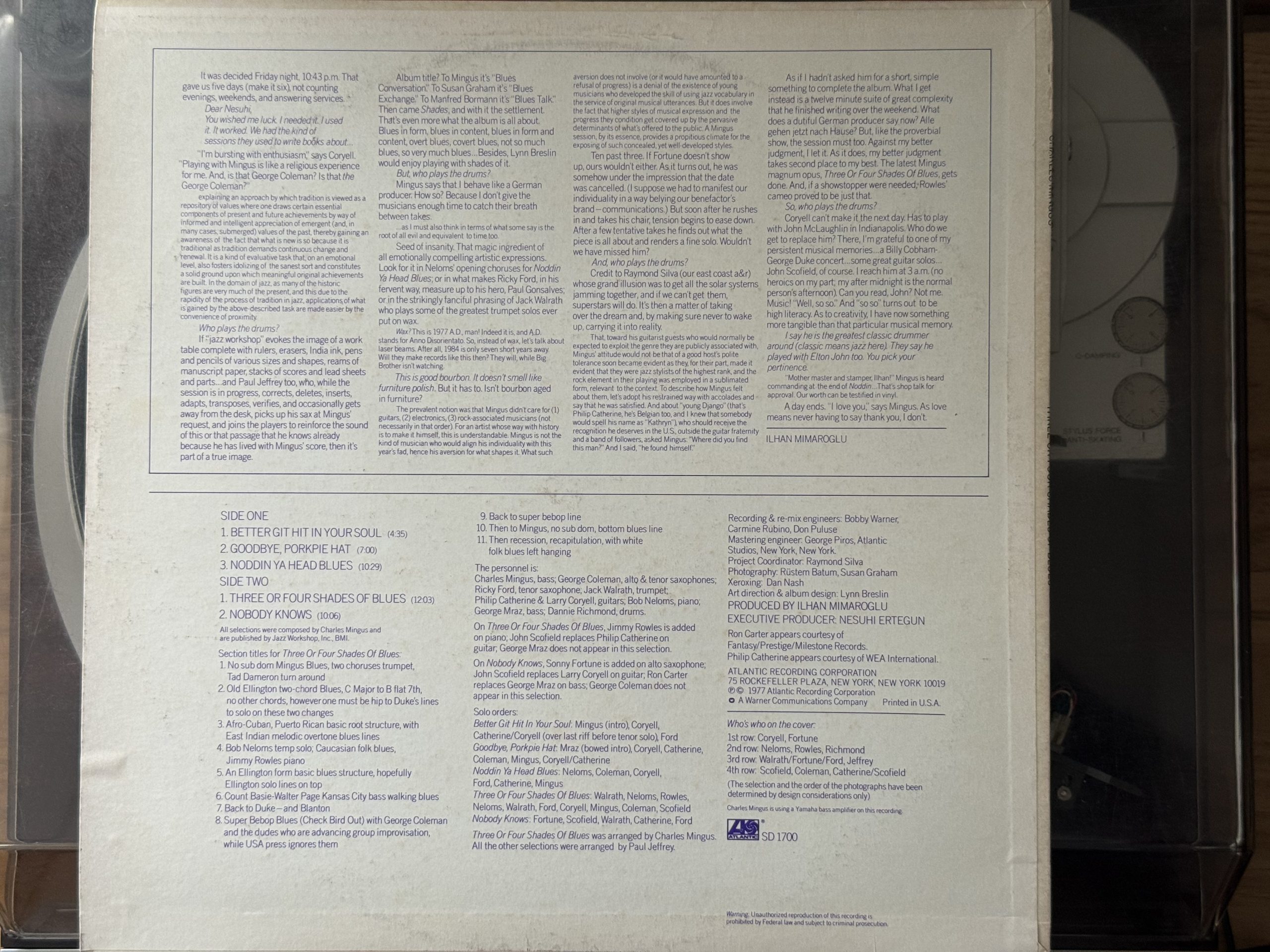
Behind the drums sat the redoubtable Dannie Richmond; almost every other musician was a new face for this column, though he had been touring with some of them for years. Jack Walrath (trumpet) and Ricky Ford (tenor sax) were part of his regular touring band, but Bob Neloms was a new face at the piano. Bowing to necessity, George Mraz sat in at bass for the first three tracks, supporting Mingus. Not one but two electric guitarists, Philip Catherine and Larry Coryell, play on the majority of the tracks; John Scofield replaces Catherine on one track and Coryell on another. A second sax player was there too: George Coleman, who after leaving Miles’ band in February 1964 had become an in-demand player, to the point that Coryell is quoted in the liner notes as saying “Is that George Coleman? Is that the George Coleman?” A second piano player, Jimmy Rowles, appears on the long track “Three or Four Shades of Blues,” and Sonny Fortune’s alto sax is on the last number, along with Ron Carter who replaces Mraz.
One could look at the track list, see the first two tunes, and assume that this was another “greatest hits” set with a different band. But there’s a completely different energy here from Mingus Mingus Mingus Mingus Mingus. Better Get Hit In Yo’ Soul” gets a better recording of Mingus’s opening bass line, for one thing, which he rips into with alacrity. And the whole temperature is elevated about ten degrees (Fahrenheit) by the two guitarists, particularly Coryell, whose solo is electrifying. There is also, unusually for this tune, a fully sung lyric on the chorus, by the entire band: “He walked on water. He ministered to the blind. He healed the sick. And he raised the dead. Talkin’ ’bout Jesus!” Ricky Ford’s tenor gives a down-home and gutsy R&B solo before taking off into a Trane-inspired series of glissandi over general mayhem in the band. Neloms hammers the keys into the last bridge as the two guitarists play blasts of chords and Jack Walrath lets loose with an apocalyptic squawk. This is Mingus as gateway to the universe; probably why this was the only track of his that made it onto one of my mix tapes as a college student.

Goodbye Pork Pie Hat” is given a subtler read. George Mraz introduces the tune, arco; and the guitarists play the melody alongside him. The guitarists are playing classical style this time, and Coryell’s virtuosity here is gorgeous but quieter; Catherine’s is practically Spanish in its precision. George Coleman provides an impeccably brilliant tenor solo leading into a key change and Mingus’s harmonically rich exploration. The two guitarists play in duet to close the solo section, leading into the final chorus and a long coda that is both wearily beautiful and impossibly sad.

Noddin’ Ya Head Blues” takes us into a twelve-bar blues by way of a gospel-inspired Neloms piano solo, punctuated by bursts of Coryell and leading into the melody stated by the two guitarists. Coleman gets a flutteringly beautiful solo that he passes virtuosically to Coryell, who does a combination of Hendrixesque flourishes and dirty Delta blues. Ricky Ford’s solo is restrained by comparison here, but yields to Philip Catherine for a twelve-bar Spanish romp that falls away for Mingus’s slow and low solo, accompanied by Mraz and Richmond up to the final chorus.

Three or Four Shades of Blues” is programmatic music, with the program helpfully spelled out in the liner notes: “No sub dom Mingus Blues; Old Ellington two-chord blues; Afro-Cuban; Caucasian folk blues; An Ellington form basic blues structure; Count Basie – Walter Page Kansas City bass walking blues; Back to Duke – and Blanton; Super Bebop Blues (Check Bird Out); Back to super bebop line; Then to Mingus, no sub dom, bottom blues line; Then recession, recapitulation, with white folk blues left hanging.” At least three or four shades of blues, indeed. There are some ingenious twists and turns in this music, especially the pivot into Afro-Cuban blues and the cheeky quote of the Mendelssohn wedding march (the Caucasian blues!). For my money this is not one of Mingus’s most essential long-form works, but it might be among his most approachable, particularly in the “super bebop” section.

Nobody Knows” is credited to Mingus, but it incorporates bits of “Nobody Knows the Troubles I’ve Seen” and “Down by the Riverside” in its brisk melody. Sonny Fortune’s sweet alto soars across the band, leading to John Scofield’s precise blues and Jack Walrath’s trumpet, here brisker and more precise than in his other featured spots. Solos from Philip Catherine and Ricky Ford round out the tune in a valedictory send-off.
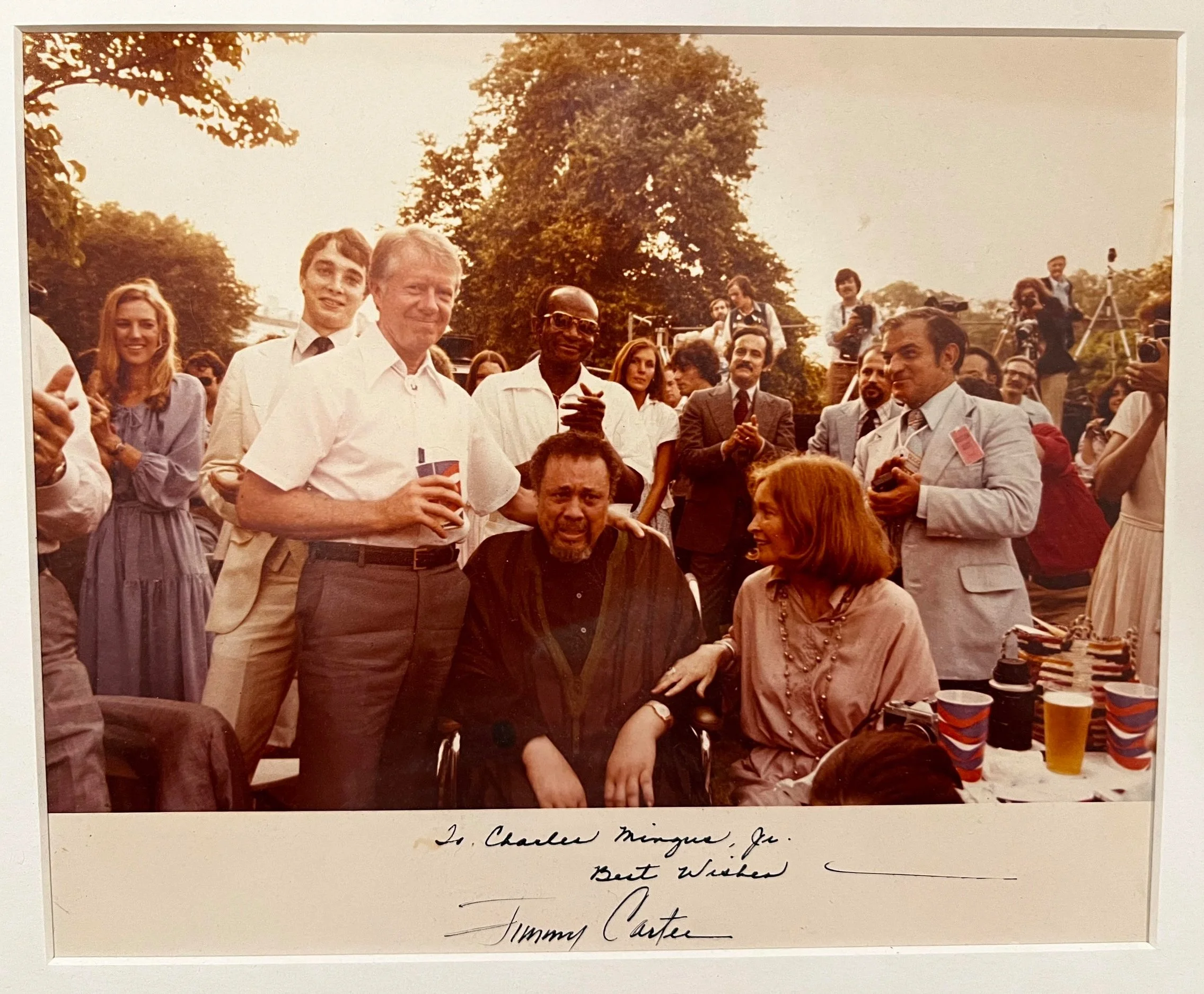
Mingus at the White House, June 18, 1978. Courtesy CharlesMingus.com

Mingus recorded two more albums following this one, but his health was going downhill fast. In 1978 he was invited to the White House as part of a ceremony honoring 25 years of the Newport Jazz Festival, where he was lauded by an enthusiastic Jimmy Carter; the moment moved Mingus, now confined to a wheelchair, to tears. He worked in his last days on a project with Joni Mitchell, which she completed after his death as her album Mingus. In late 1978 he traveled to Cuernavaca, Mexico to seek treatment and rest from his disease, and he died there on January 5, 1979. He was only 56 years old.

Mingus stands alone for many reasons: his fierce iconoclasm, his dogged insistence in pursuing his own vision, and the degree to which he succeeded in realizing that artistic direction during his short lifetime. Next week we’ll pick up a different thread that begins with another 1977 album, following the life of another iconoclastic musician who might be as well known for his knack of finding and promoting brilliant collaborators as his own distinct genius.

You can listen to this week’s album here:

BONUS: A short segment from a longer documentary about the Newport Jazz Festival featured these moments of broadcast video about the White House reception, including a few precious seconds of Mingus, overcome by Carter’s praise of his work.
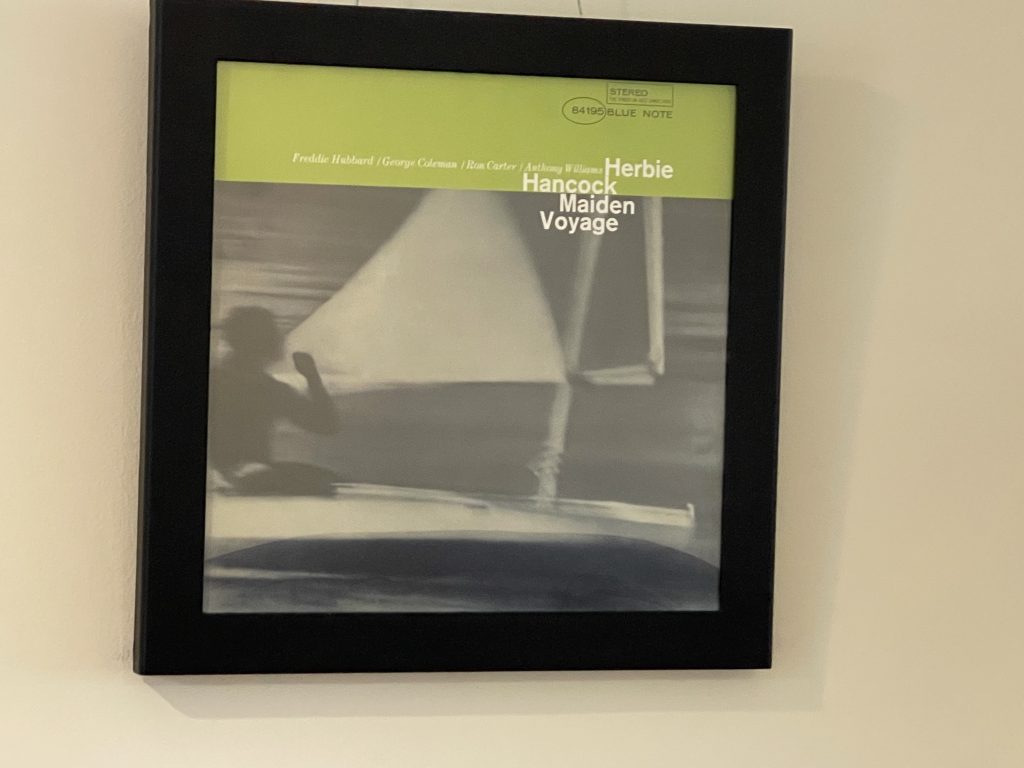
Herbie Hancock, Maiden Voyage

Album of the week, June 18, 2022

Listening to the opening of “Maiden Voyage,” it’s hard to believe that it was recorded just two months after E.S.P.—and with three of the same members. It’s also hard to believe that it opens Hancock’s fifth solo album in four years—to say nothing of his work with Miles.

The band that entered Van Gelder Studio in Englewood Cliffs on March 17, 1965 bore some strong resemblances to the one that had recorded with Miles at Columbia Studios in Hollywood on January 20-22. In addition to Hancock, Ron Carter and Tony Williams returned to the rhythm section; they had performed with Hancock on his preceding album, Empyrean Isles, as had Freddie Hubbard. George Coleman, who had played with Herbie on the live recordings of the Miles Davis Quintet from Carnegie Hall, My Funny Valentine and “Four” and More, rounded out the group on tenor sax. But though many of the players on the album had played with Miles, this album is distinctively Herbie Hancock’s work.

I write a lot about chordal structure, rhythmic interplay, and other facets of jazz improvisation in this series, but there is one essential element without which no jazz album can reach greatness: melody. One of the few weak points of E.S.P., to my ear, is the lack of distinct melodies on the second side, after the strong opening of the title track, “Eighty-One” and “Little One.” There’s no such weakness here, and “Maiden Voyage” opens the album with one of the all time great jazz melodies. It’s simple, persistent, and yearning, with a simple tune—up a fourth, then down a whole step and a four note run up a minor scale. But it’s slippery, with the same pattern repeated at a different part of the scale a few bars later, and the whole thing is set over suspended seventh chords, evoking a sense of mystery. It conveys everything about the sense of wonder of the beginning of a solo journey, combined with the mystery of the ocean. It is also unforgettable, and a substantial step forward from the Herbie Hancock who wrote the calculated hit tunes “Watermelon Man” and “Blind Man, Blind Man.

The whole track is a remarkable performance, but especially worth listening to is Tony Williams’ drum work under Hancock’s solo. Through a combination of cymbal work, snare rolls, and a bass drum heartbeat that slightly anticipates Ron Carter’s bass line. It’s an amazing evocation of the ocean, complete with creaking timbers and salt spray, and yet it’s utterly placid on the surface.

From the tranquility of the opening track we are immediately dropped into a storm. “The Eye of the Hurricane” provides an opportunity for Freddie Hubbard to demonstrate the combination of keen melodic sense, rhythmic complexity, and sheer technical acumen that would become his signature sound for the next fifteen years. His solo is astonishing. Coleman’s tenor solo following is less technically precise but is propulsive and carries the energy forward into Hancock’s solo, which is carried out almost entirely in the right hand as the chords drop way back, providing a feeling of calm at the center of the work. It’s a neat trick, but it makes me wonder what the piece would sound like in the hands of McCoy Tyner.

Hancock’s “Little One” follows, and he wisely rearranges the solos a little compared to the version on E.S.P. Here, both horns play the opening phrase, while Hubbard takes the following climb upward over Coleman’s lower accompaniment, and Hancock plays the yearning part that was Wayne Shorter’s on the earlier version. When the waltz comes in, George Coleman creates an entirely new melody over the opening, demonstrating the versatility of the tune and his own unique melodic gift. Freddie Hubbard follows the trail blazed by Coleman but quickly takes the melody to his own territory before passing it back to Herbie Hancock. His work on the solo finds him deep in impressionistic territory. Indeed, with his rhythmic chords alternating with melodic runs, he sounds like a livelier Bill Evans—a distinctively new voice from Hancock, who stretches out in several new directions on the record.

The furthest out direction he visits comes to the fore on “Survival of the Fittest.” What was I saying about melody? Here the hook is memorable but not hummable: slowly crescendoing chords, a saxophone line that sounds a lot like the opening to Wayne Shorter’s “Yes or No” (recorded seven months earlier), a scream in the trumpet, stabbing chords from the horns, a quick fragment of a melody, and then… burnout. Not in the pejorative sense, but in the sense that Branford Marsalis’s band has used it. Solos stretch past boundaries of bars and choruses and into different times and tonalities, anchored by Williams’ frantic drumming. Even here Hancock finds lyrical melody, but in a constantly shifting tonality and tempo. Finally the rest of the rhythm section falls away and it’s just Herbie playing a scherzo over chords that rock back and forth between two minor modes. It’s stunning and time stopping, and when Tony Williams comes back in he maintains the timeless feel with rolling drums in the deep. The horns come back in six bursts, restating the opening melody before abruptly halting.

And then: a surprise. “Dolphin Dance” swings gently and offers us the second most memorable melody of the record, an ascending run from the third to the fifth of the scale then down to the second, an easygoing pattern that continues with the same intervals but then starts from the tonic, the sixth and the third. It’s a vivid image, suggesting dolphins breaching out of the water one after another. And the soloists follow. Freddie Hubbard breaks out of the second repetition of the melody, taking flight for a moment, swimming along with the melody, then kicking it into a new key before passing it to George Coleman. The saxophonist swings his solo hard before going into double-time and eventually employing something like Coltrane’s “sheets of sound.” Hancock brings it back to the circling pattern, touching the other points of the scale before generating a new melody that reaches upwards, pauses, then climbs once more. The final recapitulation underscores the serenity of the melody, drifting into the distance.

It’s a fitting sendoff for the album, which stands as one of the high points of Hancock’s work—and of Blue Note Records in general. Next time we’ll hear a very different work from another member of Miles’ quintet.

You can listen to the album here.